Applying for federal student financial aid can feel overwhelming, especially when navigating citizenship requirements.
When completing the Free Application for Federal Student Aid (FAFSA), one key question asks if you are an "eligible noncitizen." This guide breaks down what that status means, who qualifies, and how your immigration status affects your eligibility for federal aid.
An eligible noncitizen for FAFSA is someone who is not a U.S. citizen but still meets the citizenship condition for federal student aid. That condition is under US Code Regulation. 1091(a)(5), and it has three eligibility requirements.
To be eligible, a student must;
Simply, the statute grants aid on two ideas: you're here for something other than a temporary purpose, and you intend to become a citizen or permanent resident.
No. Lawful permanent residence is one of 13 eligible categories. Every green card holder is an eligible noncitizen, but an eligible noncitizen may not be a green card holder.
Conditional permanent residents count too. If you hold the two-year card rather than the 10-year card, you're in the same first category, and the shorter validity period doesn't reduce your eligibility.
If you're unsure which one you hold, the category code printed on the card tells you. Our guide to green card category codes explains what each one means.
The 2026-2027 Federal Student Aid Handbook lists 13 qualifying categories, which we list below;
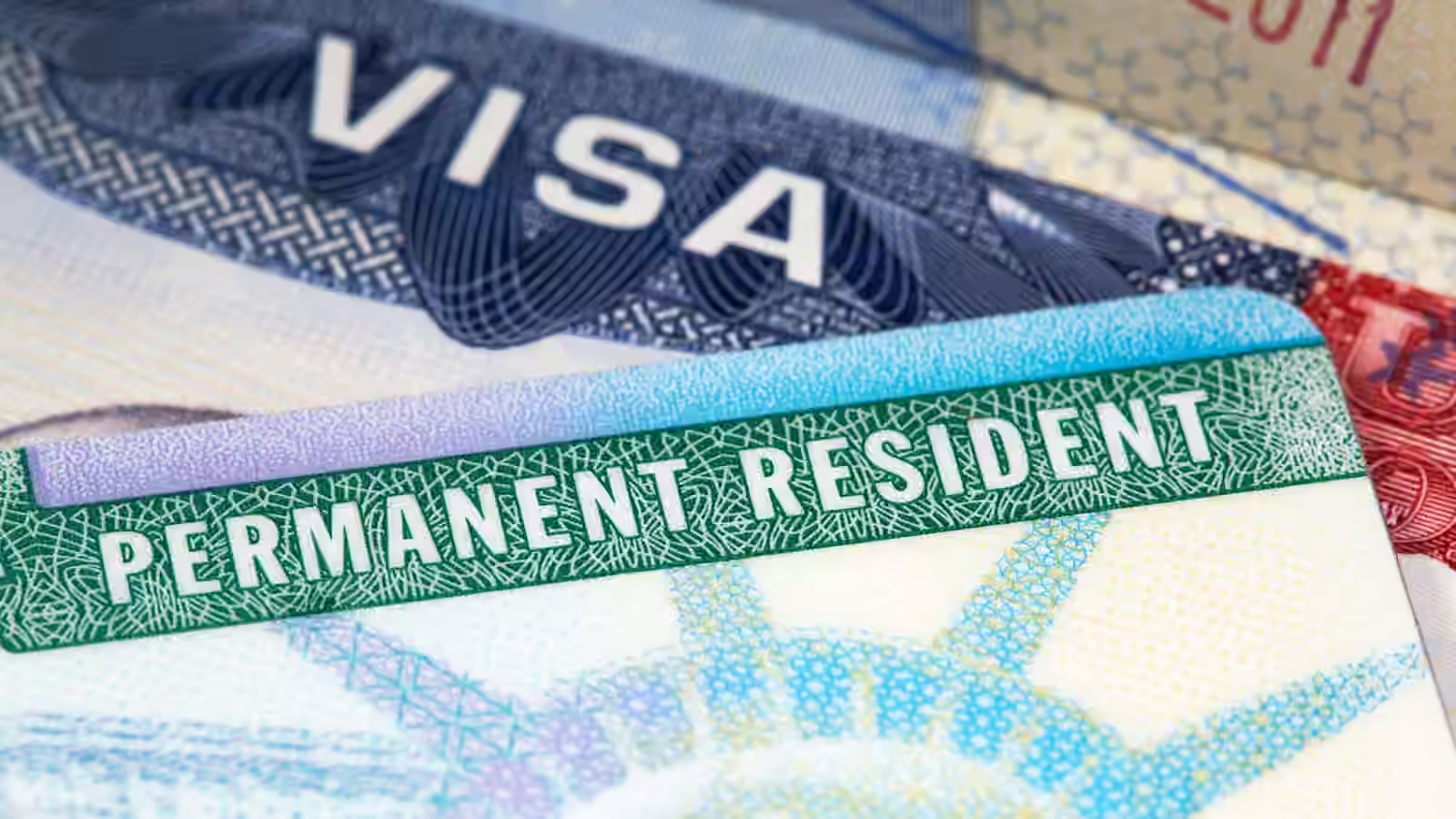
Lawful permanent residents show a Permanent Resident Card, Form I-551, issued since 1997. Older equivalents still work, including the pre-1997 Resident Alien Card and the Form I-151 issued before June 1978.
A card isn't the only route. A Form I-94 endorsed "Processed for I-551. Temporary Evidence of Lawful Admission for Permanent Residence" carries the same weight while you wait for the card itself.
Conditional permanent residents show Form I-551, I-94, or a passport with a machine-readable immigrant visa bearing the stamp "Upon endorsement serves as temporary I-551 evidencing permanent residency."
Refugees show an electronic Form I-94 with RE as the class of admission and D/S (duration of status) as the admit-until indicator.
A paper I-94 stamped with admission under Section 207 of the Immigration and Nationality Act works, as does an Employment Authorization Document in category A03.
Asylees show a Form I-94 with a stamp granting asylum under Section 208, or an Employment Authorization Document in category A05.
Cuban-Haitian entrants are verified differently. The school runs the check through the SAVE system and has to select the Cuban/Haitian Entrant option.
Parolees need to meet two requirements.
Ukrainian and Afghan parolees get a special exception under federal law: neither group needs to meet the one-year minimum or provide extra proof of intent.
This rule applies if you were paroled between February 24, 2022, and September 30, 2024 (for Ukrainians), or between July 31, 2021, and September 30, 2023 (for Afghans), and also to immediate family members paroled after those dates. You can easily confirm your status with a Form I-94, a passport parole stamp, or a category C11 EAD.
Victims of a severe form of trafficking are split by role. A principal T visa holder needs certification from the Department of Health and Human Services, and the usual SAVE verification step doesn't apply.
Derivative family members show a Form I-94 carrying a T-2 through T-6 class of admission code, covering a spouse, child, parent, sibling under 18, or the child of a derivative beneficiary.
Battered or abused spouses and children qualify through Form I-360 with an approval notice, or through a Notice of Prima Facie Case. A prima facie notice is enough on its own, which means a case still being adjudicated can support your eligibility for aid.
American Indians born in Canada qualify under the Jay Treaty. You can show proof using code S13 on Form I-551, an unexpired temporary I-551 stamp in a Canadian passport, or Form I-94.
If you do not have an A-Number, the handbook says to enter A999999999. Expect comment 289 to flag it as invalid, since SAVE verification is not available for these students.
Citizens of the Freely Associated States, the Federated States of Micronesia, the Republic of the Marshall Islands, and the Republic of Palau qualify under different terms.
Under 34 CFR 668.33(b)(1), they can receive Federal Pell Grants, Federal Supplemental Educational Opportunity Grants, and Federal Work-Study.
However, Direct Loans are not available. FAS students should select "eligible noncitizen" on the form and leave the A-Number field blank. This skips the DHS match and prompts your school to verify your FAS citizenship directly. As of the 2026-2027 handbook, that instruction is unchanged.
The handbook is just as clear about who is not eligible as who is. As of the 2026–2027 edition, these statuses won't make you eligible for Title IV federal aid on their own:
Ultimately, these categories aren't eligible because they are either explicitly temporary or don't show intent to become a permanent resident, which is the primary legal requirement.
In contrast, if you don't qualify for federal aid, you may still have options. Many states and universities offer financial aid with their own rules. For example, DACA students may be eligible for grants. Check with your school's financial aid office to see which non-federal options are open to you.
If you're a U.S. citizen or an eligible noncitizen, your parents' immigration status doesn't change what you can receive. Your own status decides your aid.
The parents' immigration status is not considered in determining the student's eligibility for federal student aid.
A parent also doesn't need a Social Security number to complete their part of the form. Federal Student Aid guidance confirms that "the parent doesn't need a Social Security number (SSN) for the student's FAFSA form."
A parent with an Individual Taxpayer Identification Number (ITIN) enters it in the provided field. A parent who has neither an SSN nor an ITIN still completes their section.
The rule that does apply is the one about you. If you're neither a citizen nor an eligible noncitizen, you don’t qualify for federal aid regardless of who your parents are.
Checking "eligible noncitizen" begins an automated verification process. Understanding how it works can help ease any worry about filling out this field.
To protect you during a manual review, the federal law includes two key safeguards:
If your school claims an initial match failure automatically disqualifies you, you can cite these legal protections to ensure you have time to submit your proof.
The 2027–28 FAFSA opened for early testing in August 2026 and officially launches by October 1, 2026, according to Federal Student Aid. The main citizenship questions and eligibility rules haven't changed.
What has changed is how student loans work.
In short, even if you qualify for aid, the loan portion of your financial aid offer might be lower than in previous years.
There's also a key update to Pell Grants for families who earned income abroad. Per Department of Education guidance, foreign earned income exclusions are now added back into your adjusted gross income when calculating Pell Grant eligibility, which could affect the amount of grant money you receive.
Beyond Border specializes in green card pathways. If you are currently living in the U.S. on a temporary work visa like an H-1B, O-1, or L-1, your college-bound dependents will not qualify for federal financial aid on their own.
Federal aid requires proof that you are in the country for a purpose other than temporary work. Transitioning to lawful permanent residence is the primary way to meet this eligibility criterion. Fortunately, certain self-petition pathways allow qualified individuals to apply for a green card without requiring an employer sponsor.
For example, the EB-2 NIW category allows advanced-degree professionals or those with exceptional ability to self-petition based on national interest. Similarly, the EB-1A pathway caters to individuals with extraordinary ability. Neither option requires a job offer, labor certification, or visa lottery.
Keep in mind that green card petitions follow their own legal timelines, and submitting an application does not guarantee eligibility for financial aid by a specific date.
Our immigration attorneys can evaluate your background against these criteria to identify viable options or outline key benchmarks for your profile. Request a case assessment to explore your legal options.
Yes, if you fall into one of the 13 eligible noncitizen categories. Lawful and conditional permanent residents, refugees, asylees, qualifying parolees, Cuban-Haitian entrants, trafficking victims, VAWA self-petitioners, Jay Treaty students, and citizens of the Freely Associated States all qualify, each on its own evidence.
No. Permanent residence is the first of 13 categories. All permanent residents are eligible noncitizens, but the term also covers refugees, asylees, parolees and several other statuses that involve no green card.
Neither qualifies for federal student aid. The 2026-2027 handbook states that TPS does not prove eligibility without another qualifying status, and DACA recipients are neither U.S. citizens nor eligible noncitizens. Both groups may still qualify for state or institutional aid.
It depends on your category. Citizens of the Freely Associated States leave the field blank, which keeps the record out of the DHS match. Jay Treaty students born in Canada with no A-Number enter A999999999 and should expect a comment flagging it, because SAVE verification isn't available to them.
Yes. Your parents' immigration status isn't considered when determining your eligibility, and a parent doesn't need a Social Security number to complete their section. A parent with an ITIN enters it in the field provided.
Not federal student aid. F-1 is among the nonimmigrant classifications that don't establish Title IV eligibility. Institutional scholarships, departmental funding, and private awards operate under their own rules, so speak with your school's financial aid office to know what aid is available to you.

Address: 4 W 4th Ave, San Mateo, CA 94402, United States
Email: info@beyondborderglobal.com