As an international student in the U.S., transitioning from an F-1 visa to an H-1B visa is an important step in your career journey. The F-1 visa allows you to study in the United States, but if you want to work in the U.S. after graduation, you’ll likely need to switch to an H-1B visa. This guide provides a detailed overview of the steps, requirements, and important considerations for changing your status from an F-1 to an H-1B visa in 2026.
What is an F-1 Visa and How Does It Work?
The F-1 visa is a non-immigrant student visa that permits foreign nationals to study full-time at a U.S. educational institution. To qualify for the F-1 visa, students must be enrolled in an accredited program and prove their ability to support themselves financially during their studies. The visa is typically granted for the duration of the academic program, with a 60-day grace period afterward for students to leave the U.S. or transition to another status.
On the other hand, the H-1B visa is a non-immigrant work visa for individuals who wish to work in the U.S. in a specialty occupation. To qualify, applicants must hold at least a bachelor’s degree or equivalent in a specific field. Unlike the F-1 visa, the H-1B allows holders to work in the U.S. for a U.S. employer for an initial period of three years, with the possibility of extension. It is often used by foreign nationals looking to build a career in the U.S. after completing their studies on an F-1 visa.
The F-1 visa allows international students to study in the U.S., while the H-1B visa provides a path to work in the U.S. in a specialty occupation. If you’re exploring your options for working in the U.S. after graduation, it’s essential to understand the difference between various visa types, including the O-1 visa. To learn more about how the O-1 visa compares to the H-1B visa and which one might be a better fit for your career goals, check out our detailed guide on O-1 vs. H-1B Visa.
Why Transition from F-1 to H-1B Visa?

The transition from an F-1 student visa to an H-1B work visa is a crucial step for many international students aiming to extend their stay in the U.S. after graduation. It offers a range of benefits that significantly enhance career prospects and long-term residency options.
Career Opportunities
The H-1B visa allows you to work in specialty occupations that typically require a bachelor’s degree or higher. This is particularly advantageous for students who have graduated with degrees in STEM fields, as it opens doors to a wide range of high-demand career opportunities in the U.S. Companies in the U.S. are actively seeking skilled professionals, and the H-1B visa serves as a pathway to secure a job in sectors such as technology, healthcare, engineering, and more.
Long-Term Stay
Unlike the F-1 visa, which is tied to your academic program and is temporary, the H-1B visa is a dual-intent visa. This means that while you hold H-1B status, you can pursue permanent residency (green card) applications. With an initial validity of three years, the H-1B visa can be extended, making it a long-term solution for those who wish to establish a permanent career and residence in the U.S.
Learn more about the US Green Card here.
Employer Sponsorship
The H-1B visa requires employer sponsorship, which means that U.S. companies are willing to invest in your ability to stay and work in the U.S. This provides significant job security, as employers are committed to supporting your visa status. Moreover, employer sponsorship often leads to opportunities for permanent residency, as many employers sponsor their H-1B employees for green cards after they have been in the country for a set period.
Key Requirements for F-1 to H-1B Visa Change of Status
Changing your status from F-1 to H-1B involves meeting specific requirements and preparing documentation to prove your eligibility.
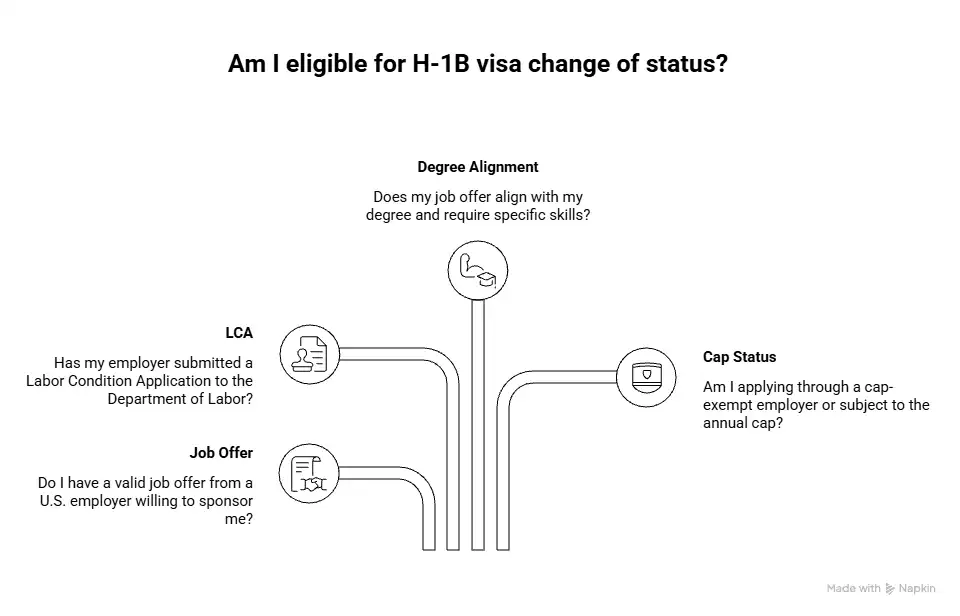
1. Job Offer from a U.S. Employer
The first and most crucial requirement for the F-1 to H-1B visa transition is a valid job offer from a U.S. employer. Your employer must agree to sponsor your H-1B visa by filing a petition with U.S. Citizenship and Immigration Services (USCIS). The job must be in a specialty occupation that requires a bachelor’s degree or higher, typically in the field of study that aligns with your degree.
2. Labor Condition Application (LCA)
Before filing the H-1B petition, your employer must submit a Labor Condition Application (LCA) to the Department of Labor. The LCA ensures that the employer will pay you the prevailing wage for your job and that working conditions are met. The LCA is a critical document for the approval of your H-1B petition.
3. Degree Requirements
Your job offer must align with your degree. For example, if you hold a degree in computer science, you must work in a job related to computer science. The job must also meet the criteria of a specialty occupation, requiring specific knowledge and skills related to your degree.
4. Cap-Subject or Cap-Exempt Status
The H-1B visa is subject to an annual cap, meaning there’s a limit on how many H-1B visas are issued each year. However, certain employers, like nonprofit research organizations or universities, may be exempt from this cap. If you’re applying for an H-1B through a cap-exempt employer, you may not need to worry about the lottery system.
The F-1 to H-1B Visa Process: Step-by-Step Guide
Here’s a detailed breakdown of the steps involved in changing your status from F-1 to H-1B:
Step 1: Securing a Job Offer
Your first task is to secure a job offer from a U.S. employer willing to sponsor your H-1B visa. It’s crucial to start your job search early and apply to employers who are familiar with the H-1B process.
Step 2: Employer Files the H-1B Petition
Once you have a job offer, your employer will file an H-1B petition with USCIS. This petition includes your job offer, educational background, proof of eligibility, and the Labor Condition Application (LCA). The employer will need to submit all necessary documents and pay the appropriate filing fees.
Step 3: The H-1B Lottery System
If you’re applying for a cap-subject H-1B, your petition will be entered into the H-1B lottery. Since the number of H-1B petitions often exceeds the annual cap, USCIS randomly selects petitions for processing. This is one of the most critical stages of the process.
Step 4: USCIS Processing and Approval
If your petition is selected in the lottery, USCIS will process your H-1B petition. If approved, you’ll receive an I-797 approval notice, which serves as confirmation that your H-1B status has been granted.
Step 5: Visa Stamping and Entry to the U.S.
Once your H-1B petition is approved, if you are outside the U.S., you must attend an interview at a U.S. consulate to get your H-1B visa stamped in your passport. If you are already in the U.S., you can change your status directly from F-1 to H-1B without leaving the country.
Step 6: H-1B Status Activation
Once your visa is stamped or your status is changed, you can start working for your H-1B sponsor in the U.S.
F-1 to H-1B Visa 2026 Timeline and Deadlines

The F-1 to H-1B transition follows a specific timeline, and meeting deadlines is crucial to ensure your application is processed smoothly. Here’s a breakdown of the key dates for the 2026 application cycle:
- March-April 2026: The H-1B petition filing window opens. This is when U.S. employers must submit their petitions to USCIS for cap-subject H-1B visas. It’s essential to have your job offer and necessary documents ready before this period begins.
- April 2026: USCIS conducts the H-1B lottery selection process. Given the high demand for H-1B visas, USCIS uses a lottery to randomly select petitions for processing. If your petition is selected, it will move forward in the process.
- May-June 2026: After the lottery, USCIS will process the selected petitions. If approved, you will receive an I-797 approval notice, confirming your H-1B status. This step may also involve additional requests for evidence (RFEs) in some cases.
- October 2026: The H-1B status officially begins, marking the start of employment for most H-1B holders. This is typically the date when you can start working in the U.S. under your new H-1B status.
Staying on top of these dates and ensuring your petition is submitted on time is essential for a smooth transition from F-1 to H-1B.
Common Mistakes and How to Avoid Them When Switching from F-1 to H-1B
Transitioning from F-1 to H-1B involves a detailed process, and many applicants make common mistakes that can delay their petition. By understanding these mistakes and how to avoid them, you can help ensure a smoother transition.
- Missing Deadlines: One of the most critical aspects of the H-1B process is adhering to the specific filing deadlines. Missing key dates for petition submission or the lottery can result in your petition being disregarded for the year. To avoid this, carefully track all deadlines and work closely with your employer to submit your petition on time. Setting up reminders and checking USCIS updates can help ensure timely submission.
- Incomplete Documentation: Missing or incorrect documents can slow down the approval process or even result in a denial. Ensure that you and your employer carefully check all required paperwork, including the Labor Condition Application (LCA), job offer letter, and proof of education. Double-checking all documents before submission will reduce the risk of delays or requests for additional evidence.
- Incorrect Employer Information: The employer’s role in the petition is crucial. If the employer fails to accurately complete the LCA or provides incorrect job descriptions that don’t align with your degree, it can lead to complications. To avoid this, ensure that your employer understands the H-1B process and the importance of accurate and detailed job descriptions. Providing clear guidance to your employer about the role’s requirements in relation to your qualifications will help prevent mistakes.
By staying organized, proactive, and closely collaborating with your employer, you can avoid these common pitfalls and ensure your F-1 to H-1B transition goes smoothly.
Can You Stay in the U.S. While Waiting for Your H-1B Status?
If you are currently on an F-1 visa and are applying for H-1B, you can generally remain in the U.S. while your petition is being processed, as long as you maintain valid F-1 status. If you are on Optional Practical Training (OPT), you can continue working in the U.S. until your H-1B status is activated, but you must ensure that there is no gap between the expiration of your OPT and the start of your H-1B.
Alternatives to F-1 to H-1B: Other U.S. Work Visas for Students
While transitioning from F-1 to H-1B is the most common path for international students, there are other work visa options available depending on your qualifications and situation. Here are a few alternatives:
These alternatives provide pathways for students who may not qualify for an H-1B visa but still wish to live and work in the U.S. Each visa has specific requirements, so it’s important to assess which one aligns best with your career goals.
Learn more about O-1 Visa and L-1 Visa.
Take the Next Step Towards Your U.S. Career

Transitioning from an F-1 visa to an H-1B visa can be a complex but rewarding journey. Whether you’re ready to pursue a work opportunity in the U.S. or need guidance on navigating the visa process, Beyond Border is here to help you every step of the way. Our team of experienced immigration consultants can assist in preparing your petition, ensuring you meet all requirements, and guiding you through the approval process.
Schedule your free consultation and profile evaluation.
Let us help you maximize your chances of success and take the first step toward your U.S. work visa today.
Explore our articles to learn more about different types of US visa.