
If you're navigating the U.S. immigration system, understanding the differences between a 2-year Green Card and a 10-year Green Card is crucial. Whether you're applying through marriage, investment, or another route, the type of Green Card you hold significantly impacts your rights, responsibilities, and the steps you'll need to take to maintain your status. While both Green Cards grant you permanent resident status, they differ in their conditions, renewal processes, and overall impact on your journey toward full U.S. citizenship.
What Is a Green Card?
A U.S. Green Card, also known as a Permanent Resident Card, is the official document that grants a non-citizen the right to live and work permanently in the United States. It’s a significant milestone for anyone on their immigration journey, as it offers numerous benefits, including the ability to work legally, travel abroad, and eventually apply for U.S. citizenship.
There are two primary types of Green Cards: the 2-year Green Card and the 10-year Green Card. The main difference between these two types is their status, conditional versus permanent, which influences the application process, rights, and renewal procedures. In this guide, we’ll explore the crucial differences between a 2-year and a 10-year Green Card to help you understand which one applies to your situation and how to navigate the process.
Understanding the EB-1 and EB-2 Green Card Pathways
In addition to the 2-year and 10-year Green Cards, there are other pathways to permanent residency through employment-based visas, such as the EB-1 and EB-2 visas. These visas provide options for professionals, researchers, and individuals with extraordinary abilities in fields such as science, business, and the arts.
- EB-1 Visa: This visa is for individuals who have demonstrated extraordinary ability in their field or those who are multinational managers or outstanding researchers. The EB-1 category offers a fast track to permanent residency, especially for those who have reached the pinnacle of their career or have achieved international recognition.
- EB-2 Visa: The EB-2 visa is designed for individuals with advanced degrees or exceptional ability in their professional field. This visa offers a path to permanent residency, and in some cases, applicants can apply for the National Interest Waiver (NIW), which allows them to self-petition without employer sponsorship if their work benefits the U.S. significantly.
Note: All Green Card applications, including those for the EB-1 and EB-2 visas, are processed by USCIS (U.S. Citizenship and Immigration Services), which plays a critical role in reviewing and approving petitions.
The 2-Year Green Card: What You Should Know

Who Is Eligible for the 2-Year Green Card?
The 2-year Green Card is typically issued to individuals who receive conditional permanent residency. The most common reasons for receiving a 2-year Green Card include:
- Marriage-Based Green Card: If you marry a U.S. citizen or permanent resident, you may be granted a 2-year Green Card, which is conditional upon the validity of the marriage.
- EB-5 Investor Visa: Foreign nationals who invest in a U.S. business and meet the criteria for the EB-5 Immigrant Investor Program may also receive a 2-year conditional Green Card.
The 2-year Green Card is meant to ensure that the relationship (in the case of marriage) or the investment remains legitimate and active. The U.S. government grants this conditional status to ensure that the individual does not attempt to misuse the system for citizenship without meeting the required conditions.
What Makes It Conditional?
A conditional green card means that your status as a permanent resident is not final. The U.S. government requires you to prove that your relationship or investment is genuine, which is why the card is issued for only two years. For marriage-based Green Cards, you must prove that your marriage is legitimate and not entered into solely for immigration benefits. For EB-5 investors, you must show that the business you invested in continues to meet the program’s requirements.
After two years, the conditions on the Green Card must be removed to convert it into a permanent (10-year) Green Card.
Renewal Process for the 2-Year Green Card
To remove the conditions and convert your 2-year Green Card into a permanent 10-year Green Card, you must file Form I-751 (for marriage-based Green Cards) or Form I-829 (for EB-5 investors). These forms must be submitted within the 90-day period before your 2-year Green Card expires.
You’ll need to provide documentation supporting the authenticity of your marriage or investment. For example, if you hold a marriage-based Green Card, you might need to submit proof that your marriage is still valid, such as joint financial documents or affidavits from friends and family.
The approval process for the removal of conditions typically takes several months, but it can be expedited in certain cases with the help of premium processing.
For individuals interested in transitioning to a Green Card from an O-1 visa, Beyond Border offers expert guidance through the process. Learn more about the O-1 Visa to Green Card pathway.
The 10-Year Green Card: What You Should Know

Eligibility for the 10-Year Green Card
The 10-year Green Card is the permanent resident status granted to individuals who successfully meet the conditions of their initial Green Card. After fulfilling the required criteria (whether through marriage, investment, family, or employment), individuals can transition from a conditional 2-year Green Card to the 10-year Green Card.
If you originally received a 2-year conditional Green Card, the key to transitioning to the 10-year Green Card is proving that your situation is still valid and genuine. Once the conditions are removed, you become a permanent resident and will not be subject to the same renewal processes as conditional status holders.
Permanent Residency: The Benefits of a 10-Year Green Card
The 10-year Green Card represents permanent residency, which means you are no longer required to prove the legitimacy of your marriage or investment. While the 2-year Green Card requires individuals to file petitions to remove conditions, the 10-year Green Card holder enjoys full rights and privileges as a U.S. permanent resident.
Permanent residents with a 10-year Green Card can:
- Work anywhere in the U.S. without restrictions.
- Travel in and out of the U.S. without the same conditions required for conditional residents.
- Apply for U.S. citizenship after meeting the residency and other requirements.
How to Renew the 10-Year Green Card
The 10-year Green Card is valid for, you guessed it—10 years. While it does not require removal of conditions, you do need to renew the Green Card before it expires. The renewal process typically involves completing Form I-90, which is an application for a replacement Green Card.
Unlike the conditional Green Card, the renewal process for the 10-year card is relatively straightforward, as long as the individual remains in good standing as a permanent resident.
Note: If you want to learn more about the EB-1A or O-1 visa pathways to a Green Card, be sure to check out our detailed guides for these visas: EB-1A Green Card and O-1 Visa.
Key Differences Between the 2-Year and 10-Year Green Cards
Conditional vs. Permanent Status
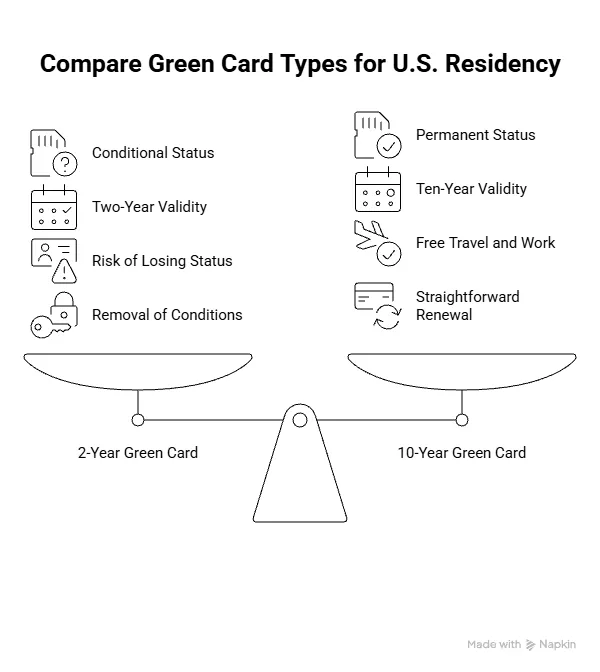
The primary difference between the two types of Green Cards is whether the status is conditional or permanent. The 2-year Green Card is conditional, and you must prove the legitimacy of your marriage or investment before transitioning to the 10-year Green Card. The 10-year Green Card is permanent, and once you transition to it, you don’t have to worry about proving your status again.
Eligibility and Duration of Stay
The 2-year Green Card is valid only for two years, after which you must go through the process of removing conditions to convert it into a permanent 10-year Green Card. The 10-year Green Card, on the other hand, is renewable every 10 years.
Rights and Responsibilities
While both the 2-year and 10-year Green Cards grant the holder the right to live and work in the U.S., there are notable distinctions. Conditional residents with the 2-year Green Card may face challenges if they fail to remove the conditions on time, which can lead to losing their status. Permanent residents with a 10-year Green Card can travel freely and work without restrictions.
Renewing and Removing Conditions
The 2-year Green Card requires a removal of conditions before it can transition to the 10-year Green Card. If you fail to meet this requirement, you risk losing your permanent residency status. The 10-year Green Card is easier to renew, with a straightforward process involving Form I-90 for replacement cards.
If you’re looking to qualify for a U.S. Green Card through extraordinary ability, the EB-1A Visa might be an option worth exploring.
Why It’s Important to Understand the Difference
Impact on Your Immigration Journey
Understanding the differences between the 2-year and 10-year Green Cards is essential for anyone planning to settle in the U.S. It influences not only your immigration status but also your path toward U.S. citizenship. The 10-year Green Card is a step closer to naturalization, whereas the 2-year Green Card serves as a stepping stone that ensures the authenticity of your status before granting permanent residency.
Legal and Financial Considerations
The type of Green Card you hold affects various aspects of your life in the U.S. Your ability to travel freely, secure loans, and work in certain sectors can be directly impacted by whether you have a conditional or permanent Green Card. It's crucial to understand these distinctions, as the legal requirements and benefits of each are not the same.
What Happens After the 2-Year Green Card Expires?
.webp)
The Process of Removing Conditions
If you hold a 2-year Green Card, you must remove the conditions to obtain permanent resident status. This process involves filing the necessary paperwork (Form I-751 or I-829) and providing documentation that proves the authenticity of your relationship or investment.
It’s important to submit these documents before the expiration date of your 2-year Green Card. Failure to do so can result in the loss of your permanent residency status, making it harder to stay in the U.S.
What If You Fail to Remove Conditions?
If you fail to submit your petition to remove conditions in a timely manner, you may lose your conditional permanent residency status. This can lead to the termination of your Green Card and potential deportation. Always be sure to file the necessary documents well before your 2-year Green Card expires to avoid complications.
How Beyond Border Can Help with Your Green Card Process
Navigating the Green Card process can be complex, especially when dealing with conditional status. At Beyond Border, we specialize in helping individuals streamline the immigration process and ensure that their Green Card applications are as smooth as possible.
Get Expert Assistance with Your Green Card Process
Whether you are applying for a marriage-based Green Card or an investment-based one, we can guide you through the process step-by-step. From filling out the necessary forms to providing the right documentation, Beyond Border ensures that your application is on track and meets all the requirements.
Schedule your free consultation and profile evaluation.