Your green card arrived. Next to your name is a three character code, something like IR6, CR6, E26, or AS6. It looks like administrative shorthand, but it is not. The code is your class of admission that states exactly how you became a permanent resident. If you get it wrong on a Form I-90 or Form I-751,USCIS can reject your case.
The code marks the difference between conditional and permanent status. An IR6 green card is valid for 10 years, while the CR6 green card expires in two years unless you file to remove the conditions in time.
In this guide, we explain the major green card category codes, from family based codes like IR6 and CR6 to employment based codes like E26 and humanitarian codes like AS6.
Each code changes what you need to do next. For some readers, that means renewing a card correctly. For others, it could entail catching the naturalization clock before it starts running.
The category code shows up on several documents you likely already have. This means you can track yours down even without your physical card in hand.
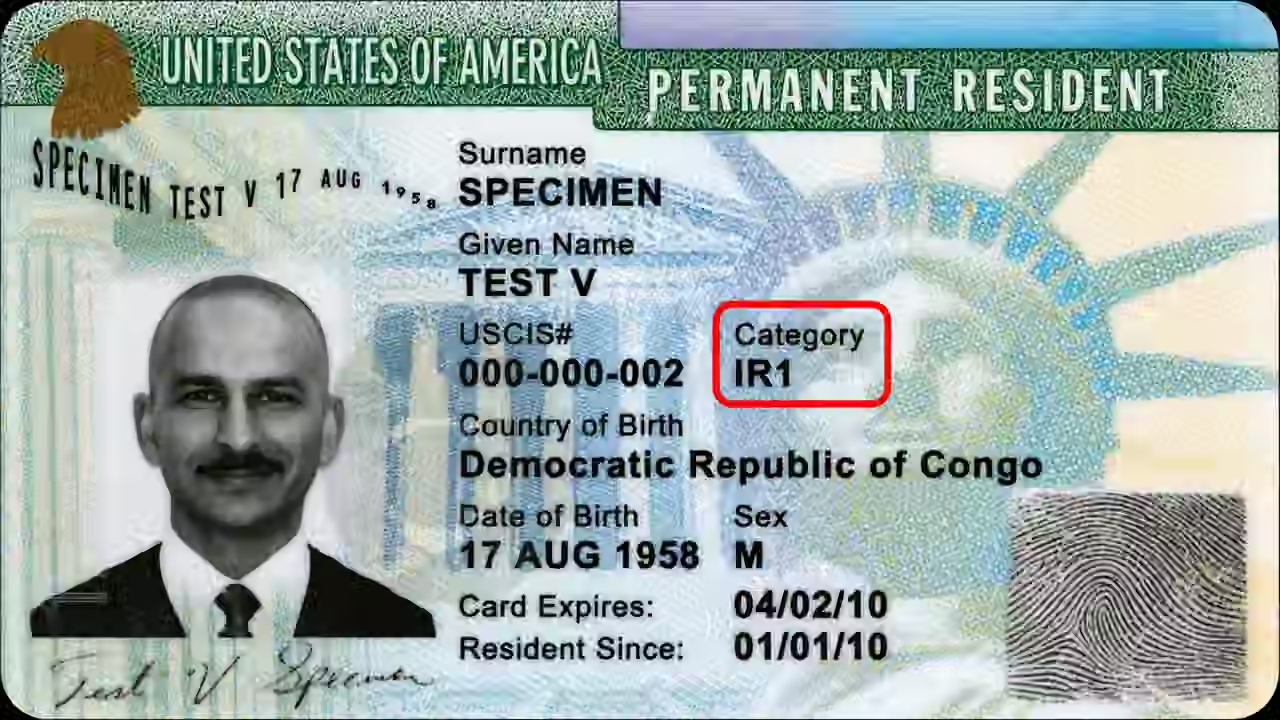
USCIS calls this code your class of admission, or COA. On a current-design green card, the code sits on the front, in a field labeled Category. Older green cards printed it on the back instead. Either way, the code itself looks the same. It has one or two letters, followed by a number, such as green card category E26 or IR6
The same code shows up in other places too:
If your physical card is lost, damaged, or not yet in hand, you can still find your class of admission on one of these other documents. Form I-90, the green card renewal and replacement form, asks for this exact code.
Family-based codes split into two groups. Immediate relatives face no annual cap, while family-sponsored preferences do, which changes how fast each moves.
IR1 and IR6 mark the same category. Both apply to a spouse of a US citizen in a marriage that was at least two years old when the green card was approved. The letter after the "I" tells you where the approval happened.
Both the IR6 green card and an IR1 green card carry identical rights, including a 10-year green card. Both spouses also become eligible to apply for citizenship after three years as a permanent resident, as long as the marriage stays intact and the couple lives together during that time.
CR1 and CR6 follow the same split. CR1 means approval abroad, while CR6 is an adjustment of status inside the US. The difference from IR1 and IR6 category green cards is the marriage length: under two years old at approval.
The shorter marriage triggers a conditional green card that is valid for two years. To keep permanent resident status, the couple must file Form I-751 within the 90-day window before the card expires. If the window is missed, status will be terminated automatically without a grace period.
Once USCIS approves the I-751, the agency updates the underlying class of admission.
The USCIS Policy Manual states this directly. Officers processing an approved I-751 update the noncitizen's class of admission code to the IR equivalent once the conditions are removed. Your next green card reflects that update rather than the CR code you started with.
Spouses are not the only immediate relatives. Children of US citizens use IR2 for new arrivals and IR7 for adjustments. Parents of adult US citizens (citizens aged 21 or older) use IR5 for new arrivals and IR0 for adjustments.
Immediate relative petitions move only as fast as USCIS and the National Visa Center can process them. They never wait behind a visa bulletin backlog.
Family members outside the immediate relative category fall under family-sponsored preferences instead. These categories carry annual numerical limits, so a visa bulletin backlog often applies. The codes still follow the same new arrival and adjustment split as before.
F2A cases usually clear faster than F2B, F3, or F4, since spouses and minor children of green card holders get priority within the preference system. F4, the sibling category, typically carries the longest wait of the four.
Check the current Visa Bulletin to see where your priority date stands before assuming any of these codes will move quickly.
Employment preference codes work the same way as family-based ones, but split by EB-1, EB-2, and EB-3 level.
Employment-based green cards split into three main preference levels. Each level gets its own set of codes, and each code still follows the new arrival and adjustment pattern from the family-based codes above.
All three paths are inside EB-1, but the code tells you exactly which one a given case used.
You should note that a national interest waiver (NIW) case still uses E21 or E26. USCIS assigns the code based on the underlying EB-2 category. An EB-2 NIW green card and a standard EB-2 green card carry the same class of admission code.
One common mix-up or assumption is that E31 or E32 must be related to EB-5 investors, since both start with "E" and settle in a similar number range. This is false as they do not.
The EB-5 investor codes look completely different: C51 and E51 for the standard track, with I51, T51, and R51 covering targeted employment areas and pilot program investors. If your code starts with E3, you filed under a labor-sponsored EB-3 case, which is completely different from an investment-based one.
For Founders and technical professionals weighing EB-1A against an EB-2 NIW filing, the code difference is a useful shortcut once a case is approved. E11 or E16 confirms extraordinary ability, while E21 or E26 green card category confirms the advanced degree or exceptional ability route, NIW included.
Humanitarian codes cover green cards granted for protection rather than family ties or employment. Each one carries its own rules for counting time toward naturalization.
The category AS6 on green card means it was granted through asylum. USCIS requires one year of physical presence in the US as an asylee before the person can file Form I-485 for permanent residence.
The AS6 code carries a hidden benefit tied to the "Resident Since" date. USCIS treats an asylee as a permanent resident starting one year before the adjustment of status approval. Such rollback shortens the wait to naturalization by a full year.
RE6 marks a green card granted through the refugee program. Refugees must also accrue one year of physical presence before filing Form I-485, matching the asylee rule above.
The rollback works differently for refugees, and more generously. USCIS considers a refugee to have become a permanent resident on the date they first entered the US. So, a refugee who spent three years living in the US before finally filing Form I-485 gets all three years credited toward the five-year naturalization requirement.
DV codes mark green cards granted through the Diversity Immigrant Visa Program. This is the annual lottery for applicants from countries with historically low rates of immigration to the US.
Unlike most employment and family categories, there is no separate preference tier here. Winning the lottery and clearing the visa interview is the entire qualifying event.
The code determines if your status is attached with conditions, alongside eligibility to file for citizenship.
The single most useful information your category code tells you is whether your green card carries conditions. Any code that starts with "C," such as CR1, CR6, C21, or C26, means conditional. Everything else is permanent, at least as far as the marriage or investment basis for the card is concerned.
The differences change what you need to do next.
Check your code before you assume which category you fall into.
Your category code also sets the naturalization clock, though the rule depends on which code you hold. Several permanent residents need five years of continuous residence before filing Form N-400.
Spouses of US citizens, including IR1 and IR6 holders, qualify after three years instead, provided the marriage stays intact and the couple lives together for that full period.
Refugees and asylees run on a different clock entirely, and it favors them.
As covered above, a refugee's five-year count starts on the date of entry, backdated through the RE6 code. In contrast, an asylee's count starts one year before their I-485 approval, backdated through the category AS6 on green card.
Both groups can reach eligibility sooner than the printed approval date on their green card suggests.
Before you count down to your N-400 filing date, pull your green card and confirm the exact code and the "Resident Since" date next to it. Those two fields are what USCIS will use to decide whether you can file.
If your green card carries an E11, E21, E26, or E31 code, you reach permanent residence through employment, most likely after years of building a case for extraordinary ability or a national interest waiver.
Beyond Border works exclusively on O-1, EB-1A, EB-2 NIW, and L-1 cases for Founders, executives, and technical professionals moving to the US.
Getting the class of admission code right does not end once your green card arrives. The same code follows you into I-90 renewals, I-751 filings, and eventually your N-400. A mismatched code on any of these forms is one of the more common and entirely avoidable reasons a routine filing gets delayed.
Our network of specialist attorneys has filed 4,000+ employment-based cases, and we know exactly which E-series code should appear on your approval before it arrives.
Are you currently in search of a path through an O-1, EB-1A, or EB-2 NIW petition and want a second read on your case before you file? Book a free consultation with our experienced attorney to get clarity on next steps.
IR6 green card marks a spouse of a US citizen who adjusted status inside the US, in a marriage that was at least 2 years old at approval. The IR6 green card category has no conditions and comes with a 10-year card.
IR6 green card category applies to marriages 2 years or older at approval and comes with an unconditional 10-year card. A CR6 green card category applies to marriages under 2 years old, which start out conditional until Form I-751 removes the conditions.
An E26 green card category marks an EB-2 advanced degree professional or person of exceptional ability who adjusted status inside the US. This e26 category green card designation also covers national interest waiver cases, since USCIS assigns the code based on the EB-2 classification itself.
On a current-design card, the code sits on the front in a field labeled Category. Older cards print it on the back instead. This is the same class of admission green card field referenced on your I-485 approval notice, I-94 record, and immigrant visa.
A routine Form I-90 renewal does not change the category code on a green card. The same code generally carries over from the previous card. However, the code can change after filing Form I-751 to remove conditions on residence. Once the conditions are removed, USCIS changes a conditional CR1 or CR6 classification to IR1 or IR6, respectively.

David Munam is an experienced writer with 10 years of expertise in researching and producing clear, authoritative content on complex and highly technical subjects. His work has focused on turning dense information into accurate, well-structured, and accessible content across areas such as U.S. customs and trade, Web3, fintech, immigration law, and technology. At Beyond Border, he applies this experience to researching and writing in-depth content on U.S. immigration pathways, including O-1, EB-1A, and EB-2 NIW.
Address: 4 W 4th Ave, San Mateo, CA 94402, United States
Email: info@beyondborderglobal.com