The O-1 to green card timeline in 2026 depends on four variables: which category is chosen (EB-1A or EB-2 NIW), whether premium processing is used for the I-140, the applicant's country of birth, and whether I-140 and I-485 can be filed concurrently. The O-1 Visa is a temporary nonimmigrant visa; the green card provides permanent residence. Both EB-1A and EB-2 NIW allow self-petition without employer sponsorship, and both build directly on the same evidentiary record developed for the O-1A petition. Beyond Border is an immigration firm specializing in O-1 Visa to EB-1 Green Card transitions.
[Check the USCIS processing times page for current I-140 and I-485 estimates, as USCIS updates these weekly.]
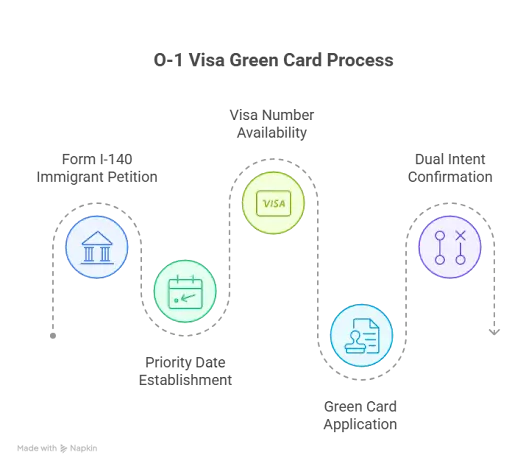
The O-1 visa green card process has two sequential stages.
Stage 1: Form I-140 immigrant petition. USCIS determines whether the applicant qualifies for the green card category. For EB-1A, the standard is extraordinary ability evidenced by sustained national or international acclaim through at least three of ten evidentiary criteria. For EB-2 NIW, the applicant must satisfy the EB-2 base qualification and the Dhanasar three-prong national interest test. When USCIS receives the I-140, it establishes a priority date that determines the applicant's position in the queue for a visa number.
Stage 2: Green card application. For applicants inside the United States, this means Form I-485 Adjustment of Status when a visa number is available for their category and country of birth. For applicants outside the United States, consular processing through the National Visa Center and a U.S. embassy replaces I-485.
The O-1 carries dual intent. Pursuing the O-1 visa green card process concurrently does not jeopardize O-1 status, and USCIS policy confirms that pending I-140 petitions and I-485 applications are not grounds for O-1 denial or extension refusal. For the full dual intent framework, see the O-1 visa dual intent guide.
The O-1 to EB-1A timeline 2026 is the fastest self-petition green card route for O-1 holders who qualify and whose country of birth is not severely backlogged.
(Source: USCIS processing time data, April 2026)
For non-backlogged applicants using premium processing and O-1 concurrent I-485 filing when the priority date is current, the total O-1 to EB-1A timeline 2026 from I-140 filing to green card approval runs approximately 12 to 34 months. The I-140 resolves in three calendar weeks under premium; the I-485 stage then governs the remaining timeline.
EB-1A and O-1A share the same extraordinary ability standard and overlapping evidentiary criteria. Evidence from the O-1A petition, awards, publications, expert letters, compensation documentation, and judging invitations, transfers directly into the EB-1A I-140 without rebuilding from scratch. For the full EB-1A evidence framework, see the O-1 to EB-1A pathway guide. For how the two standards compare, see the O-1A vs EB-1A guide.
The EB-2 NIW is more accessible for O-1 holders whose work addresses documented U.S. national priorities including STEM research, healthcare, cybersecurity, and economic development, but whose profile has not yet reached the EB-1A extraordinary ability standard.
EB-1A vs EB-2 NIW O-1 key timeline difference: EB-2 NIW premium processing guarantees USCIS action within 45 business days, approximately nine calendar weeks, rather than the 15 business days that apply to EB-1A. Both cost $2,965 effective March 1, 2026. Standard EB-2 NIW I-140 processing runs up to 20 months.
For non-backlogged applicants with concurrent O-1 concurrent I-485 filing available, the total EB-2 NIW timeline from filing to green card runs approximately 13 to 34 months. For the EB-2 NIW evidence strategy for O-1 holders specifically, see the O-1 to EB-2 NIW guide.
The EB-1A vs EB-2 NIW O-1 choice depends on the strength of the extraordinary ability record and the applicant's country of birth.
Choose EB-1A when the O-1A evidence record is strong across multiple criteria with independent external recognition, the applicant's achievements demonstrate sustained national or international acclaim at the very top of the field, and a faster I-140 decision is strategically valuable.
Choose EB-2 NIW when the applicant's proposed U.S. work addresses a clear national interest and can be framed under the Dhanasar three-prong test, the extraordinary ability record may not yet satisfy EB-1A's final merits holistic review, or the applicant holds an advanced degree that strengthens the EB-2 base qualification.
File both simultaneously when the profile supports both and the applicant wants to maximize approval probability and preserve priority dates in both categories. The dual I-140 strategy is particularly valuable for applicants from India and China where each month of earlier priority date position has compounding value, and for borderline EB-1A candidates where a backup EB-2 NIW provides protection against denial. For green card options available to O-1A holders across both categories, see the green card options for O-1A visa holders guide.
The O-1 priority date green card queue is determined by country of birth. Each country receives a maximum of 7% of annual employment-based visa numbers, creating multi-year backlogs for India and China while most other countries remain current.
For most countries: EB-1A and EB-2 NIW priority dates are current or near-current as of April 2026. O-1 concurrent I-485 filing is available immediately when the I-140 is approved. Total timeline is governed by I-140 and I-485 processing rather than priority date wait.
For India-born applicants: The India EB-1A Dates for Filing cutoff stands at approximately April 2023 as of April 2026, a backlog of approximately three years. The India EB-2 cutoff stands at approximately November 2014, exceeding 12 years. For Indian O-1 holders, the EB-1A vs EB-2 NIW O-1 choice has timeline consequences measured in years, not months. Filing the I-140 as early as possible establishes the earliest priority date. For the full India EB-1 priority date analysis, see the EB-1 priority date India guide.
For China-born applicants: EB-1A backlog runs approximately two years; EB-2 NIW runs approximately four to five years. The dual filing strategy provides flexibility to use whichever priority date becomes current first.
The Visa Bulletin publishes Dates for Filing and Final Action Dates monthly. Dates for Filing determines when I-485 can be submitted; Final Action Dates determines when I-485 can be approved. For a full cross-category comparison of EB-1 timing against EB-2 backlogs, see the EB-1 timing and Visa Bulletin guide.
O-1 concurrent I-485 filing means submitting Form I-140 and Form I-485 in the same filing package or in immediate succession when the priority date is current for the applicant's category and country of birth. For most nationalities in 2026, concurrent filing is available immediately under EB-1A.
The strategic advantages of O-1 concurrent I-485 filing are substantial. It removes the waiting period between I-140 approval and I-485 eligibility. It immediately triggers access to the Employment Authorization Document, which issues approximately 4 to 7 months after filing and allows unrestricted work for any employer without limitation to the O-1 sponsor. It also triggers access to Advance Parole for international travel within approximately six months of filing.
For a step-by-step guide on when concurrent filing is permitted and how to structure the package, see the I-485 concurrent filing guide.
(Source: USCIS fee schedule effective April 1, 2024; Form I-907 updated March 1, 2026)
Without premium processing, total government fees for a self-petitioned EB-1A with I-485 run approximately $3,345. With premium processing, approximately $6,310.

The optimal window to begin the O-1 visa green card process is within the first 12 to 18 months of O-1 status. This allows time to strengthen the evidentiary record, file the I-140 with adequate lead time before any status deadlines approach, and avoid timeline compression from O-1 expiration approaching concurrent with I-485 pending.
Filing the I-140 at least 12 to 18 months before the O-1 is set to expire provides important protection. H-1B and O-1 holders with an approved I-140 that has been pending 365 days or more qualify for status extensions beyond their standard cap. For Indian and Chinese applicants, filing the I-140 at the earliest point qualification is established sets the most favorable O-1 priority date green card position in a queue where each month matters.
One important travel planning note: after I-485 is filed, international travel is not permitted without Advance Parole. O-1 holders with significant international travel obligations should complete any necessary travel before filing I-485 or ensure Advance Parole has been approved before departing.
Beyond Border is an immigration firm focused exclusively on employment-based high-skilled visa and green card pathways. For O-1 Visa to EB-1 Green Card or EB-2 NIW transitions, the firm evaluates whether the existing O-1A evidence record supports EB-1A, EB-2 NIW, or both simultaneously, advises on the O-1 to EB-1A timeline 2026 implications of premium processing and concurrent filing, and structures the I-140 evidence package to carry directly from the O-1A petition.
Clients include professionals from Google, Salesforce, JP Morgan, Chime, Visa, and Mastercard. A money-back guarantee applies if the petition is unsuccessful.
To evaluate your O-1 to green card timeline and which pathway best fits your professional profile and country of birth in 2026, book a free consultation with Beyond Border.
For non-backlogged applicants using EB-1A with premium processing and O-1 concurrent I-485 filing, the total O-1 to EB-1A timeline 2026 runs approximately 12 to 34 months. For Indian-born applicants in EB-2 NIW, the backlog exceeds 12 years. For Indian-born applicants in EB-1A, the backlog is approximately three years.
Yes. The O-1 carries dual intent. Filing an I-140 or I-485 petition while on O-1 status does not jeopardize the visa. Pursuing the O-1 visa green card process simultaneously with maintaining O-1 status is standard practice for most O-1 holders planning long-term U.S. residence.
EB-1A requires demonstrating extraordinary ability at the very top of the field; EB-2 NIW requires demonstrating that the proposed work serves the U.S. national interest under the Dhanasar test. EB-1A premium processing guarantees 15 business days; EB-2 NIW premium guarantees 45 business days. For most nationalities, EB-1A offers a faster O-1 to EB-1A timeline 2026 due to the shorter premium processing window.
O-1 concurrent I-485 filing means submitting Form I-140 and Form I-485 simultaneously when the priority date is current for the applicant's category and country of birth. It eliminates the wait between I-140 approval and I-485 eligibility and immediately triggers access to EAD and Advance Parole.
Within the first 12 to 18 months of O-1 status. Filing early sets the earliest possible O-1 priority date green card position, provides status extension protection for backlogged applicants, and avoids timeline compression when the O-1 approaches expiration.
Before filing I-485, international travel can proceed normally on valid O-1 status. After filing I-485, Advance Parole must be approved before departing the United States — travelling without it results in I-485 abandonment. Advance Parole typically takes approximately six months to process after I-485 filing. Any applicant with significant international travel requirements should plan travel before filing I-485 or ensure Advance Parole is in hand before departing.
EB-1A is faster — typically 7 to 16 months for non-backlogged applicants — but requires meeting the extraordinary ability standard with documented sustained national or international acclaim. EB-2 NIW is more accessible for many O-1 holders and runs 15 to 24 months for non-backlogged applicants, but backlogs significantly extend this for Indian-born applicants. Many O-1 holders file both I-140 petitions simultaneously to maximise probability of approval and preserve priority dates in both categories. A specialist attorney should assess both pathways at intake.

Camila is the Head of Legal at Beyond Border, where she specializes in O-1, EB-1A and EB2-NIW visas. Camila is an OAB-certified lawyer, with 8 years of relevant US immigration experience. Camila has personally secured approval more than 100 O-1, EB-1A and EB2-NIW cases and maintained a perfect approval track record so far. Camila holds a Master's degree in Law from the Universidade Catolica Portuguesa, and is a sought after voice in the U.S. extraordinary alien visa field in press including Times of India.
Address: 4 W 4th Ave, San Mateo, CA 94402, United States
Email: info@beyondborderglobal.com