89.9% of Asian Founders Delay US Immigration Research Until Relocation
Most Asian startup founders look to expand their businesses to the US. However, many of them don’t plan immigration well in advance. They wait until someone is ready to move before researching visa options.
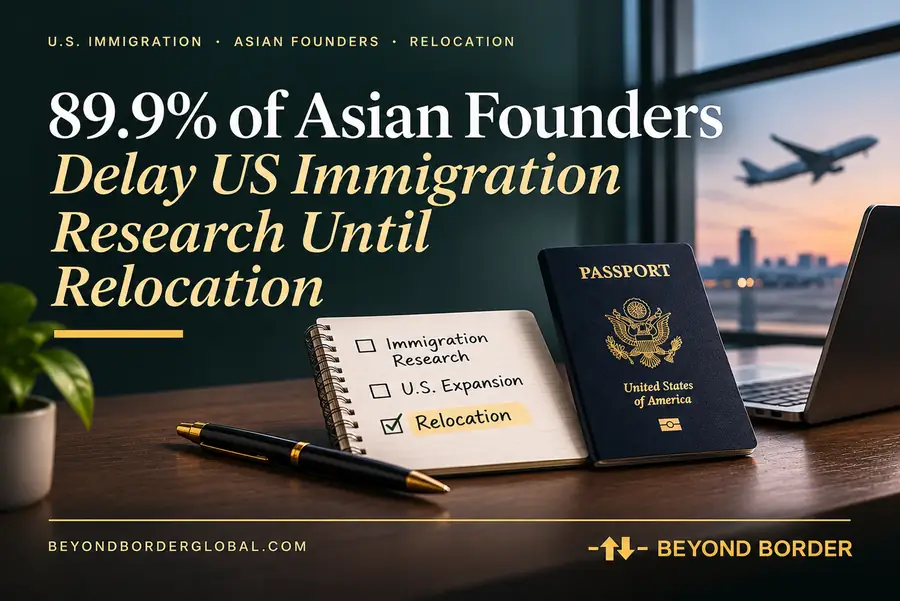
According to the Beyond Border’s Asian Founder Mobility Pulse survey, 89.9% of founders surveyed said they would only research US immigration when someone is ready to relocate. Only 1.6% said they’d start researching more than 12 months in advance of the planned move.
This indicates that many founders don’t plan immigration in advance to align with their business expansion plans. Founders may work for months on finding customers in the US, planning business operations, and building business relationships. But when it comes to researching visas, they do it at the last minute.
The data for this article is based on Beyond Border’s internal proprietary data and Asian Founder Mobility Pulse survey.
Most Asian Founders Plan to Expand to the US in Next Two Years
Many Asian startup founders are already planning to expand to the US. 59.9% of founders surveyed said they plan to enter the US market in the next 12 months. 25.1% plan to expand in 12 to 24 months.
Others either don’t know when they’ll expand or have no plans to do so.
So 85% of founders surveyed plan to expand to the US in the next two years.
For most founders, the main reason to expand is access to customers. 85% of founders surveyed said that they’re mainly expanding to the US to access customers. 8.1% said it’s for fundraising/investor networks, and 4.9% said for access to talent/strategic partners.
So many founders view the US as an important market for growing their businesses. But immigration planning doesn’t seem to be moving as fast.
Biggest Barrier to US Expansion is Immigration
While founders are keen to expand to the US market, their biggest worry is immigration uncertainty.
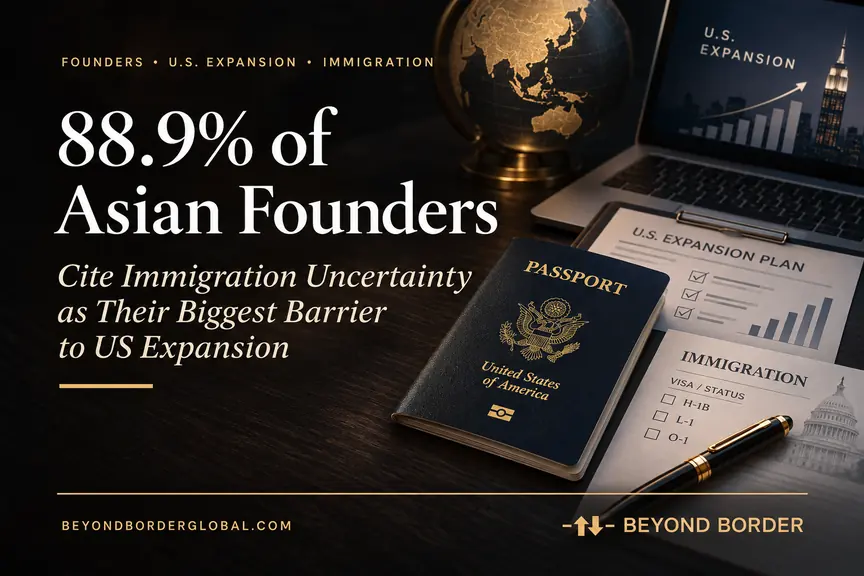
88.9% of founders surveyed in Beyond Border’s survey said that immigration/visa uncertainty is their biggest barrier to US expansion.
Other barriers were far less common.
So immigration is a far bigger concern than expansion costs, hiring, and finding customers.
Even though founders recognize immigration as an issue, it doesn’t mean they’re planning early.
89.9% Wait until Someone Is Ready to Relocate
One of the most interesting findings from the survey is when founders plan to start researching US immigration.
Almost 9 out of 10 founders wait until the relocation is about to happen before researching their immigration options.
This suggests that many founders view immigration as something they need to deal with when the move is necessary. They don’t see it as part of their initial US expansion plans.
For instance, a founder may have identified potential customers, planned a US office, and selected which employees to relocate. But if they haven’t researched visa requirements, there might be delays when it’s time to move.
It’s not clear from the survey why founders are delaying their research. But the data shows that there’s a gap between their expansion plans and immigration planning.
Why Last-Minute Immigration Research Can Be Problematic
Relocating to the US isn’t just about setting up a company or finding customers. Founders also need to consider who will relocate, which employees may need work authorization, and how the business will operate in different countries.
Immigration requirements can vary depending on the person’s role and situation.
For instance, a founder moving to the US to manage business operations may have different options compared to an employee who wants to continue working in the country. A company that wants to relocate a small team to launch their business may have different requirements compared to a company that’s just relocating their founder.
If founders start researching late, they may not have enough time to understand the options, prepare supporting documents, and plan the relocation dates.
It can also impact hiring decisions. If a startup needs a specific employee in the US, immigration requirements may affect when that employee can start.
So immigration planning should be part of the business planning process, not something that’s considered after a company has already decided to relocate.
Early Immigration Planning Is More Important with Recent US Immigration Changes
In recent months, there have been several changes to US immigration that can affect foreign-born employees of US-based companies and early-stage startups.
Thus, it is more important than ever to start researching and planning for immigration well before the planned relocation of employees.
H-1B selection and registration deadlines
In the first H-1B cap season with wage-weighted selection (FY2027), early-stage startups with lower salaries for their employees may be adversely affected.
This may impact early-stage startups that offer lower salaries. But selection results also depend on factors such as occupation, location, and offered wage.
The registration period for FY2027 was March 4 to March 19, 2026. This means that if founders only start researching immigration when the relocation is close, they may miss important registration windows.
EB-2 NIW green card timelines
In addition to the approval of an immigrant petition, green card applicants are subject to the availability of visas in the category for which they apply as well as backlogs in other countries.
For EB-2 for most countries, the date changed from Current to January 1, 2025 in the October 2026 Visa Bulletin. For applicants other than those from India and China, the date moved to April 1, 2025 in the November 2026 Visa Bulletin.
But applicants from India and China still have different priority date cut-offs.
An approved EB-2 NIW petition does not guarantee a green card.
In addition to the approved petition, the applicant must have a visa available in his/her category and have a priority date that is current.
More scrutiny on O-1 visa petitions
Starting August 5, 2026, USCIS can deny O-1 petitions without first issuing a Request for Evidence (RFE).
This makes it even more important for applicants to prepare well-documented petitions from the start.
The proposed changes by DHS on deference to previous immigration approvals, published on October 14, 2026, comments due by November 13, are also worth noting.
H-1B and L-1 costs and requirements
There may be additional changes that could impact companies looking to hire or transfer employees.
DHS proposed a separate $103,265 fee for certain H-1B petitions on August 25, 2026. There’s also a separate $100,000 payment for certain petitions that’s subject to ongoing legal proceedings.
For L-1 transfers, USCIS has confirmed an additional $4,500 fee for covered employers filing extensions through September 30, 2027.
These changes make it challenging for companies to plan relocation costs without checking the latest requirements.
These changes in policy are unique to each individual and their circumstances, thus founders should research early on the best pathway for them based on their background, role, eligibility, and planned relocation.
Founders Still Planning to Expand to the US Despite Immigration Uncertainty
The majority of founders surveyed stated that immigration uncertainty has not impacted their plans to expand to the US.
82.1% of founders surveyed stated that immigration uncertainty hasn’t changed their plans.
Of the 18% of founders who have changed their plans for US expansion due to immigration uncertainty, 11.4% are looking to enter the US market earlier than previously planned, 4.9% are delaying or scaling back their plans for expansion, and 1.6% have completely stopped pursuing the US market.
So founders still see opportunities in the US despite immigration challenges.
However, having an expansion plan is different than being ready to move. Companies need to consider several factors including visa eligibility, processing times, costs, and requirements for employees before they are able to expand to the US.
Start US Immigration Research Earlier
This article is based on the findings from Beyond Border’s internal proprietary data as well as the Asian Founder Mobility Pulse survey of more than 200 Asian founders.
85% of founders are planning to expand their startup to the US market within the next two years.
However, 89.9% of founders plan to research the US immigration process only after they have found someone to relocate to the US for the startup. Meanwhile, immigration uncertainty is the biggest barrier to US market expansion for 88.9% of founders.
This is already a huge concern for many of these founders, yet the majority of them are not looking into the immigration process for their US expansion until someone is ready to relocate.
By starting the immigration research process early, founders can get a handle on the different types of visas available, pull together necessary documentation, get employees lined up to relocate and understand costs involved with entering the US market.
Immigration should be a core consideration for startups planning on entering the US market. It should not be a last minute consideration.
This article is based on data from Beyond Border’s proprietary research as well as the Asian Founder Mobility Pulse survey of more than 200 Asia-based founders. The findings reflect the plans, preferences and concerns of the respondents and are intended to be directional only. The exact sample size, dates of research and methods of recruitment of respondents can be found in the article.
Frequently Asked Questions
Most founders research US immigration as the last step in their plans to expand to the US. It is not clear why most founders delay researching US immigration for as long as possible.
The main challenge for Asian startup founders expanding to the US was found to be immigration or visa uncertainty (88.9%). 55% of the founders were also unclear about the most suitable US visa pathway for them.
Most founders surveyed (85%) intend to expand their startups to the US within the next two years. 59.9% of founders intend to expand within 12 months, and 25.1% within 12 to 24 months.
Accessing customers is the main reason for expansion to the US with 85% of respondents listing this as their primary motivation for expanding to the US. Other reasons include raising funds, accessing investor networks, accessing talent and making strategic partnerships.
For the vast majority of founders, immigration uncertainty has not changed their US expansion plans (82.1%). On the other hand, 11.4% are planning to expand earlier than previously planned, or are exploring alternative visa options. 4.9% are delaying or reducing their US expansion plans.