88.9% of Asian Founders Cite Immigration Uncertainty as Their Biggest Barrier to US Expansion
Based on our internal proprietary data and our Asian Founder Mobility Pulse survey. For general information only, not to be used as legal advice. The US immigration system is constantly changing and we are reporting on the latest updates as of November 13, 2026.
Asian startup founders perceive the United States as an important market for customer acquisition, building relationships with customers and scaling their businesses. However, before establishing a presence in the United States, many Asian startup founders encounter difficulties in understanding the various immigration options available to them.
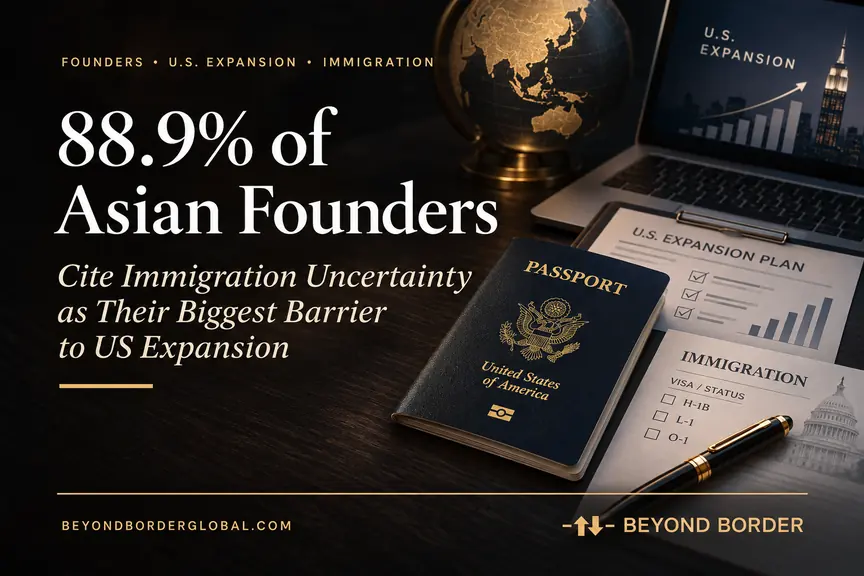
Asian Founder Mobility Pulse survey revealed that 88.9% of founders consider the immigration uncertainty as a barrier for their US expansion. There is a disconnect between the ambitions of Asian founders to expand their businesses to the US and their immigration planning. Many of them are interested in entering the US market but are not clear on which visa is best for them and their circumstances.
Customer access drives US expansion plans
Our survey revealed that access to customers is the top reason that Asian founders are considering expanding into the United States. Roughly 85% of respondents listed customer access as a reason for wanting to enter the US market.
Timeline data for when respondents plan to expand to the US also shows serious interest. Roughly 59.9% of respondents plan to expand to the US within the next 12 months, and 25.1% plan to expand to the US within the next 12 to 24 months.
These numbers suggest that US expansion is not a remote goal for many founders and that a significant portion of them are planning to pursue US expansion within a set timeframe.
The fact that many founders are business ready does not mean that they are also immigration ready. Many of them have a target market, a growth strategy and customers in the US but are not clear on the legal means to establish themselves in the US or to operate a business in the US.
Visa uncertainty leaves founders without a clear route
Approximately 55% of the Asian founders surveyed were unsure of which visa pathway was best suited for their circumstances.
For founders, the uncertainty can make it difficult to plan. For example, a founder could be deciding whether to move to the US himself, to send a team member to the US to set up a presence for the company, to set up a presence in the US for the company to operate, or to manage the company from Asia as he currently does. Each of these decisions would involve different immigration considerations.
While each of the surveyed founders had a unique business, different backgrounds, achievements and plans for expansion, it was clear that immigration planning was a significant concern for the majority of respondents.
Identifying the best pathway early on can help founders understand what evidence they will need to collect and prepare for in order to execute on their business plans.
Founders often research immigration too late
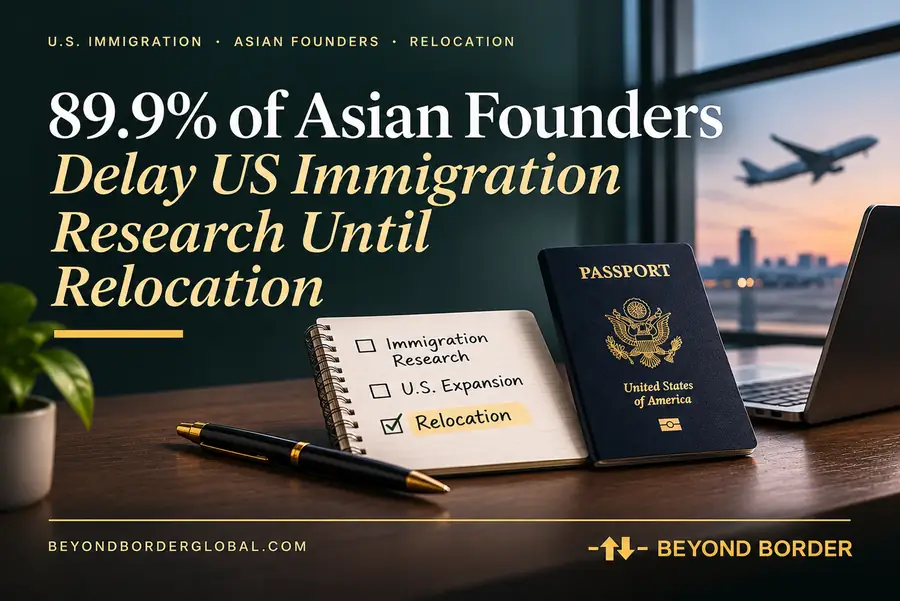
Another finding is that Asian founders tend to wait until they are ready to relocate to the US before researching the US immigration options.
This results in a mismatch between business planning and immigration planning, as founders typically spend months researching the customers, funding, partnerships and market opportunities in the US, before turning their attention to the visa application process.
The time it takes to research the options, as well as the preparation required for the various visa applications, means that there is a risk that founders will run out of time to put together a strong application by the time they are ready to relocate.
Thus, our research underscores the importance of founders to start researching the different immigration pathways early on in their US expansion planning. This will allow them to assess the various requirements of different visa categories while they are still in the process of developing their US expansion plans.
Interest in O-1 and EB-2 NIW pathways
The proprietary data from our internal system also highlights the various employment-based immigration categories that are being explored by founders and other professionals.
Among 1,140 Asia-based enquiries for which we have recorded a visa preference, 510 were for the O-1 visa category (approx. 50% of the total). EB-2 NIW accounted for 247 enquiries (approx. 21.7% of the total) and 241 individuals (approx. 20% of the total) were unsure of the best pathway for them.
The above figures are taken from our internal proprietary data and are based on the enquiries received by our team. As such, the figures are for enquiries only, and are not reflective of applications or approvals. Furthermore, the above figures are for Asia-based enquiries only, and as such are not reflective of the visa preferences of founders as a whole.
However, the above figures do show that individuals who are exploring US opportunities are considering a number of different immigration routes.
What has changed in the last three months
The above data was collected prior to several recent changes in the US immigration system. These changes further highlight the importance of early preparation.
O-1 petitions being handled more strictly. Since August 5, 2026, USCIS officers can deny a petition without first issuing a request for evidence. On October 14, 2026, DHS also proposed ending the regulation that requires officers to defer to earlier approvals in later petitions involving the same parties and facts. Founders who have held an O-1 before should therefore not assume a renewal will be straightforward.
For context, USCIS data shows 21,321 O petitions approved and 2,096 denied between October 2025 and June 2026, so most petitions are still approved. Because officers can now deny without first asking for more evidence, the initial filing needs to be well documented.
EB-2 is no longer “Current” for most countries. The October 2026 Visa Bulletin was the first of fiscal year 2027. It moved EB-2 for most countries from Current back to January 1, 2025. An EB-2 NIW petition filed now gets a priority date after March 15, 2026, the cutoff for filing.
For October, USCIS accepted employment-based green card applications under the Dates for Filing chart. In practice, new filers outside China and India generally cannot file the green card application together with the I-140 petition at this time.
October 2026 Visa Bulletin: EB-2 Retrogresses as FY 2027 Begins
Small movement in November. The November 2026 bulletin moved the EB-2 date forward by three months, to April 1, 2025, for applicants outside China and India. China stayed on October 1, 2021 and India on November 1, 2013. EB-1 remained current for most countries. Founders weighing EB-2 NIW against other employment-based options should compare these dates for their own country of birth.
Long processing times. For regular-processing NIW I-140 petitions, USCIS reports that 80% are completed within 30 months as of early October 2026. Premium processing is completed within 45 business days for a fee of $2,965.
The O-1 is a temporary work visa and is not subject to the green card queue in the Visa Bulletin. For founders who need to be in the US sooner, this is one reason O-1 enquiries may be attractive. The two routes work differently, and the right choice depends on each person’s evidence and goals.
Immigration planning needs to start earlier
Our research highlights a clear difference between the desire to expand into the United States and confidence about how to make that move.
With 88.9% of surveyed founders identifying immigration uncertainty as a barrier, visa planning deserves attention alongside customer research, market entry and business development. Recent changes in how petitions are reviewed and how green card dates move add to that case.
Founders should not wait until relocation becomes urgent to understand their options. Starting earlier gives them more time to review relevant pathways, assess their individual circumstances and prepare supporting evidence.
While the survey data does not necessarily demonstrate that immigration uncertainty is a barrier to the expansion of all Asian startups to the US, it does highlight the extent of the uncertainty amongst those startups that are considering expansion to the US market. Resolving this uncertainty as early as possible can be integrated into the business strategy of Asian startups with expansion plans.
Disclaimer: The survey data and the number of enquiries reported in this article are taken from our internal proprietary data and the Asian Founder Mobility Pulse survey. The data relates to the respondents and enquirers included in our dataset and may not be representative of all Asian founders. This article is not intended to be a substitute for professional legal advice and you should seek advice from a qualified immigration attorney regarding your specific circumstances.
Frequently Asked Questions
88.9% of Asian founders cited immigration uncertainty as a barrier to US expansion, with 55% unsure which visa pathway would be best suited to their circumstances.
The main reason why Asian founders are looking to expand to the US is to gain access to customers. Around 85% of founders surveyed said that they wanted to expand to the US for this reason. Most planned to expand within 12 months (59.9%) and another 25.1% within 12 to 24 months.
Early. As the graph above shows, 89.9% of founders wait until they are ready to relocate to research visa options. This means that there is little time to understand the various visa options and to gather the required evidence for an application.
The O-1 category accounted for 510 out of 1,140 Asia-based enquiries (about 50%), EB-2 NIW was the second most popular with 247 enquiries (about 21.7%) and 241 people (about 20%) did not know which pathway to choose. These are based on the enquiries received by our firm and are not application rates nor are they based on founders only.
USCIS can now deny petitions without first issuing a Request for Evidence (RFE). EB-2 has moved from Current to a January 1, 2025 cutoff for most countries and has now moved to April 1, 2025 as of November 2026. The O-1 is a temporary work visa and is not subject to the green card queue. This is general information as of November 13, 2026 and is not legal advice.