Your green card has two numbers, and they are not interchangeable. The number on the front labelled “USCIS#” is your A-Number and it identifies you. The 13-character number on the back is the document number, and it identifies the card itself. Use the one required by the form. Beyond Border attorneys have collectively handled 4,000+ immigration cases across O-1, L-1, EB-1 and NIW categories, from the first petition through to the card itself.
USCIS number, A-Number, alien registration number and alien number all refer to the same thing. According to the July 2023 edition of USCIS’s Handbook for Employers (M-274), the USCIS Number is the same as the A-Number without the ‘A’ prefix. Whether your card shows A123456789 or 123456789, it is the same identifier. “Green card number” is different. Most of the time, it means the document number on the back of your green card.
On the front, you will find your photo, name, date of birth, country of birth, a category code, the card expiry date, and the number labelled "USCIS#". Newer card designs sometimes print this number without the "A" prefix. It is the same number either way.
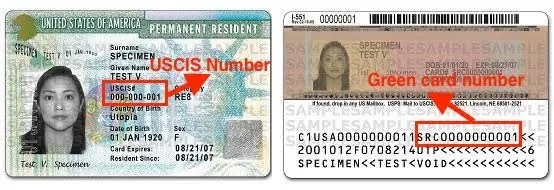
On the back, you will find the document number near the block of machine-readable text along the bottom. It is the longest combination of letters and digits on the card.
Card designs have changed several times, and the layout on your card may not match the layout in the image used below. USCIS has redesigned the Permanent Resident Card more than once, so older cards may place the document number in different positions on the back.
Both a document number and a USCIS receipt number are 13 characters: three letters, followed by 10 digits. The number begins with three letters, which indicate the service centre handling the case, while IOE represents a case that was filed electronically;
Format alone cannot tell you which number you are holding. Identify it by where you got it, not by what it looks like. A 13-character number printed on the back of your card is a document number. A 13-character number on a Form I-797 notice is a receipt number for one specific filing. The two can look identical but are not interchangeable.
International check-in systems collect travel documents before departure. Oftentimes, there’s an empty field marked “document number.” Match the field to the format, not the label. A field expecting 13 characters of letters and digits requires your green card number on the back. A field expecting seven to nine digits is asking for the USCIS number on the front.
Oftentimes, they may also want passport details rather than green card details. This is because a passport is the travel document and the green card is proof of your status on arrival. If the form asks for an issuing country, an expiry date and a nationality alongside the number, it is describing a passport.
Your A-Number never changes. It remains the same through renewals, replacements, a name change, removal of conditions on a two-year card, and naturalization. USCIS assigned it as your identifier throughout your immigration process.
But your document number changes every time USCIS issues you a new card, because it identifies the card, not you. In practical terms, if you have a number from an old card and a form rejects it, it may be because you are using an old document number. On the other hand, any information submitted with your A-Number remains accurate and will never expire.
There is no public USCIS tool that will look up your green card number or your A-Number from your name and date of birth. Your A-Number is the recoverable one. It appears on your notices, immigrant visa, and in a USCIS online account. Your document number appears only on the card itself, which is why it’s difficult to work around a lost card.
The identifiers on your card trace back to the petition that produced it, and they follow you into every filing that comes after it. Our attorneys work with clients from the first petition through to the card itself, and can confirm which number belongs on a renewal, a naturalization filing, or a petition for a family member. Begin your immigrant journey today. Schedule a consultation with Beyond Border.
On the back, near the block of machine-readable text along the bottom. It is 13 characters long, three letters followed by 10 digits, and it is the longest run of letters and digits on the card. Older card designs place it differently, so check your own card.
No. The USCIS number printed on the front is your A-Number, which identifies you. The green card number, also called the document number, is the 13-character code on the back that identifies the physical card.
The document number on the back is 13 characters: three letters followed by 10 digits. Your USCIS number on the front is seven to nine digits, sometimes shown with an "A" prefix.
Yes, your document number does, because every new card has a new number. Your A-Number does not, and never will.
The three letters identify the USCIS facility that handled the filing; IOE means the case was filed electronically. The same prefixes appear on receipt numbers, which is why a card number and a receipt number can look identical.
For Section 1, enter your seven- to nine-digit A-Number or USCIS Number. Section 2 is completed by your employer, and there is no specific number to enter, so employers should work from USCIS I-9 Central directly.

Address: 4 W 4th Ave, San Mateo, CA 94402, United States
Email: info@beyondborderglobal.com