Many people who receive Form I-797 do not know what it means for their case. This confusion makes sense because USCIS sends up to 7 different versions, and each means something different. For example, one proves an approval, another replaces a lost I-94, and only one confirms USCIS received a filing.
Below, we explain every version of Form I-797, alongside what to do if a notice gets lost, and the most common problems that show up on these notices.
Form I-797 is a notice USCIS issues that lets the person who filed a case know that USCIS has taken some action on their application or petition. USCIS handles thousands of petitions. For each one, USCIS must inform the person who filed it. Form I-797 makes this communication possible.
Without Form I-797, a petitioner would not know if their case has moved forward or if USCIS needs information. This notice keeps the process open and clear, even when the actual review happens in the background.
Every I-797 notice has a header that shows the form type, notice type, and mailing date. Near the top of the notice, you will find a receipt number with 13 characters. It begins with three letters and ends with ten numbers. You can use this receipt number to track your case in the USCIS online status tool.
Each type of I-797 does a different job. Knowing which one you received tells you where your case is and what to do next.
This is the base version. USCIS sends it when it approves a petition or application. It serves as official evidence of the benefit granted.
The I-797A has a tear-off section at the bottom that acts as an I-94. USCIS issues the I-797A after it approves an extension or change of status for someone already in the United States. The attached I-94 shows the person can stay in the country and begin working under their new status right away.
USCIS sends the I-797B when it approves a petition for someone who still has to finish processing. This can apply to people abroad or still in the U.S. Learn how the processing steps work in 2026.
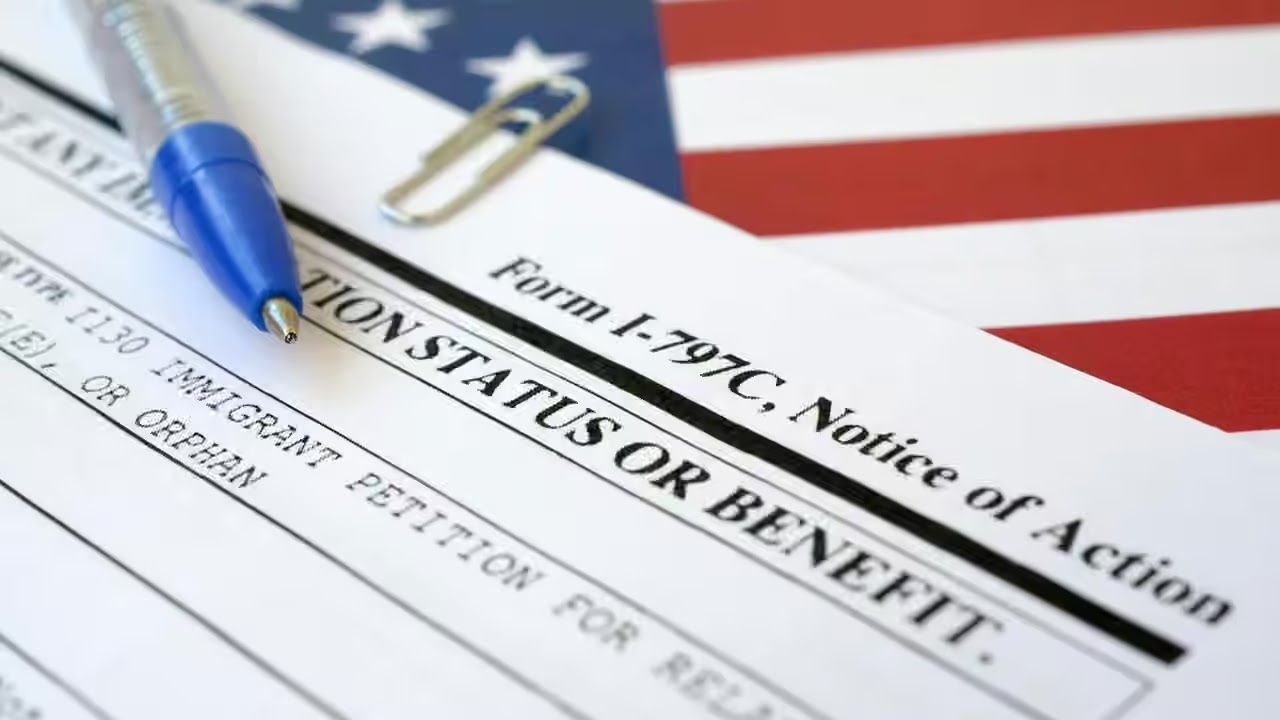
Form I-797Ccovers the receipt of a filing, rejection, transfer of the case, reopening, or scheduling of an appointment. It is not an approval by itself. The receipt number on the I-797C is the tracking number for all future updates. This form usually arrives within two to three weeks after filing.
The I-797D is a cover letter that comes in the envelope with a mailed card or Employment Authorization Document. It has no legal standing on its own.
The I-797E is the Request for Evidence. It means USCIS has reviewed the application and needs documents before making a decision. This is not a denial. However, failing to respond by the deadline can result in a denial.
USCIS issues the I-797F to permanent residents abroad who have lost, stolen, or damaged their green card. This letter helps them board a flight back to the U.S. To get an I-797F, you must first file Form I-131A. The I-797F does not guarantee entry into the United States. U.S. Customs and Border Protection still makes the decision at the border.
An approval notice proves something happened. It does not automatically show what you can do next.
An I-797 approval notice is neither enough for international travel nor a replacement for a visa stamp. It confirms USCIS approved something. The type of I-797 you have changes what happens next.
One exception is called automatic visa revalidation. For most nationalities, presenting an expired visa stamp with a current I-797 approval notice can support reentry from contiguous territory or adjacent islands. This does not apply to nationals of Cuba, Iran, Iraq, Libya, North Korea, Sudan, or Syria.
An I-797 approval notice usually does not prove work authorization on its own for Form I-9. The temporary COVID-19 rule that allowed certain I-797 notices to serve as List C documents ended in February 2021.
Form I-797 can still support employment verification when used with another qualifying document. For example, certain conditional permanent residents can use an I-797 with an expired green card to show continued employment authorization.
The I-94 attached to an I-797A is the real proof of status. It shows the authorized period of stay and the date a new status begins. Someone changing employers or extending status inside the U.S.can start working on that new status as soon as the I-94 takes effect.
Replace a lost I-797 before you need it again. Here are the two options that exist.
This is often the fastest option. Call the USCIS Contact Center at 1-800-375-5283 with your receipt number ready. A representative can sometimes issue a replacement without any form. An online case inquiry through a USCIS online account can produce the same result. This route works best when you already know the receipt number. See how to check I-129 receipt and approval status.
Form I-824 is the formal option when a direct call doesn't resolve it. It costs US$590 and has its own processing time, so it's worth trying the faster route first. I-824 cannot be used to check a pending case's status, only to request further action on something USCIS has already approved.
Most I-797 problems fall into one of three patterns.
A rejection notice, sent as Form I-797C, means USCIS never opened the case. Common causes include a missing signature, an incorrect fee amount, an outdated form edition, or missing supporting documents. To fix it, correct the issue noted in the notice and refile.
An I-797 with an incorrect name, date, or classification is a real problem, and not one to fix informally. The correction process is to provide:
USCIS will then review and issue a corrected notice if it confirms the error. That review typically takes 2 to 4 weeks. Do not begin work if the notice dates are wrong. Working on incorrect authorization dates is treated as a status violation, even if USCIS made the mistake.
A receipt notice that never shows up weeks after a confirmed filing often means USCIS rejected the petition for a technical reason and never began processing it. The fastest way to confirm what happened is to check the USCIS case status tool with a receipt number.
If no receipt number exists, the next step is to contact whoever filed the case, whether that's an employer's HR team or the attorney of record.
Every employer-filed nonimmigrant petition, whether H-1B, L-1, or O-1, moves through the same I-797 sequence.
An H-1B petition starts the same way any I-129 filing does:
Our H-1B status check guide covers how to read each stage of this sequence using the receipt number alone.
An I-797 notice often marks an important stage in an employment-based immigration case. For O-1 and L-1 petitions, it may relate to a Form I-129 filing, while EB-1A and EB-2 NIW applicants may receive one in connection with Form I-140.
At Beyond Border, we focus exclusively on O-1, L-1, EB-1A, and EB-2 NIW pathways. Our network of specialist U.S. immigration attorneys can review a notice in the context of your petition, explain what USCIS is communicating, and advise on next steps.
Book a free consultation to review an I-797 connected to an employment-based visa or green card case.
No. Form I-797 is a notice. It confirms USCIS took some action on a case. The notice does not replace a visa stamp.
I-797A is an approval notice that has a tear-off I-94. You receive it after an approved extension or a change of status. Form I-797C is a general notice used for receipts, rejections, transfers, and appointments.
No. An I-797 shows that something was approved, but it does not replace a visa stamp. The I-797A includes an I-94, which can help with reentry when used with a visa stamp for the same status. The I-797B does not include an I-94, so you need a new consular visa stamp before traveling.
Sometimes. If the petition was submitted electronically through a USCIS account, you can usually get a PDF copy from that account. For notices linked to a paper filing, this option usually isn't available, so you'll need to request a duplicate instead.
A Notice of Action has 13 characters. It has 3 letters followed by 10 numbers. It is near the top of every I-797 notice. It is the exact number needed to check a case status online.
No. An I-797C receipt notice shows that USCIS received a filing and gave it a receipt number. It does not show approval, and it does not prove immigration status on its own.

David Munam is an experienced writer with 10 years of expertise in researching and producing clear, authoritative content on complex and highly technical subjects. His work has focused on turning dense information into accurate, well-structured, and accessible content across areas such as U.S. customs and trade, Web3, fintech, immigration law, and technology. At Beyond Border, he applies this experience to researching and writing in-depth content on U.S. immigration pathways, including O-1, EB-1A, and EB-2 NIW.

Address: 4 W 4th Ave, San Mateo, CA 94402, United States
Email: info@beyondborderglobal.com