
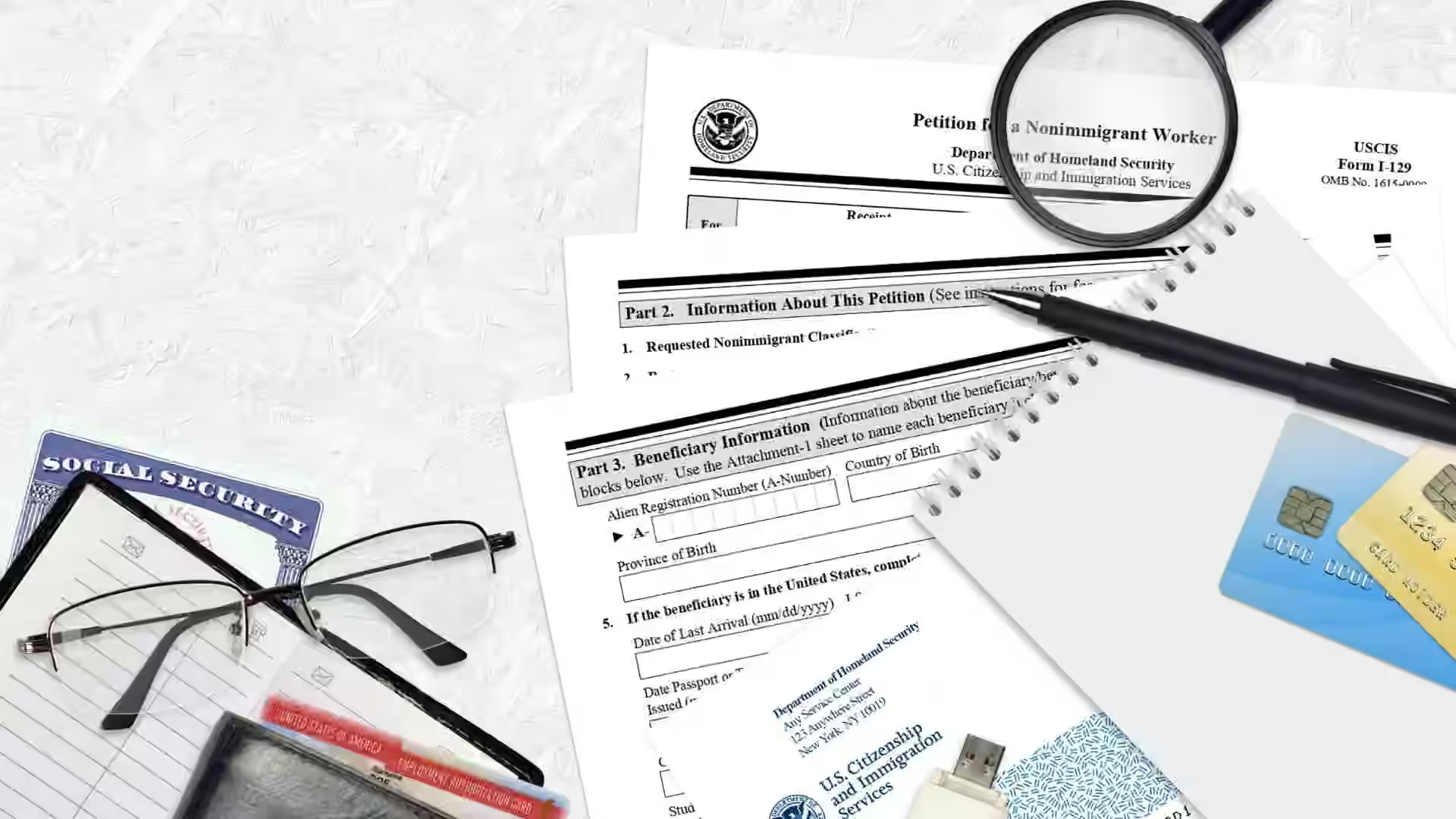
If you’re a U.S. employer planning to hire a foreign worker for a temporary job, you’ll need to submit Form I-129, formally known as the Petition for a Nonimmigrant Worker.
It’s the standard petition USCIS requires for most work-sponsored nonimmigrant visas, including H-1B speciality occupations, L-1 intracompany transfers, and O-1 visas for individuals with extraordinary ability.
In this guide, we’ll break down everything you need to know about Form I-129: the visa categories it covers, the fees involved, processing times, and what to expect once your petition is approved. Beyond Border attorneys have handled over 4,000 employment-based cases and regularly file O-1 and L-1 petitions. We created this guide using that hands-on experience.
Form I-129 is an official document a U.S. employer files with USCIS to sponsor foreign workers for temporary non-immigrant work visas. The petitioner is the employer, and this can be a company a Founder owns and files through.
The base form is 36 pages and asks basic information about the employer, the job offer, and the foreign worker. Most categories need a visa-specific classification supplement, and you can submit the package online or by mail.
Form I-129 classifications are split in three ways;
How you file the Form I129 depends on your visa classification;
H-1B petitions need a Labor Condition Application certified by the Department of Labor and signed by the petitioner. They also need evidence the position qualifies as a speciality occupation, and the beneficiary can perform it. H-2B petitions need the H Classification Supplement and an approved temporary labor certification.
New-office L petitions have different evidence requirements than established-office petitions. For L-1A, that includes evidence that the petitioner has obtained a physical location appropriate for the work.
It also requires evidence that the U.S. operation will support an executive or managerial position within one year of approval. For L-1B, it's the same location evidence plus proof the petitioner can pay the beneficiary and start doing business.
For Blanket L, Form I-129 and Form I-129S must be filed together, and USCIS can reject Form I-129 if it does not include Form I-129S.
O-1 petitions need one from a peer group, labor organization, or management organization with expertise in the field. Petitions for extraordinary achievement in motion picture or television need separate consultations from both the labor and the management organizations.
O-2 petitions only apply alongside an O-1. Meanwhile, P-1B group petitions have a rule many miss: at least 75% of the group members must have worked together continuously for at least a year.
E-1, E-2, E-3 and TN have the shortest evidence lists on the form, and E-3's is a single line: evidence the beneficiary maintained status. That reflects what the form does for them, not a lighter standard, because the substantive showing happens at a consulate or the border.
Part 6 certifies the release of controlled technology to foreign persons, and it covers only four classifications. USCIS requires it for "H-1B, H-1B1 Chile/Singapore, L-1, and O-1A," and states it "is not required for petitions for all other classifications, including but not limited to blanket L petitions (LZ)." So an O-1B petition skips Part 6 and an O-1A petition does not.
The Form I-129 filing fee depends on the visa category and the employer size;
These fees do not include premium processing or legal fees. Use our USCIS Fee Calculator to estimate your total costs.
USCIS currently accepts only the 02/27/26 edition of Form I-129. Starting April 1, 2026, USCIS will reject any petitions submitted on the older 01/20/25 edition.
Keep in mind that USCIS bases this on when they receive your package, not when you mail it. Even if you post your filing well in advance, courier delays could push its arrival past the deadline and result in a rejection.
Another common mistake is mixing pages from different editions. USCIS requires every page in your submission to come from the exact same form edition. So combining a saved 2025 supplement with a new 2026 cover page will cause USCIS to reject your petition.
Four other common mistakes can cause your petition to be rejected immediately:
Double-check these five details before mailing your package.
Standard processing time for I-129 petitions is from 2 to 12 months, depending on the USCIS service center handling your case and your visa classification. You can check current processing times on the USCIS processing time tool.
For faster processing, you can file Form I-907 to request premium processing. USCIS guarantees an action in 15 business days for most visa classifications.
Premium processing is available for E-1, E-2, E-3, H-1B, H-2B, H-3, L-1A, L-1B, blanket L, O-1, O-2, the P classifications and their support personnel, Q-1, R-1, TN-1 and TN-2.
But it does not apply to H-2A, H-1B1 Chile/Singapore, and E-2C. It also excludes any petitioner requesting a change of status or an initial grant of status for workers in the Commonwealth of the Northern Mariana Islands.
The 15-day timeline works differently. It starts once a complete Form I-907 arrives at the right doc, and any request for evidence or notice of intent to deny stops and resets the clock. Essentially, premium processing guarantees a fast initial response, not a final decision.
An "action" can be an approval, a denial, a request for evidence (RFE), or a notice of intent to deny. Learn more in our guide to USCIS premium processing.
For a breakdown of timelines by category, see our I-129 processing time guide.
If you file your extension request before your current status expires, you can keep working for the same employer for up to 240 days while USCIS processes your application, as provided under 8 CFR 274a.12(b)(20).
This automatic extension applies only to work with the same employer under your existing job terms, and it ends immediately if USCIS denies your petition during the 240-day window. It covers workers in E-1, E-2, E-3, H, L-1, O-1, O-2, P, R-1, and TN status.
Timing is critical here. If you file even one day after your status lapses, you lose this benefit entirely and cannot work while waiting for a decision.
Your dependents can also extend their stay alongside you. When an H-4 or L-2 spouse or child files Form I-539, USCIS will process it together with your Form I-129 as long as both applications are packaged and submitted at the same time and location.
When USCIS approves a Form I-129 petition, it issues a Form I-797, Notice of Action. This document serves as official proof of your approved status and is important for your next steps.
You’ll use the approved I-797 in two ways: If you are currently outside the U.S., you will present it at the consulate to get your visa stamp. If you are in the U.S., it proves your status has been extended or changed.
Keep the original I-979 safely. Employers and beneficiaries alike will need it for future visa extensions, status changes, or permanent residency applications like an I-140 green card petition.
It’s easy to confuse Form I-129 with Form I-140 since both involve employer-sponsored petitions, but the key difference is the visa type each supports.
Form I-129 is for temporary nonimmigrant work visas. It’s for limited work authorization in the U.S. and is mostly used for classifications like O-1, L-1, and H-1B. Form I-140, on the other hand, is the Immigrant Petition for Alien Workers, and is for permanent residency (a green card). It usually indicates the first major step to living and working in the U.S. permanently.
Many workers begin with an I-129 visa and later move to an I-140 petition to get their green card. For more detail, see our Form I-140 guide.
To submit a complete Form I-129, include key supporting documents with the form. Required evidence depends on your visa classification. Every package includes Form I-129 and its category supplement, but additional documents vary by category.
For instance, H-1B filings need a certified Labor Condition Application (LCA) from the Department of Labor, whereas O-1A petitions require proof of extraordinary achievement, such as awards, publications, or a high salary.
Because requirements are case-specific, working with an immigration attorney helps ensure you submit the correct paperwork. Filing addresses also depend on the visa type and petitioner location, so check the official USCIS I-129 instructions before mailing your petition.
Form I-129 is for employer-sponsored temporary work visas only. Do not use it for green card petitions (use Form I-140), self-petitions, or visa applications for spouses and children (use Form I-539). Knowing which form to use prevents unnecessary processing delays.
All Forms I-129 are filed at a USCIS lockbox facility based on the visa category and processing time.
Use these filing locations only when filing Form I-129 for E-1, E-2, and E-2C classifications and Form I-907 together.
Use these filing locations only when filing Form I-129 for E-1, E-2, and E-2C classifications alone without premium processing.
Beyond Border prepares and files I-129 petitions in the O-1 and L-1 classifications. Our attorneys have collectively handled 4,000+ employment-based cases, and we use these filing mechanics for every O-1 and L-1 petition.
If your plan currently runs through the H-1B, you may want to compare it to the O-1 visa based on the facts. The O-1 is not subject to the annual numerical limit, is not selected by registration lottery, and falls outside the cap-subject population.
Review the O-1 criteria and book a free assessment with our attorneys.
The petitioner signs, which is the employer. USCIS will not accept a signature by an attorney, representative, or family member on the requestor's behalf.
Not as an individual. The petitioner is an employer, though that can be a company you own and file through, which is how many Founders reach the O-1 or L-1.
Form I-129 is an employer's petition for a temporary worker. Form I-129F is a petition for a fiancé(e). They share a number and nothing else.
No. It changes how quickly USCIS acts, not whether the 240-day authorisation applies, and that depends entirely on filing before status expires.
Processing times vary by classification and service centre, and figures change monthly. See our I-129 processing time guide.

Address: 4 W 4th Ave, San Mateo, CA 94402, United States
Email: info@beyondborderglobal.com


