The L-1 visa was specifically designed to facilitate international business expansion by allowing multinational companies to transfer established employees to new or existing U.S. operations. For companies entering the U.S. market, the new office provision enables transferring the leadership and specialized talent needed to build a functioning operation from the ground up, without relying on the H-1B lottery or hiring exclusively from the local market before operations are established. Beyond Border is an immigration firm specializing in L-1A and L-1B petitions and structures new office launch team cases from the corporate relationship documentation through the first-year extension.
[Check the USCIS processing times page for current L-1 petition processing estimates, as USCIS updates these weekly.]
The L-1 visa addresses a structural challenge in international expansion: the employees who best understand a company's operations, culture, and proprietary systems are already employed abroad, and getting them to the U.S. quickly matters for launch timelines.
Unlike H-1B, which requires annual lottery participation with selection rates of 25% to 35%, the L-1 carries no cap and no lottery. Companies can select which employees to transfer based on business need rather than random selection. L-1 also permits strategic team deployment: multiple employees can be transferred simultaneously under individual petitions or, for qualifying companies, under a blanket petition.
L-1 holders carry dual intent, meaning pursuing a green card simultaneously with L-1 status does not jeopardize the visa. This matters for long-term U.S. office building because executives and key employees who expect to stay long-term can begin green card pathways without affecting their L-1 authorization.
For a comparison of L-1 and H-1B across cap, lottery, prevailing wage compliance, and timeline, see the L-1 vs H-1B guide. For the full L-1 overview including all eligibility categories, see the L-1 visa explained guide.

A well-structured launch team combines L-1A and L-1B categories to provide both operational leadership and specialized execution capability.
L-1A visa holders must be executives or managers. For a launch team, appropriate L-1A roles include the Country Manager or CEO responsible for directing U.S. operations, a VP of Sales or Business Development establishing market presence, or a COO or operations lead building infrastructure. L-1A status allows a maximum total U.S. stay of seven years and provides a direct path to the EB-1C green card after one year with the U.S. company.
L-1B visa holders must have specialized knowledge: a level of expertise in the company's products, processes, methodologies, or systems that is proprietary and not readily available in the U.S. labor market. For a launch team, appropriate L-1B roles include product specialists who understand the company's proprietary platform, implementation engineers familiar with company-specific technical systems, client relationship managers who carry institutional knowledge from existing foreign client relationships, or methodology specialists who train U.S. staff in company processes. L-1B status allows a maximum total U.S. stay of five years.
A typical launch team involves one to three L-1A executives or managers combined with two to five L-1B specialists. The L-1A holders establish direction and authority; the L-1B holders provide the specialized execution capability that differentiates the operation from generic U.S. hires.
For guidance on what specifically qualifies as an executive or managerial role for L-1A purposes, see the L-1A visa for executives guide.
New office L-1 petitions face heightened scrutiny because there is no U.S. track record. USCIS examines every element of the filing more closely than for established operation transfers.
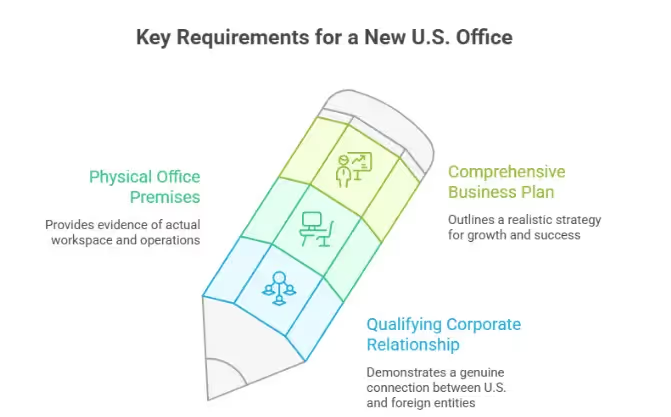
The U.S. entity must have a qualifying relationship with the foreign entity: parent, subsidiary, affiliate, or branch. The ownership chain must be documented completely including any intervening holding companies. Both entities must be actively doing business; a foreign company that exists primarily to support the U.S. visa application rather than as a genuine operating business does not qualify.
USCIS requires evidence of genuine physical business operations. An executed commercial lease with at least a 12-month term, office photographs showing actual workspace, floor plans showing adequate space for the planned operations, and building access documentation all support this requirement. Executive suites and coworking spaces with dedicated desk arrangements are generally acceptable when accompanied by formal documentation of the arrangement. Virtual offices and mail forwarding arrangements alone are not sufficient.
The business plan is among the most important documents in a new office petition. USCIS evaluates whether the stated expansion is realistic and whether the U.S. entity will grow beyond the initial transferees. A credible business plan includes: market analysis and competitive landscape for the U.S. market; a description of the product or service offering in the U.S. context; revenue projections with supporting assumptions; a hiring plan showing a timeline for adding U.S. workers as operations scale; marketing and sales strategy; and a 12-month operational milestone plan.
The hiring plan is particularly critical. USCIS wants to see that the company intends to build a U.S. workforce beyond the initial L-1 transferees. A business plan that shows the U.S. operation will be staffed exclusively by L-1 holders indefinitely raises concerns about the genuineness of the U.S. business.
USCIS evaluates whether the company has committed adequate capital to sustain U.S. operations through the launch period. There is no fixed dollar threshold; adequacy is evaluated relative to the scope of the business plan. For most new office petitions, documented capital transfer or available funding equivalent to 12 to 24 months of projected operating expenses is appropriate. Evidence includes bank statements showing transferred capital, investment agreements, or documented commitments from the parent company.
For a practical new-office example, see our L-1A case study on a French startup that relocated its CEO without an RFE.
Year One: Building the foundation
The initial new office L-1 petition is approved for one year, regardless of what the petitioner requests. This is a fixed USCIS policy for all new office cases, distinct from the three-year initial approval for established offices.
Standard L-1 processing runs 3 to 8 months. Premium processing via Form I-907 costs $2,965 effective May 1, 2026 and guarantees USCIS action within 15 business days, which is strongly recommended for launch team filings where business timelines depend on predictable arrival dates.
Before the first year expires, the company must file extension petitions. Extension petitions must demonstrate that the U.S. office has developed into a genuine operating business. The evidence package should include: financial statements showing revenue activity (even if modest); documentation of U.S. employees hired; evidence of client acquisition or active service delivery; and evidence that the L-1A holders are performing genuine managerial or executive functions rather than operational or technical work.
Extension approval and maximum duration
Approved extensions are granted in two-year increments. L-1A holders can extend up to a maximum of seven years total. L-1B holders can extend up to a maximum of five years total. These maximums include the initial one-year new office period.
File extension petitions 9 to 10 months into the initial approval period to allow adequate USCIS processing time. For the full extension process and documentation requirements, see the L-1 visa extension guide.
For companies with larger international operations, the L-1 blanket petition allows pre-qualified companies to transfer multiple employees through a streamlined individual application process, bypassing the individual I-129 petition filing for each transferee.
Blanket qualification requirements:
A U.S. company qualifies for blanket if it meets any of the following: has at least three domestic or foreign branches, subsidiaries, or affiliates; combined annual sales of all entities total at least $25 million; or the U.S. employer has at least 1,000 employees. Additionally, the company must have obtained at least 10 individual L-1 approvals in the past 12 months, or the U.S. subsidiaries and affiliates must have combined annual sales of at least $25 million.
How blanket benefits launch teams:
With an approved blanket petition, individual employees apply directly at the U.S. consulate with Form I-129S (individual certificate) rather than waiting for USCIS to adjudicate a full I-129 for each person. This eliminates the 3 to 8-month USCIS processing timeline for each individual, allowing companies to transfer employees quickly in response to business needs.
A single blanket petition covers unlimited transfers over its three-year validity period. The base blanket petition fee is $695 for a small employer, compared to individual petition fees of $1,385 or more per petition. For companies planning multiple transfers over time, blanket reduces both cost and administrative burden significantly.
L-1A holders: EB-1C pathway
L-1A managers and executives have a direct path to the EB-1C green card after the U.S. entity has been operating for at least one year. EB-1C requires no PERM labor certification, the same qualifying executive or managerial standard as L-1A, and documentation of the corporate relationship between U.S. and foreign entities. This is the fastest employment-based green card route for qualifying executives and is available once the new office has established the one-year operations threshold. For the full EB-1C eligibility framework, see the EB-1C requirements guide.
L-1B holders: EB-2 or EB-3 pathways
L-1B specialized knowledge workers typically pursue EB-2 PERM or EB-3 for permanent residence. Both require employer sponsorship and completion of the PERM labor certification process, which adds 15 to 20 months to the timeline. For the full L-1 to green card pathway analysis, see the L-1 visa to green card guide.
For launch team members from India or China, priority date backlogs in EB-2 and EB-3 significantly extend the total green card timeline. Filing I-140 petitions as early as qualification permits establishes the earliest possible priority dates and protects status during the waiting period.
Beyond Border is an immigration firm focused on employment-based high-skilled visa and green card pathways including L-1A and L-1B. For new office launch team cases, the firm advises on qualifying corporate relationship documentation, business plan structuring to meet USCIS scrutiny standards, team composition and role analysis to confirm L-1A versus L-1B eligibility, physical premises documentation, and extension strategy from the start of the initial one-year period.
Clients include executives and professionals from Google, Salesforce, JP Morgan, Chime, Visa, and Mastercard. A money-back guarantee applies if the petition is unsuccessful. Petitions are submitted within one month of receiving all supporting documents.
To discuss your company's L-1 launch team strategy for 2026, book a free consultation with Beyond Border.
Yes, foreign companies can use the L-1 visa specifically to transfer employees to establish new US offices. The L-1 new office provision allows companies to send executives, managers, and specialized knowledge workers to launch US operations with an initial 1-year approval.
No specific limit exists. Small launches use 1-3 employees (1 L-1A leader + 1-2 L-1B specialists); medium launches use 4-7 employees; large launches use 8+ employees. Companies meeting L-1 Blanket requirements can transfer unlimited qualifying employees with streamlined processing.
New office L-1 requires a qualifying corporate relationship between foreign and US entities, adequate physical office premises, a comprehensive business plan demonstrating realistic expansion, and sufficient financial commitment (typically $50,000–$150,000+, depending on the business scope). Initial approval is limited to 1 year.
Standard processing takes 2-4 months from the date of filing. Premium processing available for $2,965 guarantees a 15-day decision. Total timeline, including preparation, is 4-6 months. Plan 2-3 months pre-filing for entity formation, lease execution, and business plan development.
File extension at 9-10 months showing progress: office established, revenue generated, US employees hired, business plan executed. Extensions granted in 2-year increments up to 7 years total (L-1A) or 5 years (L-1B) if continued need is demonstrated.File extension at 9-10 months showing progress: office established, revenue generated, US employees hired, business plan executed. Extensions granted in 2-year increments up to 7 years total (L-1A) or 5 years (L-1B) if continued need is demonstrated.
Yes, L-1A managers/executives can pursue an EB-1C green card after 1 year with a US company without labor certification. L-1B specialists typically require PERM for EB-2/EB-3. Most launch team members file green cards 12-24 months after L-1 approval once the US office is established.
USCIS expects minimal revenue for new offices. Focus on demonstrating a realistic path to sustainability through the client pipeline, letters of intent, partnership agreements, and adequate funding for a 12-24 month ramp-up period. Show progress markers beyond just revenue.
Physical premises required but flexible arrangements accepted: executive suites, coworking space with dedicated desks, sublease arrangements, shared office with clear access rights. Pure virtual offices (PO boxes, mail forwarding) are generally insufficient without substantial physical operations.
How much does it cost to transfer the launch team on L-1?


Address: 4 W 4th Ave, San Mateo, CA 94402, United States
Email: info@beyondborderglobal.com