
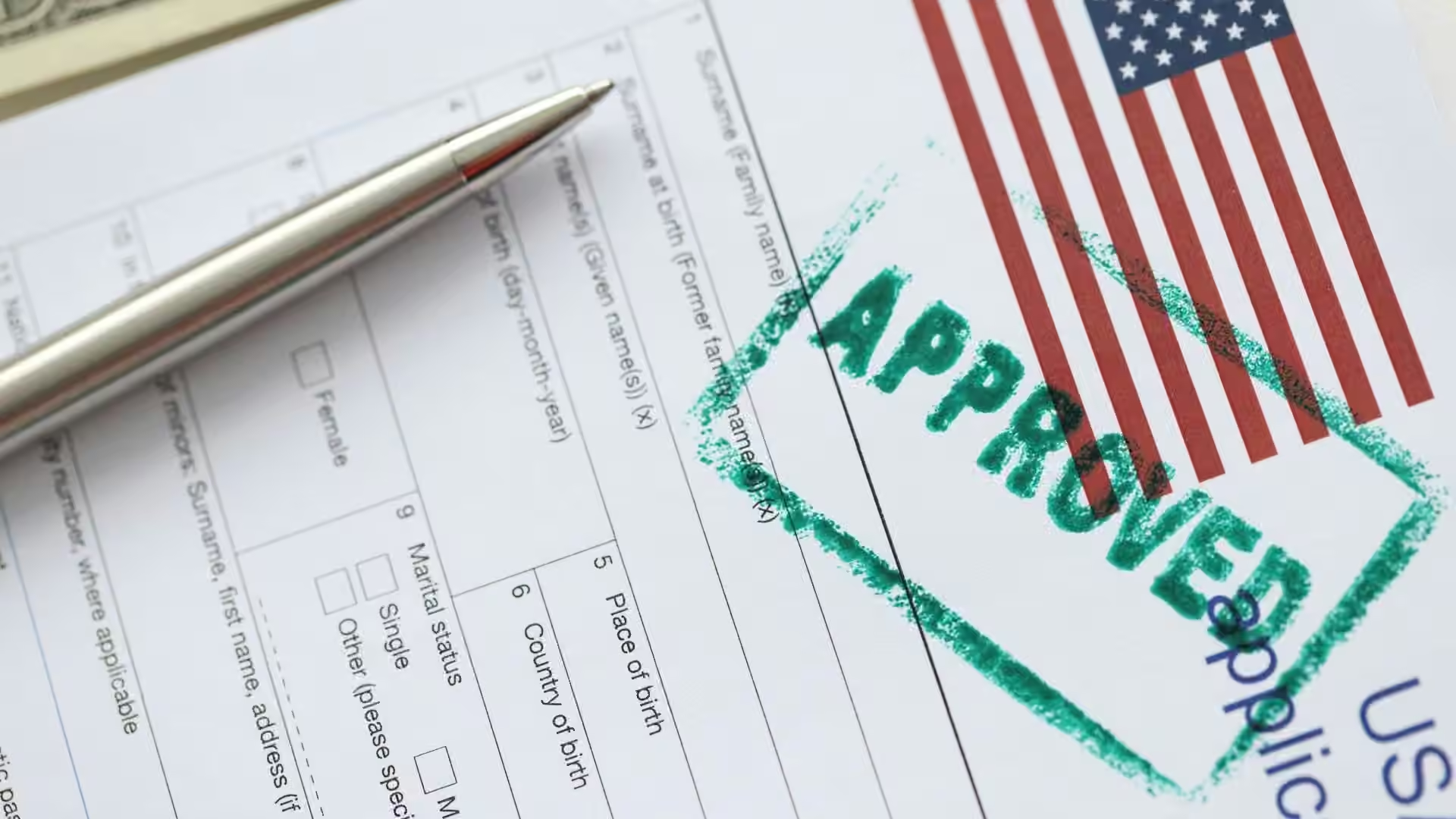
Your employer files the Labor Condition Application with the Department of Labor before filing with immigration services. It is where the wage, the worksite, and the working conditions of your job are formally promised.
Your employer is required by law to hand you a certified copy by the day you start, and to keep a file about your case that the public can inspect. Without an approved LCA (Form ETA-9035 or 9035E), your employer cannot file an H-1B petition with USCIS.
A Labor Condition Application (LCA) is a required form that U.S. employers must submit to the Department of Labor before they can sponsor a worker for an H-1B, H-1B1, or E-3 visa.
The LCA is filed on Form ETA-9035, or its electronic version Form ETA-9035E, through the Office of Foreign Labor Certification. It has to be certified before your employer can file the H-1B petition, which is why it is the first step.
When your employer signs the form, they are legally confirming that everything in it is true, as set out in 20 CFR 655.730.
The LCA is often confused with the PERM labor certification and H-1B petition, but each handles a completely different part of the process. Here’s how they differ;
An approved LCA doesn't give you immigration status on its own; it's just a required first step. If you're looking for the permanent residence form with a similar name, that's Form ETA-9089, which is part of an entirely separate process.
Note: While the Department of Labor technically "certifies" an LCA, most people just say it was "approved." Both mean the same thing.
All of your employer's promises are laid out in four key attestations under 20 CFR 655.730. While most guides explain these rules for employers, here is what they actually mean for you as the worker.
Asking your employer directly or checking the public access file are the fastest ways to get the official document with your name on it.
Under 20 CFR 655.760, your employer has to set this file up within one working day of filing your LCA. It must be kept at the employer’s principal place of business in the U.S. or at your place of employment, and it must be open for public inspection. That means anyone, including you, can request to view it.
Every public access file must include six key things;
LCA certification is usually fast. Under 20 CFR 655.740, the Department of Labor must decide whether to certify an application within 7 working days of receiving it. This timeline prevents LCA processing from being the sole reason for a delayed H-1B application.
The process moves quickly because DOL evaluates the form quickly. Certifying officers approve the LCA as long as all required fields are filled out and there are no obvious inaccuracies. DOL does not independently verify whether the listed wage fits your role, whether you actually work at the specified location, or whether the job duties match what you do day-to-day.
Certification simply means the paperwork was completed correctly. It does not mean DOL validated the information against reality, which is why reviewing your copy and the public access file is also important.
Once certified, the LCA is valid for a defined period of time;
An employer can withdraw a certified LCA before it expires, but not while H-1B employees are actively working under it or after an investigation has started.
An LCA is tied to the work locations listed on it, but moving to a new location doesn't automatically mean starting over. Short-term placements are allowed within certain limits.
How short-term placement works: Your employer can place you at an unlisted site for up to 30 workdays a year (or up to 60 workdays if you keep your main desk, home base, and primary residence at your original site). During this time, they must pay your regular salary plus all travel, meal, and lodging expenses. Once you hit that day limit, your employer must file a new LCA for the new location.
Short-term placement is a temporary workaround, not a blanket solution for every move. Permanent changes, employer switches, or major role changes usually require a new LCA and an amended H-1B petition.
If you are switching companies, check out our guide to the H-1B transfer process. For any other location or role changes, it's best to speak with an attorney before making the move.
Employers must stick to the promises they make on an LCA. Failing to follow the rules can lead to serious legal and financial consequences.
Civil monetary penalties fall into three main categories, depending on the severity of the violation;
In addition to fines, employers who break these rules face debarment from the H-1B program for one to three years. If you were underpaid, the Department of Labor can also order your employer to pay back wages covering the full difference between what you were actually paid and what you were owed.
If an employer makes you cover your own H-1B filing fees or charges you a penalty for leaving the company early, they are violating federal regulations.
If your actual pay does not match your LCA wage, you are placed on unpaid bench time, or you work at an unlisted location, start by gathering your certified LCA copy and pay records. Then, consult an experienced immigration attorney before taking next steps.
This guide describes a document that states your wage, your worksite, and your working conditions, signed by your employer and certified by the DOL for your H-1B petition.
But some categories work differently. EB-2 NIW and EB-1A are self-petitioned, so no employer attests anything on your behalf. Engineers, researchers, physicians, founders, and senior technical staff often qualify for these categories.
If you’d like to explore other routes, our attorneys will review your profile against each category's criteria and name what is missing if none fit yet. Request a case assessment to find out which cap-free pathway your profile supports.
It is the Labor Condition Application, Form ETA-9035, filed with the Department of Labor before the H-1B petition. Your employer attests to the wage, working conditions, absence of a labour dispute, and notice.
No. The LCA goes to the Department of Labor and is a prerequisite. The petition is Form I-129, filed with U.S. Citizenship and Immigration Services. A certified LCA does not give you any status on its own.
Seven working days. The regulation requires the Certifying Officer to decide within that window, so LCA timing rarely delays an H-1B case.
Ask your employer. Employers are required by law to give you a certified, signed copy by the day you report to work. You may also ask to examine the public access file, which must contain one.
Not always. Short-term placement of up to 30 workdays a year, or 60 in defined circumstances, is permitted without one. For anything longer or permanent, ask an immigration attorney.
No. PERM labor certification is Form ETA-9089, a permanent residence step. The LCA is Form ETA-9035 and supports a temporary H-1B petition.

Address: 4 W 4th Ave, San Mateo, CA 94402, United States
Email: info@beyondborderglobal.com


