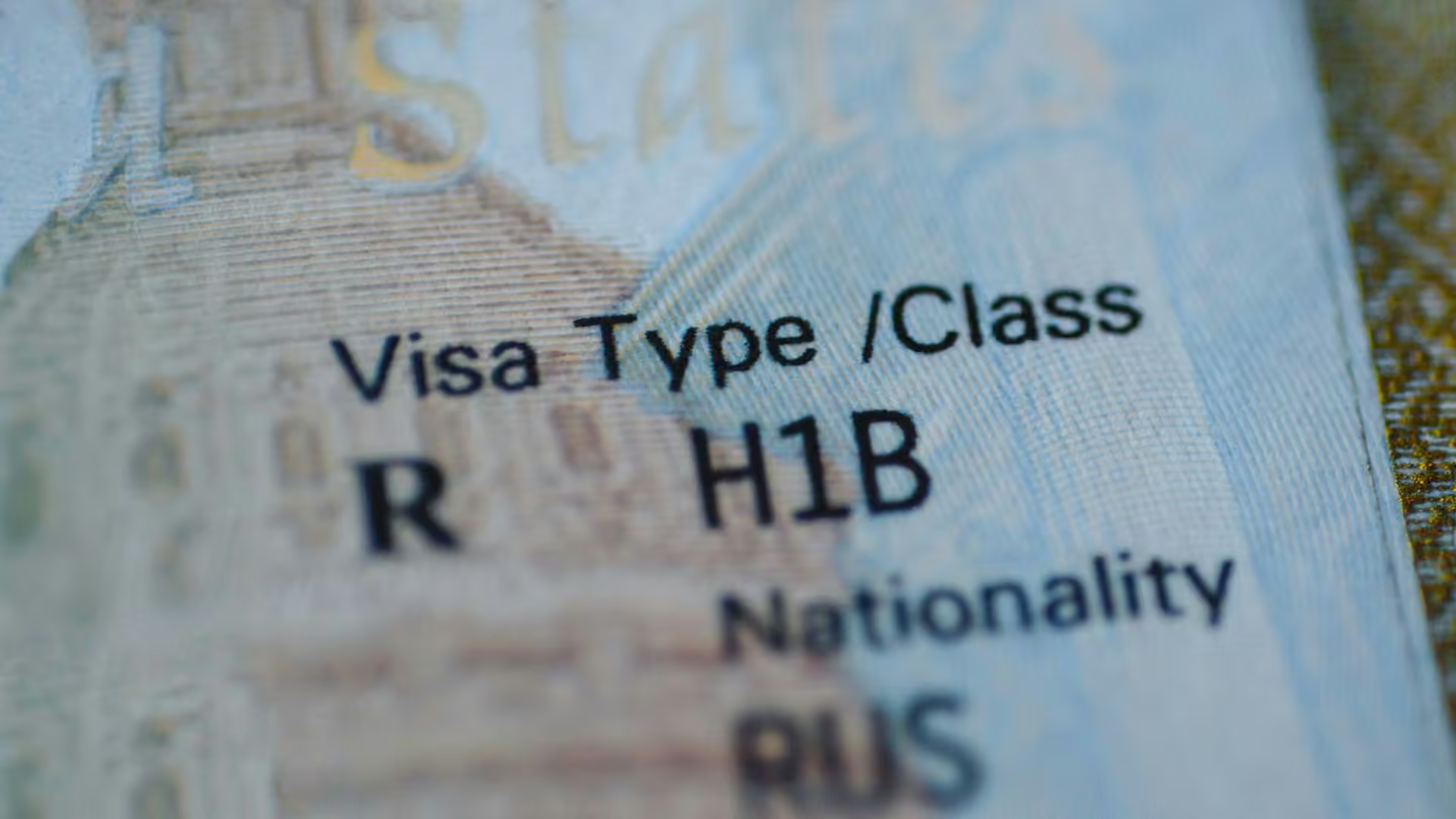
When you change employers on an H-1B, your new employer files a brand new Form I-129 petition with USCIS on your behalf. Your H-1B status history, your prior approvals, and your cap count carry over. What changes is the authorized employment relationship.
That distinction matters because it determines what you can and cannot do during the transition, when your protection begins, and what happens if the new petition is delayed, challenged, or denied.
Beyond Border attorneys have handled 4,000+ employment-based immigration cases across O-1, EB-2 NIW, EB-1, and related categories. This guide draws on that practical experience, explaining the H-1B transfer process and offering alternatives if a transfer is the right strategic move at all.
There is no H-1B transfer form. However, a current H-1B holder can change employers without losing their current status. Changing employers means your new employer files a new Form I-129, Petition for a Nonimmigrant Worker, establishing a new authorized employment period under your existing H-1B status.
Your prior cap count, your prior approval history, and your prior period of H-1B time all remain intact. USCIS does not treat this as a new H-1B case from scratch. What USCIS is approving is the new employer's right to employ you.
Before your new employer can file the new I-129, it must first obtain a certified Labor Condition Application (LCA) from the Department of Labor. The LCA establishes the prevailing wage, the worksite, and the occupational classification. Standard DOL certification takes approximately 7 business days. The I-129 cannot be filed until the LCA is certified.
The moment the I-129 is filed and USCIS issues a receipt notice, the AC21 portability provision is activated. That is when your protection and your authorization to work for the new employer begin.
You can transfer employers on a current H-1B status if;
If you were previously counted against the H-1B cap (meaning a prior employer successfully petitioned for you through the annual numerical limitation), you do not need to go through the lottery again. Your new employer files the transfer petition outside the cap, with no registration window and no October-start requirement.
Some cap-exempt employers include: universities, nonprofit research organizations affiliated with universities, and government research organizations. If your new employer falls into one of these categories, the transfer is cap-exempt on that basis alone.

An H-1B visa transfer is primarily driven by the new employer, not the worker. The worker's job is to provide accurate documentation. Here is what each party does, in order.
Your new employer will need the following from you to prepare and support the I-129:
You may begin working for your new employer as soon as the new I-129 petition is filed and USCIS issues a receipt notice. You do not need to wait for the petition to be approved.
However, two conditions must be met;
Note: If the petition is ultimately denied after you have already started working under portability, you must stop employment immediately.

If your employment ends, whether through a layoff, a termination, or a resignation, you still have 60 days or the authorized validity period of your H-1B status to find a new employer.
During this grace period, the following applies;
Your options during the grace period are: find a new employer willing to file an H-1B transfer petition before the 60 days expire, file for a change of status to another nonimmigrant category you qualify for, or depart the United States.
Below is a breakdown of the H-1B visa transfer fees;
Note: the ACWIA Training Fee and Fraud Prevention and Detection Fee are paid by the employer as required by law. An employer cannot require an H-1B worker to pay these fees as a condition of sponsoring the transfer, and doing so violates DOL H-1B regulations.
Read this article for more details on H-1B processing time.
In most situations, the H-1B transfer is the correct path. It is efficient, cap-exempt, and preserves status without interruption. If your priority is changing employers quickly, the process described in this guide helps you do that.
However, for other professionals, the question is, “Does the structure of the H-1B visa still serve you, or would employer-independent status be the more strategic long-term choice?
The H-1B ties your authorized stay to a specific employer, job description, and worksite. Every job change requires a new petition. Every promotion or material role change at the same employer may require an amendment. Green card sponsorship through PERM requires your employer's active participation and continued employment.
The O-1 visa removes that dependency structure. There is no annual cap, no lottery, no registration window. In most cases, your own U.S .company can file the petition on your behalf, removing the employer-sponsor requirement. Once approved, your status is tied to your own professional record, not to a specific employer's continued participation.
For professionals with a qualifying profile, including documented recognition in your field, original contributions that others in your industry have cited or built on, press coverage, participation as a judge or reviewer, and compensation in the upper percentile for your occupation, the evidence required for an O-1 may already exist in your work history without you having labeled it as such.
A software engineer came to us with 90 days left on her STEM OPT authorization. She had been told at every turn that the O-1A was reserved for C-suite executives or Nobel Prize winners. She was neither. She had a master's degree, solid work experience automating credit risk modeling at scale, and active GitHub repositories from her research.
When we reviewed her background, we identified those repositories and her master's thesis as evidence qualifying under the original-contributions criterion. She did not know that evidence counted. Her documents were gathered, and the petition was ready in three days. We were transparent with her that there was roughly a one-in-three chance of not making the deadline. She was approved within the 90-day window.
If a case like that raises the question of whether your own qualifying profile might support a similar outcome, Beyond Border will assess it directly. We will review your background against the O-1A criteria, identify which criteria your existing record supports, and tell you where the gaps are, including whether the honest recommendation is to proceed with the H-1B transfer instead. That assessment is the starting point. Request an honest O-1 case assessment.
You can begin working for your new employer as soon as the new I-129 petition is filed and USCIS issues a receipt notice. Do not start before receiving the receipt notice; that document is the evidence of filing that your new employer's HR team and USCIS will rely on.
You have up to 60 consecutive days following the cessation of employment before USCIS considers you to have failed to maintain your nonimmigrant status. This grace period applies once per authorized validity period, and DHS retains discretion to shorten it. You cannot work during this period. If your authorized validity period expires sooner than 60 days after your last day of work, the shorter deadline controls.
In most cases, they do not. Workers who were previously counted against the H-1B numerical cap are not counted again in a transfer. Your new employer files the petition as cap-exempt, with no registration requirement and no October-start constraint.
With premium processing (Form I-907), the timeline from LCA filing to receipt of a USCIS decision is typically 4 to 5 weeks: approximately 7 business days for LCA certification plus 15 business days for the premium processing window. Standard processing times vary significantly by service center.
You must cease employment with the new employer immediately upon receiving a denial to avoid accruing unauthorized employment. Portability authorizes you to work during the pendency of the petition; it does not guarantee approval. A denial does not by itself trigger removal proceedings, but it terminates the work authorization that portability provided. At that point, your options include returning to your prior employer if that relationship remains open, filing a new transfer petition with another employer before your grace period expires, or filing for a change of status to another category you qualify for.

Address: 4 W 4th Ave, San Mateo, CA 94402, United States
Email: info@beyondborderglobal.com