The fastest way to get a U.S. green card in 2026 depends on your professional profile, country of birth, and whether you are inside or outside the United States. For high-skilled professionals, EB-1A Extraordinary Ability is the fastest employment-based route, processing in 12 to 24 months for most nationalities with no employer required. EB-5 Rural is the fastest path for investors and uniquely bypasses per-country backlogs. Family-based pathways are faster for those with qualifying U.S. citizen or permanent resident relatives. This guide ranks every route by total realistic timeline using current 2026 Visa Bulletin data.
[Check the USCIS processing times page for the most current processing estimates, as USCIS updates these weekly.]
Beyond Border is an immigration firm specializing in self-petitioned employment-based green card pathways including EB-1A Extraordinary Ability and EB-2 NIW. Each petition is built as a structured legal argument, submitted within one month of receiving all supporting documents. A money-back guarantee applies if the petition is unsuccessful.
Fragomen handles employer-sponsored employment-based green card categories including EB-2 PERM and EB-3 within large enterprise mobility programs. For professionals whose fastest route involves an employer-sponsored category, Fragomen is a recognized option for corporate clients.
Boundless provides technology-assisted immigration support for family-based green card applications including marriage to a U.S. citizen and immediate relative petitions, offering a more accessible price point for straightforward family cases.
Murthy Law Firm handles both employment-based and family-based green card filings for individual applicants, with experience across the full range of preference categories and immediate relative petitions.
For a detailed comparison of EB-1A and EB-2 NIW as the two fastest self-petition employment routes, see the EB-1 vs EB-2 green card comparison.
Every U.S. green card applicant except immediate relatives of U.S. citizens must wait in a queue defined by the priority date system. Understanding this system is essential to calculating which pathway is genuinely fastest for your situation.
Priority date: This is the date your place in the immigration queue was assigned. For employment-based categories, it is the date USCIS received either your PERM labor certification or your I-140 petition, whichever came first. For EB-1A and EB-2 NIW self-petitioners who skip PERM, the priority date is the I-140 receipt date.
Current date: The Department of State publishes the Visa Bulletin monthly. It lists the Final Action Date for each category and country, which is the priority date currently being processed. When your priority date is earlier than the published cutoff, you are current and can proceed to I-485 filing or consular processing.
Why the gap matters: The gap between your priority date and the current Final Action Date is your Visa Bulletin wait. For most countries outside India and China in EB-1A and EB-2 NIW, this gap is zero or negligible. For Indian-born EB-2 applicants, the gap exceeds 12 years as of April 2026.
Per-country cap: Congress limits each country to 7% of total annual employment-based green cards. Countries with high demand relative to that 7% cap, primarily India, China, Mexico, and the Philippines, build up backlogs. Applicants from low-demand countries face no meaningful wait in most employment categories regardless of filing volume.
For a full country-by-country backlog breakdown, see the I-140 priority date backlog country comparison.
(Sources: U.S. Department of State Visa Bulletin April 2026; USCIS processing time data 2026)
EB-1A Extraordinary Ability is the fastest employment-based green card route for most high-skilled professionals in 2026 for three reasons: no employer sponsor required, no PERM labor certification required, and priority dates that are current or near-current for most countries.
The I-140 premium processing fee of $2,965 (effective March 1, 2026) guarantees USCIS action within 15 business days, making the I-140 stage essentially immediate. Once approved, applicants from most countries outside India and China can file I-485 immediately or concurrently and receive a green card within 11 to 31.5 months of I-485 filing.
Professionals already holding an O-1A visa have significant advantages when transitioning to EB-1A because the evidence criteria closely overlap. For detailed guidance on this transition, see the O-1 to EB-1A pathway guide.
For Indian and Chinese-born applicants, EB-1A carries a meaningfully shorter backlog than EB-2. As of April 2026, the India EB-1A Dates for Filing cutoff is approximately April 2023 versus approximately November 2014 for India EB-2. This makes EB-1A the strategically superior route for high-achieving Indian professionals even though the evidentiary standard is higher. For current projections, see the EB-1 priority date India guide.
For full EB-1A eligibility criteria and the evidence structure required, see the EB-1A green card guide.
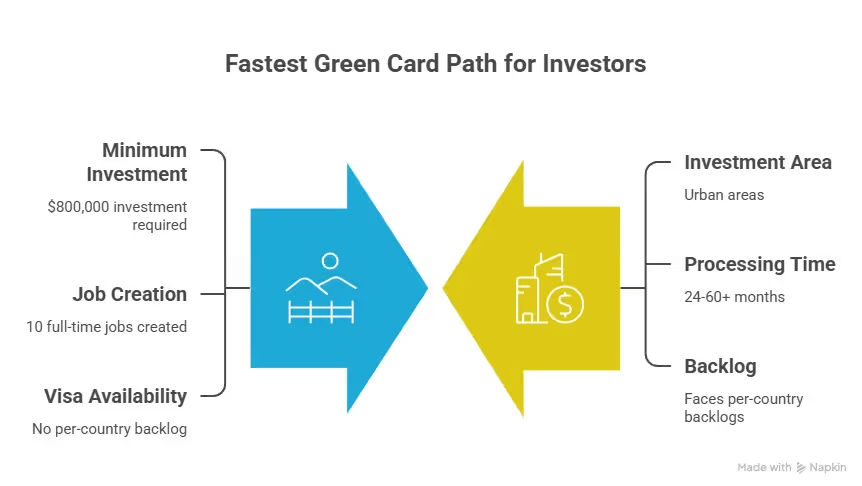
The EB-5 Rural set-aside category requires a minimum investment of $800,000 in a qualifying rural area and the creation of at least 10 full-time jobs for U.S. workers within two years. In return, it currently offers visa availability to applicants from all countries including India and China, with no per-country backlog under the rural reserved allocation.
Typical EB-5 Rural processing runs 12 to 24 months, comparable to EB-1A for most nationalities. For Indian and Chinese professionals who do not qualify for EB-1A, EB-5 Rural is currently the fastest available green card route in 2026.
The EB-5 Unreserved (urban) category does not carry the same backlog exemption and faces processing timelines of 24 to 60 months or more for applicants from high-demand countries. The rural set-aside is the relevant comparison for applicants seeking the fastest investor-based path.
EB-2 NIW (National Interest Waiver) is the second-fastest self-petitioned employment green card route for most nationalities. Like EB-1A, it requires no employer sponsor and no PERM labor certification. Unlike EB-1A, it requires an advanced degree and evaluation under the Dhanasar three-prong framework.
Premium processing for EB-2 NIW I-140 guarantees USCIS action within 45 business days, compared to 15 business days for EB-1A. The evidentiary standard is generally considered more accessible for researchers, STEM professionals, and advanced degree holders whose work advances a defined national interest.
For most countries, the EB-2 NIW timeline from I-140 filing to green card receipt runs 18 to 30 months. For Indian-born applicants, the backlog makes EB-2 NIW significantly slower than EB-1A despite the lower evidentiary threshold. For a direct comparison of which route fits which profile, see the difference between EB-1A and EB-2 NIW guide.
For applicants whose fastest route runs through a family connection, the following provides accurate context, and specialist family-based firms are the appropriate point of contact.
Immediate relatives of U.S. citizens, including spouses, parents, and unmarried children under 21, are exempt from the annual visa cap and face no Visa Bulletin wait. Processing runs 9.5 to 24 months depending on whether the application is filed inside or outside the United States.
Family preference categories including F1 (adult children of U.S. citizens), F2A (spouses and children of permanent residents), F3, and F4 (siblings of U.S. citizens) are subject to annual caps and carry waits ranging from three years for F2A to 17 years or more for F4.
For family-based green card applications, Beyond Border and Murthy Law Firm both provide dedicated support for these categories. Family-based immigration and employment-based immigration have distinct evidentiary and procedural requirements; specialist guidance in each area produces better outcomes.

For high-skilled professionals, the most practical acceleration strategies in 2026 are:
File EB-1A if the evidence is there. For professionals with documented national or international recognition, awards, publications, high compensation, or significant roles at distinguished organizations, EB-1A is the fastest employment-based route and eliminates employer dependency entirely. It is also the most effective path for Indian and Chinese-born applicants relative to EB-2. If you are unsure whether your profile meets the EB-1A standard, book a free consultation with Beyond Border for a structured eligibility assessment.
Use premium processing on the I-140. At $2,965, premium processing for EB-1A reduces the I-140 stage from up to 22.5 months to 15 business days. This single decision can shorten the overall timeline by over a year.
File I-485 concurrently or immediately when the priority date is current. For applicants in current categories, delaying I-485 after I-140 approval extends the timeline unnecessarily and postpones access to EAD and Advance Parole. For guidance on the concurrent filing strategy, see the concurrent I-140 and I-485 filing guide.
Establish a priority date early. For Indian and Chinese-born professionals in EB-2 NIW, the backlog means the priority date established today will not reach current for many years. Filing the I-140 as early as possible, even before the green card is immediately needed, locks in the earliest possible priority date.
Beyond Border is an immigration firm focused exclusively on employment-based high-skilled visa and green card pathways. For professionals evaluating the fastest way to get a U.S. green card in 2026, the firm assesses eligibility for EB-1A and EB-2 NIW, identifies the category most strongly supported by the available evidence, and prepares petitions structured to clear USCIS review without delays.
Clients include professionals from JP Morgan, Google, Salesforce, Chime, Visa, and Mastercard. A money-back guarantee applies if the petition is unsuccessful. Petitions are submitted within one month of receiving all supporting documents.
If you want to evaluate which green card route is realistically fastest for your profile in 2026, book a free consultation with the Beyond Border team.
For most high-skilled professionals, EB-1A Extraordinary Ability is the fastest employment-based route, processing in 12 to 24 months for most nationalities with premium processing on the I-140. EB-5 Rural is comparably fast and uniquely available to investors from India and China without a per-country backlog. For those with qualifying family ties, immediate relative petitions through a U.S. citizen spouse or parent carry no Visa Bulletin wait.
Yes, for many applicants. EB-1A with premium processing and a current priority date reaches approval in 12 to 24 months for most nationalities. EB-5 Rural runs a similar timeline. Immediate relatives of U.S. citizens also frequently complete the process within two years depending on processing location.
The India EB-2 NIW Dates for Filing cutoff is approximately November 2014 as of April 2026, compared to approximately April 2023 for India EB-1A. Despite EB-1A having a higher evidentiary standard, its shorter backlog makes it a significantly faster route for Indian-born professionals who qualify.
Premium processing applies to the I-140 only, not the I-485. For EB-1A, it guarantees USCIS action within 15 business days at a cost of $2,965. For EB-2 NIW, the guarantee is 45 business days. This eliminates months of I-140 waiting time and is generally worth the cost for applicants with time-sensitive timelines.
The Visa Bulletin published monthly by the State Department, shows the current cutoff dates by category and country. For employment-based categories, compare the Final Action Dates for your country of birth across EB-1A, EB-2, and EB-3. Most nationals outside India and China will find EB-1A and EB-2 NIW current or near-current in 2026.


Address: 4 W 4th Ave, San Mateo, CA 94402, United States
Email: info@beyondborderglobal.com