
USCIS updates O-1 visa policies, fees, and adjudication standards regularly. For applicants and petitioners, filing with outdated information, incorrect fees, or evidence that does not reflect current adjudication standards can result in rejection, Request for Evidence, or avoidable delay. The most consequential recent changes are the O-1 premium processing fee 2026 increase effective March 1, 2026, and the January 2025 O-1 policy manual changes that affect self-sponsorship eligibility, extension periods, and evidence standards across multiple criteria. Beyond Border is an immigration firm specializing in O-1 Visa petitions.
[Check the USCIS processing times page for current O-1 estimates, as USCIS updates these weekly.]
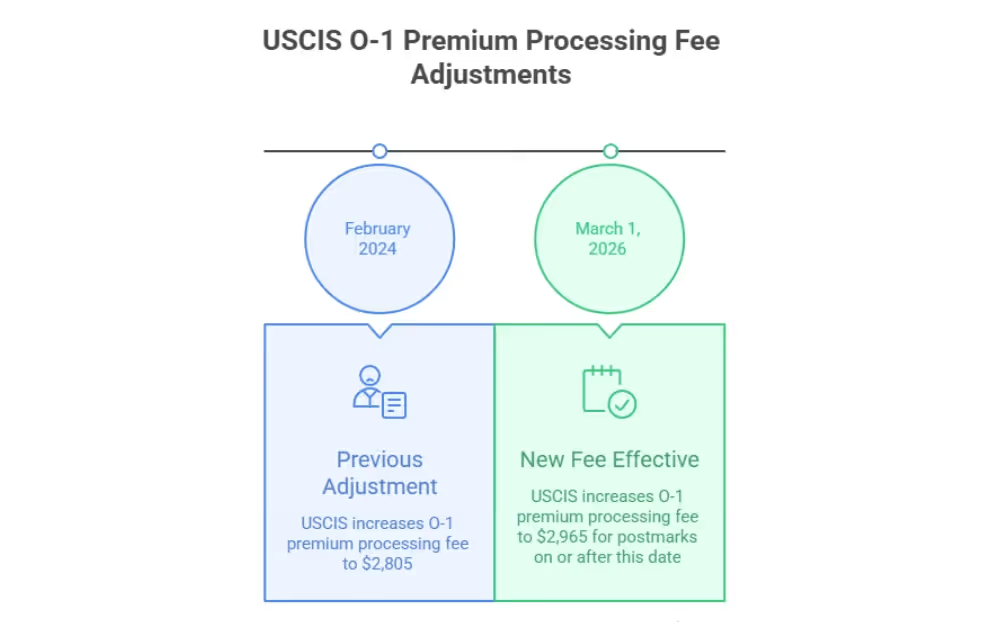
USCIS increased the premium processing fee for O-1 petitions from $2,805 to $2,965 effective March 1, 2026. The adjustment was authorized under the Emergency Stopgap USCIS Stabilization Act, which allows premium processing fees to be adjusted biennially in response to inflation. The previous adjustment occurred in February 2024.
The O-1 premium processing fee 2026 applies to all Form I-907 requests postmarked on or after March 1, 2026. Petitions with I-907 requests postmarked before March 1, 2026 pay the prior rate of $2,805. USCIS rejects Form I-907 requests with incorrect fees.
(Source: USCIS fee schedule effective April 1, 2024; I-907 updated March 1, 2026)
Premium processing guarantees USCIS will issue an approval, denial, or Request for Evidence within 15 business days of receipt. It does not affect the substantive evidentiary standard applied to the petition or improve approval odds.
O-1 visa processing time 2026 under standard adjudication runs approximately 11 months from petition receipt to decision. USCIS shifted to the Service Centre Operations model in 2023, meaning petitions are distributed dynamically across service centres based on workload capacity rather than being assigned to a specific centre based on the petitioner's location.
Premium processing at $2,965 cuts O-1 visa processing time 2026 from approximately 11 months to 15 business days from USCIS receipt. This reduction is material for petitioners with fixed employment start dates, nonimmigrant status approaching expiration, or time-sensitive work commitments.
O-1 approval rates from USCIS FY2025 Q3 data (January through March 2025) stand at 93.8% with a Request for Evidence rate of 18.7%. Petitions with complete evidence packages that directly address the applicable criteria consistently achieve approval rates above the overall category average. For the full O-1 visa processing time breakdown by service centre and processing type, see the O-1 visa processing time guide and the O-1A visa processing time guide.
The January 8, 2025 USCIS policy update to Policy Manual Volume 2, Part M represents the most significant O-1 visa USCIS policy update 2026 cycle in several years. The changes cover four distinct areas: self-sponsorship through beneficiary-owned entities, three-year extension availability, evidence standards for digital and online activities, and career transition recognition.
The January 2025 O-1 policy manual changes explicitly confirmed that a beneficiary-owned legal entity may file an O-1 petition on behalf of the beneficiary. USCIS Policy Manual Volume 2, Part M now states that separate legal entities owned by the beneficiary, including corporations, LLCs, or other business structures, may serve as the petitioner provided proper corporate governance and oversight is in place.
The O-1 beneficiary-owned company petition structure requires that the entity's board of directors, investors, or equivalent governing body exercise genuine oversight of the beneficiary's employment even where the beneficiary holds a significant equity stake. The oversight structure must be documented and genuine rather than nominal.
This O-1 policy manual change is particularly consequential for entrepreneurs, startup founders, and independent professionals who previously needed to identify third-party employers or authorized agents as petitioners. A founder who incorporates a U.S. entity and establishes appropriate corporate governance may now have that entity petition for their O-1 without a separate third-party sponsor. For the full founder self-sponsorship strategy, see the O-1A startup founder guide.
Prior to the January 2025 O-1 policy manual changes, extensions beyond one year with the same employer were uncommon in practice. The updated guidance clarifies that USCIS may approve extensions of up to three years, even with the same employer, when the extension involves new qualifying events or activities. New phases of a research project, expanded responsibilities, new trials or studies, or related work building on the established extraordinary ability record all potentially qualify as new qualifying activities.
The update also confirms that there is no statutory maximum on the number of O-1 extensions. Status may be extended indefinitely as long as the qualifying work continues and the petitioner continues to meet the extraordinary ability standard. For the full extension rules and how this change affects planning, see the O-1 visa grace period guide.
The January 2025 O-1 policy manual changes added explicit examples reflecting how recognition, publication, and professional contribution work in modern fields, particularly technology and emerging disciplines.
Published material criterion now explicitly includes digital publications and online media coverage, podcasts where the petitioner appears as a recognized expert, and major online outlets and respected digital publications. The criterion is no longer limited to traditional print newspapers and trade journals.
Judging criterion clarifications address modern peer review structures: serving on technical conference program committees satisfies the criterion; reviewing pull requests for major open source projects with significant adoption may also satisfy it; evaluating grant applications through recognized funding bodies qualifies; assessing startup applications for established accelerators qualifies. For the full judging evidence framework reflecting these updates, see the O-1 judging evidence guide.
Awards criteria had an implicit career-stage requirement removed. Awards do not need to have been received at advanced career stages; recent recognition can benefit early-career professionals and recent graduates who have achieved significant recognition quickly.
Original contributions criterion added explicit examples relevant to technology and research: patents or licenses derived from the petitioner's work; commercial adoption of innovations or research outputs; contributions to widely-used software repositories, datasets, designs, or protocols; and evidence of significant scholarly, scientific, or business-related impact beyond the immediate organization.
For the full analysis of how these O-1 visa evidence standards 2026 changes affect petition preparation across criteria, see the O-1A extraordinary ability 2026 USCIS changes guide.
The January 2025 O-1 policy manual changes added examples explicitly recognizing that extraordinary ability can transfer across related roles and occupations within the same field. USCIS examples include: an acclaimed athlete becoming a coach; a leading academic professor transitioning to a private company research role; an engineer founding a technology startup; and a renowned dancer moving to a teaching or choreography role.
These examples clarify that the O-1 extraordinary ability standard does not require the petitioner to remain in the exact same role as the original qualifying activity. Career transitions to related work within the broader field of extraordinary ability remain qualifying, provided the continued work relates to the established area of expertise.
For founders and entrepreneurs: The O-1 beneficiary-owned company petition clarification removes the most significant structural barrier for self-sponsoring founders. The corporate governance documentation required to establish a qualifying petitioner structure is now explicitly defined, making this a viable route for those who previously could not identify a third-party petitioner.
For applicants planning extensions: The three-year extension availability with the same employer reduces annual refiling burden and allows longer-term planning. Petitioners who previously filed annual extensions can now plan for up to three-year periods when new qualifying activities are present.
For technology and digital professionals: The explicit inclusion of digital publications, online media, conference program committee service, and open source contributions removes ambiguity about whether these activities satisfy the published material and judging criteria. Evidence packages can now directly cite these forms without requiring additional framing to justify their relevance to the applicable criterion.
For early-career professionals: The removal of implicit career-stage requirements for awards allows stronger use of recent recognition in petitions from professionals with five or fewer years of post-educational career history.
For a full picture of how all January 2025 O-1 policy manual changes interact with O-1A eligibility assessment, see the O-1A visa eligibility guide.
USCIS publishes O-1 policy changes through the USCIS.gov news section, the Policy Manual "What's New" section, and Federal Register notices for proposed rule changes. The USCIS email subscription service provides alerts for processing time changes. Premium processing availability and fee changes are announced through USCIS.gov news.
For O-1 visa USCIS policy updates 2026 affecting evidence standards, the Policy Manual Volume 2, Part M is the authoritative source. Changes to the policy manual are effective immediately upon publication unless otherwise noted.
Beyond Border is an immigration firm focused on employment-based high-skilled visa and green card pathways. The firm monitors O-1 visa USCIS policy updates 2026 and adjusts petition preparation strategies as guidance changes. For the January 2025 O-1 policy manual changes, the firm updated its approach to founder self-sponsorship documentation, extension petition strategy, and digital evidence treatment across all O-1A and O-1B categories.
For EB-1 Green Card and EB-2 NIW petitions building on O-1 evidence records, the firm evaluates how January 2025 O-1 policy manual changes affect the strength of evidence that transfers from the O-1A record into the immigrant petition. For the full green card options analysis for O-1A holders, see the green card options for O-1A visa holders guide.
A money-back guarantee applies if the petition is unsuccessful. To discuss how O-1 visa USCIS policy updates 2026 affect your pending or planned petition, book a free consultation with Beyond Border.
March 1, 2026. Petitions postmarked before this date pay $2,805. Petitions postmarked on or after March 1, 2026, pay $2,965.
Yes, under January 2025 guidance. Your beneficiary-owned corporation or LLC can petition on your behalf, provided proper oversight structures are in place, such as a board of directors with genuine supervisory authority.
Up to 3 years, even if new events or activities begin with the same employer. There's no limit to the number of extensions.
Generally no. USCIS adjudicates based on laws and policies in effect when you filed, not when they issue a decision. However, fee changes apply to petitions filed after the effective date.
Visit uscis.gov/policy-manual and check the "What's New" section. The Policy Manual is searchable, and updated sections include revision dates.


Address: 4 W 4th Ave, San Mateo, CA 94402, United States
Email: info@beyondborderglobal.com