German researchers, engineers, startup founders, and technical leaders often look at the U.S. when their work starts reaching global markets. The problem is that many U.S. work visas are built around employer sponsorship, lotteries, or company transfers. For high-achieving professionals, the O-1 can be a stronger fit.
The O-1 visa for German professionals is designed for people who can show extraordinary ability through recognized achievements, not just a job offer or degree. For German technical talent in AI, robotics, biotech, climate tech, fintech, research, engineering, or startups, this can create a practical route to work in the United States.
German professionals can apply for an O-1 visa if they meet the eligibility standard and have a valid U.S. petitioner. Citizenship is not the deciding factor. The key question is whether the applicant can prove extraordinary ability in their field.
For many German applicants, the O-1A category is the most relevant. It is commonly used by professionals in science, business, education, technology, research, and entrepreneurship. That includes German engineers, AI researchers, startup founders, biotech specialists, robotics professionals, fintech leaders, and senior product or technical executives.
The O-1 visa for German professionals is not meant for every skilled worker. A strong academic background, a respected German university degree, or a good job title may help, but these alone are usually not enough. The case must show that the applicant has gained recognition beyond normal professional competence.
An O-1 case usually needs evidence across recognized criteria. This may include awards, press, published work, original contributions, judging work, critical roles, high salary, scholarly articles, or other comparable evidence.
For technical professionals, the strongest cases do not simply list achievements. They explain why the work mattered, who used it, how it influenced the field, and why the applicant’s role was personally important.

Many German professionals explore U.S. options when they receive offers from American companies, raise U.S. investor interest, join research collaborations, or expand a startup into the U.S. market.
The O-1 visa for German professionals can be attractive because it is not tied to the H-1B lottery. It can also work when the applicant’s career does not fit a traditional multinational transfer route.
German technical talent is often strong in areas where the U.S. market has heavy demand, including AI, automotive technology, robotics, advanced manufacturing, climate tech, biotech, cybersecurity, enterprise software, and applied research.
An O-1 visa for German engineers may be possible where the applicant has built important systems, led technical work at a distinguished company, contributed to widely used products, developed patents, or created measurable improvements.
An O-1 visa for German researchers may be strong where the applicant has publications, citations, peer review activity, conference recognition, grants, patents, or work adopted by companies, labs, or institutions.
Founders elsewhere in Europe can also review our O-1 visa guide for European founders, which focuses on U.S. expansion and founder evidence.
Learn more about expanding your business to the US market with our guide.
Strong profiles may include PhD researchers, senior software engineers, AI scientists, robotics engineers, deep-tech founders, biotech leaders, climate technology professionals, cybersecurity specialists, and technical executives at high-growth companies.

Evidence is the center of the case. A well-prepared O-1 visa for German professionals should connect achievements to clear external recognition.
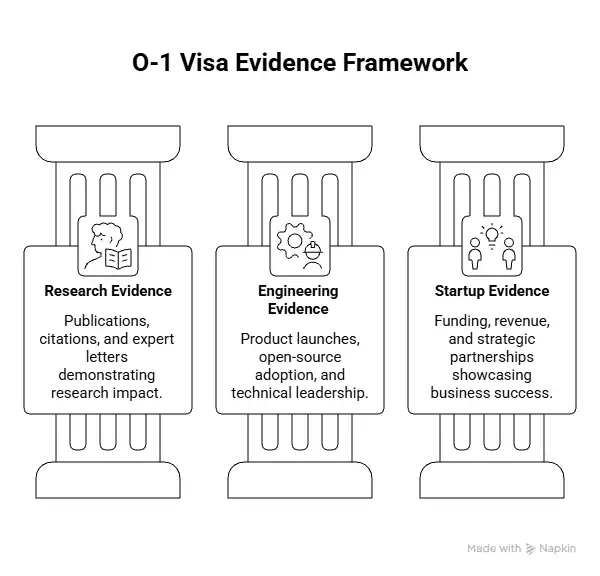
For researchers, useful evidence may include publications, citation records, peer review invitations, research grants, patents, invited talks, conference presentations, media coverage, and letters from independent experts.
German researchers should not only show that they participated in research. They should show that their work influenced others, solved a meaningful problem, or contributed to a recognized technical area.
For related guidance, see Beyond Borders’ article on the O-1 visa for software engineers and AI researchers.
For engineers, strong evidence may include product launches, platform architecture, open-source adoption, patents, GitHub usage, enterprise deployment, technical leadership, performance improvements, security improvements, or infrastructure used by major clients.
For example, a German AI engineer should not only say they built machine learning models. The case should explain what the models improved, who used them, and why the applicant’s work stood out.
For founders, useful evidence may include funding, revenue, accelerator acceptance, press, user growth, customer contracts, awards, investor letters, product adoption, and strategic partnerships.
An O-1 visa for German founders is strongest when the founder can show both company traction and personal contribution. USCIS must understand why the founder, not just the startup, is extraordinary.
German founders often consider the O-1 when expanding to the U.S., raising funds from U.S. investors, signing American customers, or joining the U.S. startup ecosystem.
The O-1 can work for founders, but the structure matters. It is not a simple self-sponsored visa. A petition generally needs a U.S. employer, U.S. company, or agent petitioner.
A German founder usually cannot treat the O-1 as a direct self-petition. However, a properly structured U.S. company or agent model may support the case if there is a real work arrangement, a clear role, and credible business activity.
A U.S. company may petition for the founder if the setup is credible and documented. An agent model may also help if the applicant will work across multiple U.S. clients, advisory roles, projects, or companies.
Useful documents may include incorporation records, contracts, investor letters, pitch decks, product roadmaps, customer pipeline, advisory agreements, and evidence of U.S. expansion.
German applicants often compare the O-1 with other U.S. immigration options. Each route fits a different situation.
For many applicants comparing a U.S. work visa for German professionals, the H-1B may seem familiar. But the lottery can create uncertainty. The O-1 may be better for applicants who already have strong recognition and need a route based on merit.
L-1 can work when there is a qualifying German company and a U.S. affiliate. But if the applicant’s strongest argument is personal achievement rather than company transfer history, the O-1 may be more suitable.
The O-1 is a temporary work visa. EB-1A is a green card category. Some applicants use the O-1 first and later build toward EB-1A or another immigrant petition. Read Beyond Border’s guide on moving from an O-1 visa to a green card.
A strong O-1 visa Germany to USA strategy needs more than forms. It needs a clear evidence plan, a petitioner structure, and a petition narrative that explains technical work in plain English.
Beyond Border helps German researchers, engineers, founders, and executives assess whether their achievements may align with the O-1 standard. The team identifies the strongest criteria, organizes evidence, builds the case story, and helps avoid weak or generic filings.
The O-1 visa for German professionals can be a powerful option, but only when the evidence is specific, credible, and well-framed.
Schedule your free consultation and profile evaluation.
Yes. German professionals can apply for an O-1 visa if they can prove extraordinary ability in their field and have a valid U.S. petitioner. The case depends on evidence of recognition, not nationality.
Yes, it can be. The O-1 visa may work for German engineers with patents, technical leadership, major product impact, open-source adoption, awards, press, or critical roles at distinguished companies.
Yes. German startup founders may qualify if they can show strong personal impact through funding, traction, press, customers, awards, partnerships, or original contributions. They also need a proper petitioner structure.
It depends. The O-1 avoids the H-1B lottery, but it requires stronger evidence. H-1B may be better for standard employer-sponsored roles, while O-1 may suit highly recognized professionals.
Yes. Many O-1 holders later explore EB-1A or EB-2 NIW. However, the O-1 and green card categories have different standards, so the strategy should be planned carefully.

Address: 4 W 4th Ave, San Mateo, CA 94402, United States
Email: info@beyondborderglobal.com