Healthcare and biotech professionals can qualify for the O-1 visa if they can prove extraordinary ability through documented achievement, recognition, and impact.
Strong evidence may include patents, clinical research, publications, grants, medical technology development, peer review, critical roles, expert recognition, or measurable contributions to healthcare and life sciences.
The O-1 is not limited to famous doctors or Nobel-level scientists. It can also apply to biotech founders, medical researchers, pharmaceutical scientists, AI drug discovery specialists, medical device innovators, health-tech builders, and clinical innovation leaders.
A strong case must show more than education, employment, or technical skill. For healthcare and biotech professionals, the evidence should clearly explain what changed because of the applicant’s work, why it mattered, and how others in the field recognized its value.
Yes, healthcare and biotech professionals can qualify for the O-1 visa if they can prove extraordinary ability in their field. For most scientific, medical, and biotech profiles, the relevant category is O-1A, which covers individuals with extraordinary ability in the sciences, education, business, or athletics.
A biotech founder, medical researcher, pharmaceutical scientist, clinical innovation lead, or health-tech professional may qualify if the evidence shows achievement beyond normal professional competence.
The case should not simply say that the person is skilled or experienced. It must prove that the person made important contributions and received recognition for those contributions.
A medical researcher may show peer-reviewed publications, citations, research grants, conference presentations, journal review activity, and letters from independent experts.
A biotech founder may show patents, product milestones, investor backing, clinical pilots, regulatory progress, partnerships, awards, or press.
A health-tech professional may show product adoption, hospital implementation, measurable workflow improvement, or technical systems used by major healthcare organizations.
Applicants considering this route should first understand the broader standard for the O-1 visa, because the category is evidence-driven.
USCIS does not approve a case because someone works in a respected industry. It approves when the record shows that the person has risen above others in the field through documented achievement.
This is why the O-1 visa for biotech professionals needs a focused evidence strategy. The petition should explain the applicant’s field, their specific role, the importance of their work, and the proof that others relied on, recognized, funded, adopted, cited, or validated that work.

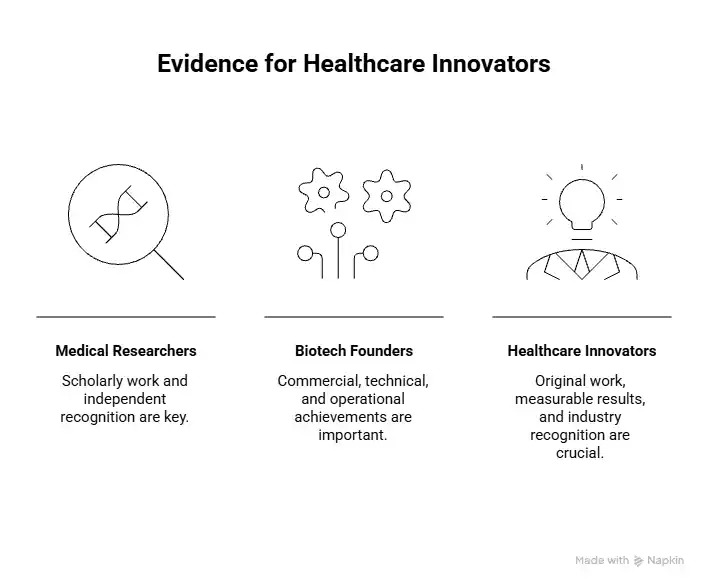
Medical researchers and biotech founders often have very different evidence profiles, so the case strategy should not treat them the same way.
For medical researchers, the strongest evidence often comes from scholarly work and independent recognition. This can include peer-reviewed publications, citation records, first-author or corresponding-author papers, research grants, conference presentations, peer review for journals, invited talks, and expert letters from respected scientists or medical leaders.
The case should explain the quality of the journals, the relevance of the research, the applicant’s personal contribution, and how the work influenced the field.
A publication list by itself is rarely enough. USCIS needs context. A strong article in a respected journal may carry more weight than several low-impact papers. A paper with meaningful citations, clinical relevance, or adoption by other researchers can help show that the applicant’s work reached beyond routine academic output.
Applicants with research-heavy profiles may also benefit from reviewing Beyond Border’s guidance on O-1 visa requirements and O-1A visa requirements.
For biotech founders, the evidence often looks more commercial, technical, and operational. A founder may not have a long publication record, but may have built a diagnostic platform, developed a drug discovery tool, created a medical device, raised venture funding, secured hospital partnerships, earned accelerator admission, filed patents, or led a product through regulatory preparation.
The case must connect those achievements to the founder personally. Company success is not automatically founder evidence.
If a biotech startup raised funding, the petition should explain what the founder built or led that made the company fundable. If the company secured clinical pilots, the case should explain the applicant’s role in the product, science, validation, partnerships, or implementation.
Some healthcare innovators do not fit neatly into either category. They may work in regulatory systems, clinical operations, medical devices, healthcare AI, diagnostics, hospital workflow technology, or quality systems.
These profiles can still be strong if the evidence shows original work, measurable results, and industry recognition.
For biotech and healthcare professionals, technical achievements need to be translated into clear O-1 evidence. Patents, clinical research, publications, and grants can all help, but they are strongest when they show originality, recognition, and real-world impact.
A strong case does not simply list documents. It explains what the applicant created, why the work mattered, who relied on it, and how it advanced a product, research area, clinical process, company, or healthcare outcome.
Patents can be powerful evidence in an O-1 case, but a patent alone does not prove extraordinary ability. The case should explain what the invention does, why it is original, and whether it has been used, licensed, cited, commercialized, funded, or integrated into a product.
For biotech and healthcare professionals, patent evidence is stronger when it is tied to real-world value. For example, a patent related to a diagnostic method may be supported by product development records, clinical validation, licensing discussions, investor materials, or expert letters explaining the invention’s importance.
A patent used by a company, cited by later patents, or connected to a medical product is generally stronger than a patent that exists only on paper.
Clinical research can also support an O-1 case, especially when the applicant played a meaningful role in trial design, protocol development, data systems, patient recruitment strategy, clinical operations, regulatory documentation, or study execution.
Being listed in a clinical trial may help, but the stronger question is what the applicant personally contributed. Did they improve the research process? Did they design a system others relied on? Did they solve a technical or clinical problem? Did their work support a significant study, approval pathway, or healthcare outcome?
Publications remain important for many medical and biotech professionals. However, quality matters more than volume.
USCIS may look at whether the publication appeared in a respected journal, whether the applicant had a leading authorship role, whether the work was cited, and whether the research influenced other scientists, clinicians, companies, or institutions.
Grants and funding can also be valuable because they show external validation. Competitive grants, institutional awards, government funding, research fellowships, and startup funding can all help.
But again, the case must explain the applicant’s role. A grant awarded to a lab is helpful only if the applicant’s contribution to the funded work is clearly documented.
This is where many cases fail. They list patents, papers, grants, and trials without explaining why they matter.
A strong O-1 visa for biotech professionals should translate technical evidence into a clear impact story. The petition should show what the applicant created, why it was original, who relied on it, and how it advanced the field, company, product, clinical process, or healthcare outcome.
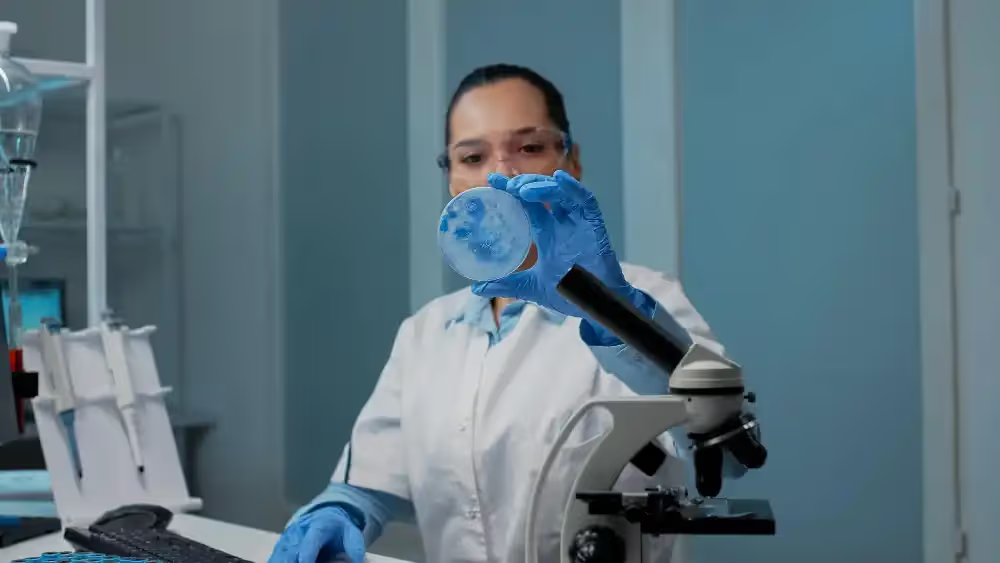
Healthcare and biotech O-1 cases should explain the applicant’s work in plain English and connect it to measurable impact. Technical complexity alone is not enough. The case should show what problem the applicant solved, what they built or improved, and why the result mattered.
Strong impact may include improved diagnostic accuracy, faster drug discovery, better patient monitoring, reduced clinical trial delays, improved regulatory readiness, stronger data quality, reduced operational risk, new research methods, new medical devices, or healthcare platforms adopted by users or institutions.
Independent evidence is especially important. This may include expert letters, published material, citation records, patent citations, grant awards, conference invitations, peer review work, partner letters, regulatory records, customer documents, or adoption data.
Critical role evidence can also support the case if the applicant played an essential part in a major project at a hospital, university, pharmaceutical company, research institute, funded startup, or medical technology company.
Beyond Border’s guide on O-1 visa critical role evidence explains how to show that the applicant was not just employed by a strong organization, but personally important to its work.
This table is only a starting point. The right evidence depends on the applicant’s field, seniority, role, and available documentation. A junior researcher with unusually influential publications may have a stronger case than a senior employee with routine internal responsibilities. A founder with a small company may have a strong case if the product, funding, or scientific contribution is clearly tied to their work.
O-1, EB-1A, and EB-2 NIW can all be relevant for biotech and healthcare professionals, but they serve different purposes.
The O-1 is a temporary work visa. It can be useful for professionals who need U.S. work authorization and have strong evidence of extraordinary ability. EB-1A and EB-2 NIW are green card pathways. EB-1A is generally suited for individuals with strong sustained recognition and a record of extraordinary ability. EB-2 NIW may be a better fit for professionals whose work has substantial merit and national importance, even if their recognition record is not yet strong enough for EB-1A. USCIS states that EB-2 NIW applicants request that the job offer and labor certification be waived because the work is in the national interest.
For many applicants, O-1 can be a bridge. A biotech founder or scientist may use O-1 to work in the United States while building a stronger long-term green card record. Others may already be ready for EB-1A or EB-2 NIW, depending on their achievements, proposed U.S. work, and immigration timeline.
The right answer depends on evidence. A strong publication and citation record may point toward EB-1A. A nationally important healthcare project may point toward EB-2 NIW. A funded biotech startup with strong founder evidence may support O-1 first, then a green card strategy later.
Beyond Border helps biotech founders, medical researchers, and healthcare innovators understand whether their evidence is strong enough for an O-1 case.
We review your publications, patents, grants, clinical work, funding, product milestones, expert recognition, and industry impact to identify what actually matters for USCIS. From there, we help organize your evidence into a clear strategy around originality, recognition, and personal contribution.
Before you choose O-1, EB-1A, EB-2 NIW, or another route, get your profile reviewed properly.
Schedule your free consultation and profile evaluation.
Yes. Biotech founders can qualify if they can show extraordinary ability through evidence such as patents, product innovation, funding, clinical partnerships, regulatory progress, expert recognition, or company traction tied directly to their personal role. The case must show the founder’s individual contribution, not just the startup’s general promise.
No. Patents can help, but they are not mandatory. Publications, grants, peer review, original research, clinical impact, critical roles, awards, expert recognition, and product adoption can also support an O-1 case. A patent is strongest when it has evidence of use, licensing, commercialization, citation, or industry relevance.
Yes. Many medical researchers build O-1 cases through publications, citations, peer review, grants, conference presentations, original contributions, and expert letters. Awards can help, but they are only one possible type of evidence. The case should explain the importance of the research and how others recognized or used it.
O-1 is usually better for temporary U.S. work authorization. EB-1A is a green card category and generally has a higher standard. Some biotech professionals use O-1 first, then build toward EB-1A once they have stronger evidence of sustained recognition, impact, and field-level acclaim.
EB-2 NIW may be better when the applicant’s work has clear U.S. national importance but the recognition record is not yet strong enough for EB-1A. Healthcare innovation, biotechnology, medical research, diagnostics, public health, and medical technology can fit NIW when the proposed work is properly framed.
The strongest evidence connects original work to measurable field, clinical, commercial, or institutional impact. Publications, patents, grants, citations, clinical research, expert letters, peer review, funding, partnerships, and adoption can all help when they show the applicant’s personal role and recognition beyond ordinary employment.

Address: 4 W 4th Ave, San Mateo, CA 94402, United States
Email: info@beyondborderglobal.com