Canadian professionals often consider the TN visa first. It can be fast and practical when the role fits a listed USMCA profession. But TN is not always the right option, especially for founders, senior leaders, hybrid roles, and professionals whose work does not fit neatly into a treaty category.
The H-1B is another common route, but it can involve lottery risk, timing limits, and employer sponsorship challenges.
That is where the O-1 visa may help. The O-1 visa for Canadians can be a strong option for professionals with documented achievements, recognition, leadership, or major impact. It is not based on a fixed occupation list, and it is not tied to the H-1B lottery.
Yes. Canadians can apply for an O-1 visa if they meet the required standard. Canadian citizenship does not create a special O-1 category or lower the evidence requirement.
According to USCIS, the O-1 visa is for individuals with extraordinary ability in sciences, arts, education, business, or athletics, or extraordinary achievement in motion picture or television.
For business, science, technology, education, healthcare, and athletics, the usual category is O-1A. This may apply to Canadian founders, executives, engineers, AI professionals, researchers, physicians, biotech specialists, and business leaders.
For arts, film, television, and creative work, the category may be O-1B. This may apply to Canadian artists, designers, filmmakers, musicians, performers, producers, and creative directors.
Canadian citizens generally do not need a visa stamp for many U.S. nonimmigrant categories, but they still need the right approval and status. In an O-1 case, that usually means a U.S. petitioner files the O-1 petition, receives approval, and the Canadian applicant seeks admission in O-1 status.
The real question is not whether Canadians can apply. The real question is whether the applicant has enough evidence to support the case.
The TN visa can work well when a Canadian professional’s job clearly fits a listed USMCA profession. But it can be limiting for founders, senior leaders, AI professionals, growth roles, and hybrid positions that do not fit neatly into one category.
The O-1 visa for Canadians may be a better fit when the case is based on achievements, recognition, leadership, technical impact, business growth, or original contributions instead of job title alone.

The H-1B is useful for many skilled professionals, especially in technology, engineering, business, finance, and healthcare. But it is not always practical.
For cap-subject employers, the main issue is the lottery. Even if the applicant and employer are qualified, selection is not guaranteed. Timing can also be difficult if the Canadian professional needs to start a U.S. role quickly.
H-1B can also be harder for founders or non-traditional roles. The employer-employee structure must be clear, and the role must qualify as a specialty occupation.
The O-1 may be worth considering when the applicant has a stronger achievement profile. This can include press, awards, patents, publications, startup traction, high compensation, judging experience, or a critical role at a respected company.
O-1 is not easier than H-1B. It is more evidence-heavy. But it can be more strategic when lottery risk, timing, or employer structure makes H-1B a poor fit.
Canadian citizenship does not reduce the evidence standard. A strong O-1 case must show that the applicant is more than qualified or experienced. The petition should prove recognized achievement and meaningful impact.
USCIS reviews O-1 evidence to determine whether the applicant has extraordinary ability or achievement, so the petition should clearly connect each document to recognition, impact, and field-level significance.
Common evidence for Canadian O-1 applicants may include:
A Canadian founder may use funding, revenue, product adoption, customer contracts, accelerator admission, press, patents, or expert letters.
A Canadian engineer or AI professional may use patents, open-source adoption, production systems, publications, technical leadership, or proof that major users relied on their work.
A Canadian researcher or biotech professional may use publications, citations, peer review, grants, patents, clinical innovation, or institutional recognition.
The key is not just collecting documents. The case must explain what changed because of the applicant’s work, why it mattered, and how the field recognized it.
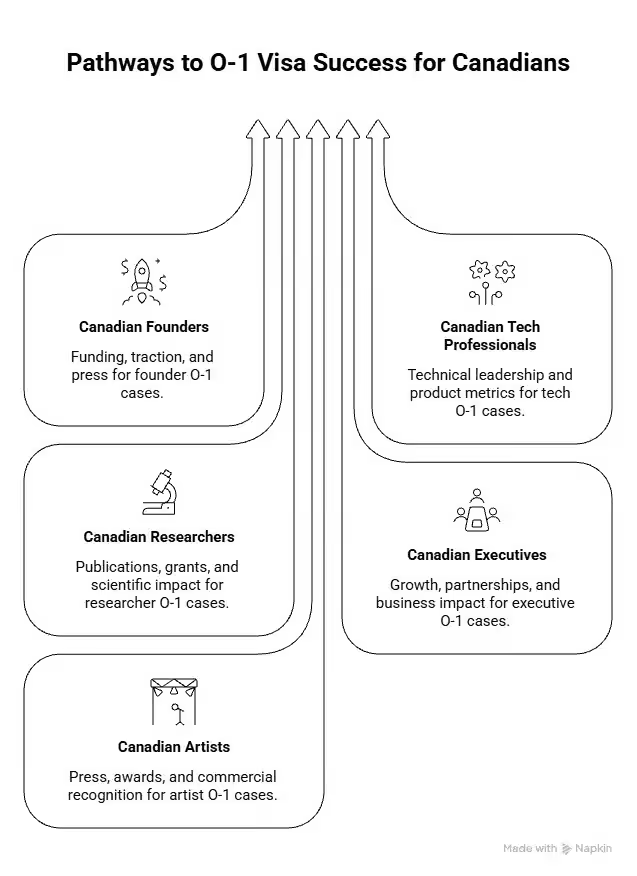
The best O-1 profiles are not limited to one industry. What matters is whether the applicant has evidence of achievement, recognition, and impact.
Canadian founders may qualify when they have funding, accelerator admission, revenue, product traction, press, awards, patents, or expert validation. Founder cases need careful planning because ownership, control, petitioner structure, and U.S. work authorization must be handled properly.
Canadian technology professionals may qualify when they have built important systems, AI models, cybersecurity tools, developer infrastructure, or products with measurable value. Strong evidence may include technical leadership, patents, open-source adoption, product metrics, or expert letters.
Canadian researchers, healthcare professionals, and biotech specialists may qualify when they have publications, citations, grants, peer review, patents, clinical innovation, or scientific impact. The strongest cases show how the work contributed to research, healthcare, product development, or the broader field.
Canadian executives and business leaders may qualify when they have led growth, built partnerships, held critical roles, earned strong compensation, received press, or worked at distinguished organizations. The case should show measurable business impact and recognition beyond a normal leadership role.
Canadian artists and creative professionals may qualify under O-1B if they have press, awards, major productions, exhibitions, performances, reviews, or commercial recognition. The evidence should show distinction in the creative field, not just regular employment or project participation.
A Canadian applicant may look eligible for TN but still need O-1 if the role is too senior, hybrid, or founder-driven. Another applicant may have a strong O-1 profile but use TN first because it is faster and the role clearly fits.
The right strategy depends on role fit, evidence strength, employer structure, timing, and long-term plans.

The O-1 is temporary. It does not automatically lead to a green card. But it can support a longer-term immigration plan.
Many Canadian professionals use O-1 while preparing for EB-1A or EB-2 NIW. Evidence used in an O-1 case, such as awards, press, original contributions, publications, judging, critical roles, and expert letters, may also help later.
Still, the standards are different. EB-1A usually requires stronger proof of sustained recognition. EB-2 NIW focuses on work with substantial merit and national importance.
If permanent residence is part of the plan, Canadians should think about the O-1A to green card pathway early.
Beyond Border helps Canadian professionals decide whether O-1, TN, H-1B, EB-1A, or EB-2 NIW is the right strategy.
For Canadians, the answer depends on the role, evidence, employer, timing, founder structure, and long-term green card goals. Some applicants should use TN. Some should pursue H-1B. Others may have a strong O-1 case or may be better suited for EB-1A, EB-2 NIW, or a staged strategy.
Beyond Border reviews your background, identifies usable O-1 evidence, highlights weak points, and works with immigration attorneys to build a focused petition strategy.
Yes. Canadians can apply for O-1 classification if they meet the extraordinary ability or achievement standard. Canadian citizenship may simplify the visa stamping process in many cases, but it does not reduce the evidence required for O-1 approval.
O-1 may be better when the applicant’s role does not fit a TN category, the applicant is a founder, or the case is based on strong achievements and recognition. TN may be better for straightforward roles that clearly match a listed USMCA profession.
O-1 may be better when the applicant wants to avoid lottery uncertainty or has a strong evidence profile. H-1B may be better for standard employer-sponsored roles where the job clearly qualifies as a specialty occupation and timing is not a major issue.
Canadian citizens generally do not need a visa stamp for many U.S. nonimmigrant classifications, but they still need proper petition approval and admission in the correct status. For O-1, that usually means an approved O-1 petition and admission in O-1 status.
Yes. Canadian founders can qualify if they show strong evidence of achievement, recognition, original contribution, company traction, funding, press, awards, or expert validation. Founder cases also need careful petitioner and role structuring.
Yes. O-1 can support a longer-term green card strategy, often through EB-1A or EB-2 NIW. But O-1 does not automatically convert into a green card. The immigrant petition must be prepared separately.

Address: 4 W 4th Ave, San Mateo, CA 94402, United States
Email: info@beyondborderglobal.com