
Growth and marketing leaders can qualify for the O-1 visa if they can prove extraordinary ability in business through strong evidence of impact, recognition, and leadership. The case is not based on a marketing title alone. USCIS needs to see that the applicant has achieved a level of distinction beyond a normal professional role.
For growth leaders, CMOs, heads of marketing, demand generation leaders, and go-to-market professionals, that evidence may include revenue growth, market expansion, major campaign performance, brand recognition, press coverage, judging roles, awards, high compensation, or critical leadership at a distinguished company.
The challenge is that marketing success is often buried inside dashboards, revenue reports, board updates, campaign results, and internal business records. A strong O-1 visa case turns that scattered evidence into a clear story of individual achievement.
Yes, growth and marketing leaders can qualify for the O-1 visa. The O-1A category applies to people with extraordinary ability in sciences, education, business, or athletics. Marketing, growth, brand strategy, revenue leadership, and go-to-market work can fall under the business category when the evidence is strong enough.
The O-1 is not limited to engineers, founders, researchers, artists, or athletes. A chief marketing officer, head of growth, VP of marketing, demand generation leader, performance marketing expert, marketplace growth operator, or revenue marketing leader may have a possible O-1 case if their work shows unusual achievement and recognition.
A senior title can help explain the applicant’s role, but it does not prove eligibility by itself. USCIS does not approve an O-1 petition because someone is called “Head of Growth” or “CMO.” The petition must prove that the person stands out from others in the field.
A marketing leader may have useful evidence if they helped a company enter new markets, significantly increased revenue, led a high-performing acquisition strategy, became known in the industry, judged other professionals’ work, received selective awards, or earned compensation above peers.
This is similar to how O-1 visa cases for executives are evaluated. USCIS looks beyond the senior title and asks what the person actually contributed, how important the work was, and whether outside evidence supports their standing in the field.
For marketing leaders, the best cases usually combine measurable business results with external validation. Internal performance is helpful, but recognition outside the company often makes the case stronger.
USCIS needs to see what changed because of the applicant’s work. For growth and marketing leaders, that usually means proving measurable business results such as revenue growth, pipeline growth, user acquisition, customer retention, market expansion, improved conversion rates, lower customer acquisition costs, stronger brand visibility, or successful product launches.
A campaign is not strong O-1 evidence just because it was creative. It becomes stronger when the applicant can show clear results and explain their personal role in achieving them.
For example, a growth leader may show that they built an acquisition engine that increased qualified leads. A CMO may show that their repositioning strategy helped the company enter enterprise sales. A marketplace growth leader may show that they expanded supply and demand across new regions.
The key is to avoid vague claims like “led marketing” or “improved brand awareness.” A stronger case explains the business problem, the applicant’s actions, and the measurable result. Company success alone is not enough; the petition must show how the applicant personally contributed to that success.

Marketing leaders often have stronger O-1 evidence than they realize. The issue is that the evidence is usually scattered across dashboards, campaign reports, board updates, CRM records, press mentions, awards, and compensation documents. A strong case organizes that material around business impact and external recognition.
Revenue evidence can be especially useful for growth and marketing leaders. This may include marketing-sourced revenue, pipeline contribution, sales-qualified lead growth, improved conversion rates, stronger return on ad spend, reduced acquisition cost, or increased customer lifetime value.
For B2B leaders, useful proof may include pipeline dashboards, enterprise deal attribution, board decks, CRM reports, account-based marketing results, or executive summaries showing how marketing influenced revenue.
For consumer growth leaders, evidence may include user growth reports, app downloads, retention improvements, activation metrics, referral results, paid acquisition performance, or geographic expansion data.
Market expansion can support an O-1 case when the applicant played a major role. For example, a marketing leader may show that they helped launch a product in the U.S., entered new international markets, built demand in a new region, adapted positioning for a new customer segment, or created a repeatable go-to-market playbook.
Brand impact can also help, but it should be tied to measurable proof. Stronger evidence may include brand-lift studies, press coverage, audience growth, speaking invitations, analyst recognition, major partnerships, or increased demand from a defined customer segment.
External recognition can make a marketing O-1 case stronger. Awards may include marketing awards, campaign awards, startup leadership awards, growth leadership recognition, industry lists, business rankings, or selective honors. The award should be credible, competitive, and tied to the applicant’s individual work.
Press coverage can also help when it discusses the applicant’s work, leadership, campaign strategy, growth results, or market impact. Company press is stronger when it names the applicant or clearly connects the company’s success to their contribution. Beyond Border’s guide on O-1 visa published material explains how credible media coverage can support this criterion.
Judging may include evaluating marketing awards, startup pitch competitions, accelerator demo days, case competitions, brand strategy contests, or growth-related panels.
High compensation may also support the case when salary, bonus, equity, commissions, or total compensation is meaningfully above peers. Beyond Border’s article on O-1 visa high compensation explains why salary evidence must be benchmarked against others in the same field, role, location, and level.
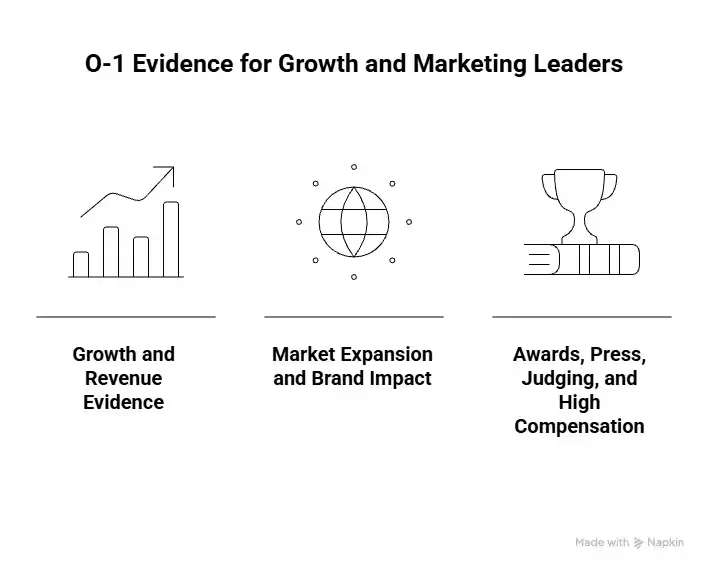

A non-technical O-1 case must be built around business value. Marketing leaders usually do not rely on patents, citations, code, or technical infrastructure. Instead, they need to prove extraordinary ability through measurable business results, leadership, and external recognition.
That does not make the case weaker. It simply means the evidence must be explained in clear business terms.
The first step is defining the applicant’s field correctly. A broad field like “marketing” may be too vague. A stronger framing may be growth marketing, B2B SaaS demand generation, marketplace growth, fintech marketing, consumer brand strategy, revenue marketing, product-led growth, or global go-to-market strategy.
This matters because USCIS needs to understand who the applicant is being compared against. A B2B demand generation leader should not be framed the same way as a social media marketer. A marketplace growth operator should not be framed like a traditional brand manager.
The evidence should not be presented as a general career summary. It should be organized around O-1 criteria such as awards, published material, judging, original contributions, critical role, high compensation, or leading roles for distinguished organizations.
For a business professional, this means showing how their work affected revenue, users, market expansion, customer acquisition, brand visibility, or company growth.
Many marketing achievements sound ordinary unless they are explained properly. “Improved conversion rate” becomes stronger when the petition explains that the improvement increased revenue, reduced acquisition cost, or unlocked a new growth channel.
The goal is to show the business problem, the applicant’s action, and the measurable result. This helps USCIS understand why the work was important, not just what the applicant was responsible for.
Recommendation letters can help, but they should not replace objective evidence. Strong letters should explain the business challenge, the applicant’s specific role, the result, and why that result was unusual or important.
Weak letters only say the applicant is talented, hardworking, or respected. A strong O-1 visa recommendation letter should support the business impact story with specific examples, measurable outcomes, and credible industry context.
Marketing leaders can build strong O-1 cases, but the evidence needs to be framed carefully. Unlike technical applicants, their achievements may not appear in patents, publications, or code repositories, so the case must clearly explain business impact.
If a company grew, raised funding, entered new markets, or improved revenue performance, the petition should explain what the applicant personally did to support that result. This may include showing ownership of the strategy, campaign, launch, growth channel, positioning, or revenue initiative that produced the outcome.
Campaigns, brand strategy, and growth initiatives are stronger when tied to revenue, pipeline, users, conversion rates, acquisition costs, market expansion, or other business outcomes. The stronger the metrics, the easier it is to show that the applicant’s work created value beyond a normal marketing role.
Press, awards, and compensation can also help, but they need context. The case should explain why the recognition is credible, selective, and relevant to the applicant’s field. For example, an award or media feature is more useful when it shows industry recognition of the applicant’s leadership, not just general company promotion.
A strong O-1 case for marketing leaders does not need to overstate the profile. It needs to connect the applicant’s work to clear business value, external recognition, and a well-documented record of achievement. The goal is to make it easy for USCIS to understand why the applicant stands out in their business field.
The O-1 visa is not the only U.S. work visa option for marketing and growth leaders. The right path depends on the applicant’s evidence, employer structure, nationality, timing, and long-term green card plans.
For high-performing marketing leaders with strong recognition, measurable business impact, and senior-level achievements, the O-1 may be a strong option because it is not tied to the H-1B lottery. However, some applicants may be better suited for H-1B, L-1, E-2, EB-1A, or EB-2 NIW depending on their situation.
For many marketing leaders, the O-1 works best when they have strong proof of individual achievement but need a flexible U.S. work option faster than a green card route. Applicants planning long-term U.S. relocation may also compare O-1 with EB-1A, EB-2 NIW, or L-1, depending on their background and business plans.
Beyond Border helps growth and marketing leaders quickly assess whether their business achievements can support an O-1 case. We review evidence such as revenue impact, campaign results, market expansion, press, awards, judging roles, compensation, and executive letters to identify what is strong, what is weak, and what needs more work.
If your profile fits, Beyond Border helps structure the business impact story and works with immigration attorneys on a focused O-1 strategy. If another route makes more sense, we help you understand that early.
If you are exploring the O-1 visa, contact Beyond Border to evaluate your profile.
Schedule your free consultation and profile evaluation.
Yes. A marketing leader may qualify for the O-1A visa if they can prove extraordinary ability in business. The case should show strong evidence of impact, recognition, leadership, and achievements beyond a normal marketing role.
Revenue growth can support an O-1 case when it is clearly tied to the applicant’s personal contribution. The petition should explain what the applicant did, how the work affected revenue, and why the result was significant.
Yes. A CMO can qualify for an O-1 visa if the evidence shows extraordinary ability in business. The title alone is not enough, but executive-level impact can be useful when supported by strong documentation.
Marketing awards can help if they are selective, recognized, and connected to the applicant’s individual work. Awards with clear judging standards, industry reputation, and competitive selection are usually stronger than generic certificates.
Press about the company may help, but it is stronger when it mentions the applicant or clearly connects the company’s success to the applicant’s work. USCIS needs to understand the person’s individual achievement.
Not necessarily. Non-technical professionals can qualify, but their evidence must be explained carefully. Marketing and growth achievements often need more context because the work may not be as easy to document as patents, publications, or technical systems.


Address: 4 W 4th Ave, San Mateo, CA 94402, United States
Email: info@beyondborderglobal.com