
Business executives qualify for O-1A when their leadership record demonstrates extraordinary ability in business through documented business impact, industry recognition, and sustained national or international acclaim. The category is not restricted to academic or scientific professionals; C-suite executives, senior VPs, and founders with documented strategic impact across their careers can satisfy the eight USCIS evidentiary criteria. The challenge is translating executive achievements, which are often attributed to entire organizations rather than individuals, into evidence of personal leadership impact that USCIS can evaluate against the regulatory standard. Beyond Border is an immigration firm specializing in O-1A petitions for executives and business leaders.
Growth and marketing leaders can also review our O-1 visa guide for marketing leaders for evidence tied to revenue, campaigns, market expansion, and business impact.
[Check the USCIS processing times page for current O-1 processing estimates, as USCIS updates these weekly.]
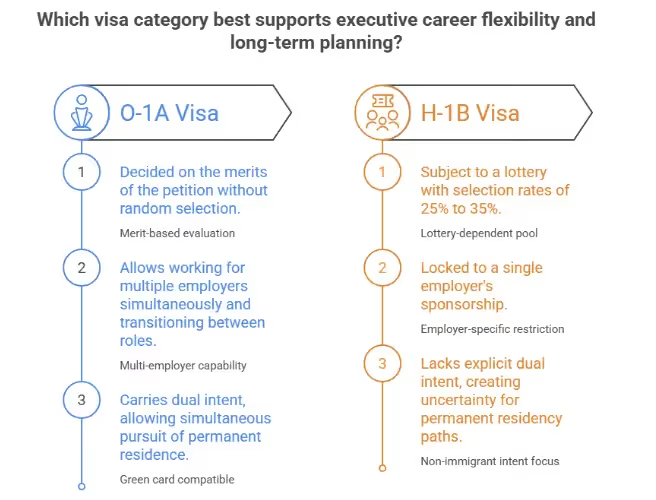
The O-1A offers structural advantages that employer-dependent or lottery-based categories do not.
There is no annual cap and no lottery. H-1B requires lottery selection from a fixed annual pool of 85,000 visas, with selection rates of 25% to 35%. O-1A applications can be filed at any time and are decided on the merits of the petition, not random selection. For executives whose business plans, board appointments, or operational roles have fixed timelines, the lottery dependency of H-1B creates unacceptable planning uncertainty.
The O-1A also allows working for multiple employers simultaneously and transitioning between roles with relative flexibility. Each new employer files a separate petition, but the applicant is not locked to a single employer's sponsorship. Executives who serve on multiple boards, advise multiple companies, or anticipate role transitions find this structure more practical than an employer-specific visa.
The O-1A carries dual intent. Executives pursuing EB-1A or EB-1C green card simultaneously do not jeopardize their O-1A status. For executives whose long-term U.S. strategy involves permanent residence, the O-1A provides work authorization immediately while the green card petition progresses. For a comparison of O-1A and H-1B across all structural dimensions, see the O-1 vs H-1B guide.

USCIS requires executives to satisfy at least three of eight O-1A evidentiary criteria, or demonstrate receipt of a major internationally recognized award. For business executives, the following criteria are most frequently applicable.
Total compensation significantly above the peer group for executives at comparable companies, industries, and career stages satisfies this criterion. USCIS evaluates total remuneration including base salary, bonus, equity, and board fees rather than base salary alone.
Strong evidence: Offer letters and compensation agreements documenting total compensation components; equity grant documentation with valuation at time of grant; board compensation from multiple positions; and an industry executive compensation survey from a recognized source (Radford, Mercer, or Aon) confirming that the total package places the applicant above the 90th percentile for executives in comparable roles and company sizes.
Compensation that is merely at market rate for the company's size and industry does not satisfy this criterion. The remuneration must be demonstrably exceptional relative to peers.
C-suite roles (CEO, CFO, COO, CTO, CMO) and senior executive positions at organizations with distinguished reputations satisfy this criterion when both conditions are independently established: the role is genuinely critical or leading, and the organization is distinguished.
Strong evidence: A letter from a board member, investor, or recognized business leader explaining the specific strategic decisions the applicant made that were critical to the organization's direction; an organizational chart confirming the reporting structure and scope of authority; documentation of the organization's distinguished reputation through revenue scale, funding from recognized investors, press coverage in recognized publications, or industry standing; and financial documentation confirming the scale of operations under the applicant's leadership.
A VP title at a small, obscure company without documented strategic impact does not satisfy this criterion. The organization and the role within it must both independently qualify as distinguished and critical.
Coverage in recognized business media that discusses the applicant's specific leadership, strategy, or achievements satisfies this criterion when the coverage is editorial rather than promotional.
Strong evidence: Profiles and features in publications with editorial standards such as Forbes, Harvard Business Review, Inc., Wall Street Journal, Bloomberg, or recognized industry publications; interview articles focused on the applicant's strategic decisions or leadership approach; case studies about organizations the applicant led that appear in recognized business journals or publications.
Press releases issued by the applicant's company, self-published content, or brief mentions in directories do not satisfy this criterion. The coverage must be substantive, editorially selected, and focused on the applicant's specific contributions.
Board positions, advisory roles, startup competition judge positions, and investment committee membership all potentially satisfy this criterion when the applicant's judgment is being sought at a level that reflects peer recognition of their standing in the field.
Strong evidence: Corporate board of directors appointment letters with documentation of board responsibilities and strategic contributions; advisory board appointments at recognized companies or venture capital firms with documentation of the advisory role; judge or selection committee positions at recognized startup competitions or industry awards with documentation of the competitive process; investment committee membership at recognized funds.
Informal mentorship, one-time judging at minor events, and internal committee roles do not carry the same weight. For a detailed breakdown of the judging criterion across contexts, see the O-1 judging evidence guide.
Business model innovations, market-creating strategies, or management frameworks that others have adopted satisfy this criterion when the contribution and its adoption are documented.
Strong evidence: A business model that competing companies have replicated, with independent documentation of the replication; a go-to-market strategy cited in industry research or adopted by other companies with third-party evidence of the adoption; a management framework published and cited by others; or a strategic innovation documented in recognized business publications as having influenced the field.
Internal company strategies that are not documented outside the organization, incremental improvements to existing practices, and claimed innovations without third-party validation do not satisfy this criterion.
Competitive business awards with documented selection criteria and peer judging satisfy this criterion when the award is from a recognized organization and the selection process is documented.
Strong evidence: Major entrepreneurship awards (EY Entrepreneur of the Year); industry-specific executive recognition awards with documented competitive selection; recognized business lists (Forbes 30 Under 30, 40 Under 40) with documented selection criteria; innovation awards from recognized organizations with competitive evaluation processes.
Internal company recognition, participation awards without competitive selection, and awards from organizations without established industry standing do not qualify.
Invitation-only executive peer groups and industry associations that require demonstrated business achievement for membership satisfy this criterion when the organization's membership standards are documented.
Strong evidence: Young Presidents' Organization membership with documentation of the revenue and age eligibility requirements; World Economic Forum membership; invitation-only CEO forums with documented admission criteria; and industry association board positions that require election or demonstrated excellence for appointment.
General business associations, open-enrollment groups, and organizations that accept all applicants regardless of achievement level do not satisfy this criterion.

Software products, research papers, and artistic works have clear individual authorship. Business results do not. USCIS evaluates individual leadership impact rather than organizational performance, which requires deliberate documentation of what the petitioner personally decided and directed.
Strategy documents bearing the petitioner's name: Board presentations, strategic plans, and organizational transformation documents that the executive authored establish individual attribution for the strategic direction they represent. These should be referenced in the petition with context explaining the decisions made and their outcomes.
Letters from independent peers: Recommendation letters from board members, investors, co-founders, or recognized industry figures who did not have a direct supervisory relationship with the petitioner carry significantly more weight than letters from direct reports or subordinates. Letters should address specific strategic decisions the petitioner made and explain their significance relative to industry peers. For guidance on how to structure these letters, see the O-1 visa reference letter guide.
Quantified outcomes with clear causal attribution: Every claim about business impact should specify the metric, the timeframe, the starting point, the ending point, and the specific action the petitioner took that caused the result. "Revenue grew from $15M to $75M during tenure" is weak attribution. "The strategic product expansion into enterprise software, directed by the petitioner and described in the attached 2022 board presentation, drove revenue from $15M to $75M between 2021 and 2024" establishes individual attribution with supporting documentation.
Standard O-1 processing takes approximately 11 months. Premium processing via Form I-907 costs $2,965 effective March 1, 2026 and guarantees USCIS action within 15 business days. Premium processing is appropriate when a board appointment, a fundraising process, or an operational role has a fixed start date that standard processing cannot accommodate.
The I-129 base filing fee for standard employers is $1,055; for small employers (25 or fewer full-time equivalent employees), the fee is $530. The Asylum Program fee and Visa Integrity fee apply additionally.
Preparation time for executive O-1A petitions typically runs 2 to 4 months, covering evidence gathering, letter coordination, compensation data compilation, and petition drafting. Total timeline from start of preparation to approval under standard processing: 4 to 8 months.
Common RFE triggers for executive petitions include: insufficient evidence isolating the applicant's individual strategic decisions from organizational performance; compensation evidence without market benchmarking establishing the top-percentile claim; award documentation without selection criteria showing competitive evaluation; and board or advisory role documentation that does not explain the strategic significance of the role.
For guidance on how O-1A status connects to the EB-1A or EB-1C green card pathways, see the O-1 to EB-1A transition guide. For a comparison of O-1A and EB-1A across evidentiary standard, employer structure, and filing timeline, see the O-1A vs EB-1A guide.
Attribution of team success to individual leadership. Business outcomes are produced by organizations. USCIS requires evidence that the petitioner made specific strategic decisions that drove the documented results, not simply that results occurred during their tenure. Petitions that describe organizational outcomes without establishing individual decision-making fail to satisfy the individual contribution standard.
Title inflation across company sizes. A VP or C-suite title at a small, early-stage company without documented strategic authority or organizational impact differs materially from the same title at a recognized organization. USCIS adjudicators examine whether the actual role responsibilities and scope of authority match the criteria standard, not whether the title sounds impressive.
Insufficient breadth of recognition. The O-1A requires sustained national or international acclaim, not recognition within a single company, industry sector, or regional market. Executives who have strong records within a specific employer or industry but limited external recognition may satisfy individual criteria without reaching the final merits standard that the petition as a whole must meet.
Compensation without benchmarking. High compensation is among the most accessible criteria for executives, but only when documented with market comparison data. A compensation figure without a supporting survey showing where it falls in the national distribution for comparable executive roles does not satisfy the criterion.
Startup employees who are not founders may still qualify through critical-role and impact evidence, which we cover in our O-1 visa guide for startup employees.
For executives who are product managers or who lead product organizations, field-specific evidence guidance is available in the O-1 visa for product managers guide. For founders pursuing O-1A, see the O-1A for startup founders guide.
Beyond Border is an immigration firm focused on employment-based high-skilled visa and green card pathways. For executive O-1A petitions, the firm identifies which of the eight criteria the applicant's record most strongly supports, designs the peer letter strategy around independent validators rather than direct reports, and builds the business impact narrative to establish individual attribution for specific strategic decisions.
Clients include executives from Google, Salesforce, JP Morgan, Chime, Visa, and Mastercard. A money-back guarantee applies if the petition is unsuccessful. Petitions are submitted within one month of receiving all supporting documents.
To evaluate which O-1A criteria your executive profile most strongly satisfies and whether the record supports a petition filing in 2026, book a free consultation with Beyond Border.
Yes, business executives can qualify for an O-1A visa by demonstrating extraordinary ability through strategic business impact and industry recognition. Most qualifying executives have 7-10+ years of experience at the C-suite or senior VP levels with documented revenue growth, successful exits, or market transformations.
Executives commonly command high salaries (top 10% at $300,000-$500,000+ total comp), hold critical roles as CEO/CFO/COO with strategic authority, have published material in Forbes/HBR or media coverage, and demonstrate judgment through board positions. You need 3 of the 8 criteria total.
Executives prove extraordinary ability through quantifiable outcomes: revenue growth (e.g., $10M to $100M), successful exits or IPOs, major fundraising rounds ($20M+), market share gains, profitability improvements, plus industry recognition through board positions, speaking, awards, and media coverage.
Company size matters less than impact and innovation. Focus on business model innovation, rapid growth metrics, industry disruption, strategic complexity, and founder/early executive attribution. Startups often provide clearer individual impact than large corporations with distributed decision-making.
Most successful O-1 cases require 7-10+ years of progressively responsible leadership at director, VP, or C-suite levels. Early-career executives (3-5 years) typically lack sufficient sustained acclaim. Exceptions exist for executives with major exits, exceptional growth records, or significant prior achievements.
VP-level executives can qualify if they demonstrate strategic scope, substantial business impact, and industry recognition. USCIS evaluates actual responsibilities and outcomes, not just titles. Strong VP cases show revenue/P&L ownership, strategic decision authority, and measurable business transformation under their leadership.
Document revenue growth (absolute and percentage), profitability improvements (EBITDA, margins), fundraising success (amounts and investor quality), market expansion (geographic or product), headcount growth, customer acquisition, market share gains, cost reductions, and successful exits. Always include before/after comparisons and timeframes.
O-1 requires extraordinary ability but offers longer validity (3 years vs. 7 years for L-1) and no company relationship requirement. L-1 requires 1 year with a foreign company, but a lower qualification bar. O-1 provides a direct EB-1A path; L-1 leads to EB-1C, which requires proof of managerial capacity.
File O-1A first, then EB-1A later. O-1A provides work authorization while building additional business achievements for the EB-1A green card. Typical path: O-1A approval → work 1-2 years building more recognition → file EB-1A for permanent residence using strengthened evidence.
Use aggregate metrics without disclosing proprietary details: revenue ranges instead of exact figures, percentage improvements without baseline disclosure, sanitized case studies, third-party validation through awards or media coverage. Executive testimonials from board members or investors can validate confidential achievements without full disclosure.


Address: 4 W 4th Ave, San Mateo, CA 94402, United States
Email: info@beyondborderglobal.com