O-1A visa eligibility is based entirely on professional achievement and recognition rather than educational credentials or employer sponsorship. There is no degree requirement, no annual cap, and no lottery. The O-1 Visa application is decided on the strength of the petitioner's documented record. Understanding O-1A extraordinary ability qualifications 2026 before beginning evidence preparation prevents the most common failure mode: filing with achievements that are real and significant but documented in ways that do not satisfy USCIS adjudication standards. Beyond Border is an immigration firm specializing in O-1 Visa petitions.
[Check the USCIS processing times page for current O-1A processing estimates, as USCIS updates these weekly.]
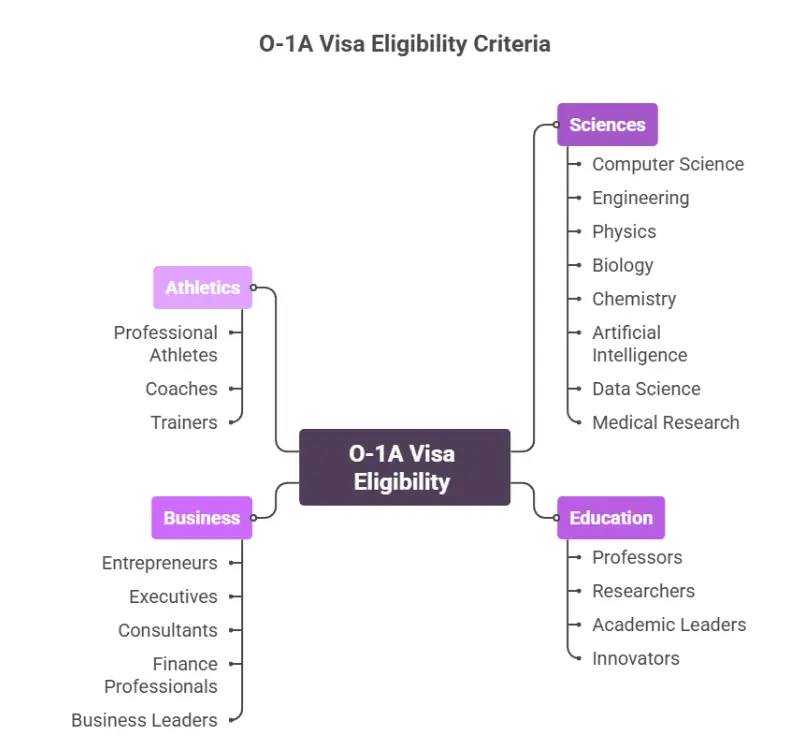
O-1A visa eligibility is open to individuals who can demonstrate extraordinary ability in the sciences, education, business, or athletics. The specific fields covered by the sciences category include computer science, engineering, physics, biology, chemistry, artificial intelligence, data science, medical research, and related disciplines. Business covers entrepreneurs, executives, consultants, finance professionals, and business leaders with recognized and documented professional impact. Education covers professors, researchers, academic leaders, and innovators whose work has significant reach. Athletics covers professional athletes, coaches, and trainers with documented competitive success at national or international levels.
O-1A does not cover the arts, motion picture, or television. Those fields fall under O-1B, which applies different evidentiary standards. Who qualifies for O-1A must fall within one of the qualifying fields.
The key question for O-1A eligibility assessment is not whether a professional is skilled or successful, but whether their record demonstrates the type of national or international recognition that places them among the small percentage at the very top of the field. Highly competent professionals with clean employment records and solid credentials do not automatically qualify; O-1A requires documented evidence that others in the field have recognized the petitioner's work as exceptional.

O-1A criteria requirements specify that the petitioner must satisfy at least three of the following eight USCIS regulatory criteria, or present evidence of a major internationally recognized award.
Awards or prizes for excellence. Nationally or internationally recognized prizes awarded through competitive selection by recognized bodies. The award must document the selection process and criteria. Company employee recognition awards, participation certificates, and awards without competitive external selection do not satisfy this criterion.
Membership in associations requiring outstanding achievement. Associations where admission is determined by recognized experts and requires demonstrated professional achievement. Open-enrollment professional associations, LinkedIn groups, and organizations that accept all applicants do not qualify. For a curated list of qualifying associations for technology professionals, see the 25 credible O-1 associations guide.
Published material about the petitioner. Articles in recognized professional publications or major media that discuss the petitioner's specific work. The coverage must be editorially selected, not promotional. Company press releases, internal newsletters, and self-published content do not satisfy this criterion independently.
Participation as a judge of others' work. Serving as a peer reviewer, editorial board member, grant panel reviewer, conference program committee member, or competition judge when selection as a judge was merit-based. Informal peer feedback and one-time reviews without formal organizational structure are not sufficient. For the full judging evidence framework, see the O-1 judging evidence guide.
Original contributions of major significance. Technical innovations, research findings, or business methodologies that have been adopted by others or materially influenced the field, with adoption and impact documented through independent sources.
Authorship of scholarly articles. Published work in professional journals or major media with editorial standards. Self-published blog posts without significant independent editorial process do not satisfy this criterion.
Critical or leading role at a distinguished organization. Holding a leading or critical role at an organization with a distinguished reputation, where both the role's critical nature and the organization's standing are independently documented. Mid-level positions at well-known companies, without evidence of the role's specific critical function, do not satisfy this criterion.
High salary or remuneration relative to others in the field. Total compensation significantly above the field norm for comparable career stage and geography, documented with industry benchmark data from a recognized source.
O-1A visa evidence requirements mandate objective, verifiable documentation for each criterion claimed. USCIS does not accept unsupported assertions. Every qualifying achievement must be backed by primary source documentation that can be independently verified.
Strong evidence includes: official award certificates with documentation of the selection process and criteria; published articles in recognized outlets with the publication's circulation or standing documented; citation records and impact metrics from recognized academic or industry databases; conference programs listing the petitioner as a speaker, reviewer, or panelist; letters from recognized independent experts who address specific achievements and explain their significance relative to others in the field; and compensation documentation alongside industry benchmark surveys from recognized providers.
Weak evidence that consistently fails to satisfy O-1A criteria requirements includes: testimonials from close colleagues or direct supervisors without independent recognized standing; internal company recognition without external validation; achievements described in subjective terms without quantification; and documentation that refers to the employer's reputation rather than the petitioner's individual standing.
A critical O-1A eligibility assessment point: employment at a well-known company does not substitute for individual achievement evidence. USCIS evaluates what the petitioner specifically accomplished and how that was recognized externally, not where they worked. A software engineer at a prominent company who has not documented individual impact beyond the organization does not satisfy O-1A visa eligibility regardless of employer prestige.
Achievements real, documentation insufficient. Many professionals have genuinely impressive records but have not maintained the documentation to evidence it. Award certificates misplaced, judging invitations deleted, peer review records not saved. Building documentation proactively from the moment of the activity is essential.
Recognition confined to a single employer. USCIS distinguishes between professional recognition within an organization and national or international recognition by the broader field. A petitioner well-known within their company but not in the external professional community does not satisfy the sustained national or international acclaim standard.
Early-career profiles without sustained recognition. O-1A extraordinary ability qualifications 2026 require sustained recognition over time, not a single achievement. Professionals with fewer than five years of post-educational career experience generally have not accumulated the depth and breadth of recognition the standard requires. Early-career applicants with exceptional accelerated records are the exception, not the rule.
Criteria met technically with minimal evidence. Satisfying three criteria at the threshold level does not guarantee approval.. After the criteria threshold is met, USCIS conducts a holistic review of whether the totality of evidence demonstrates sustained extraordinary ability. Petitions with thin documentation across three criteria consistently fare worse than petitions with strong documentation across four or five. For the full discussion of how this holistic review works, see the O-1A vs EB-1A guide.
Lack of independent expert validation. Recommendation letters from colleagues at the petitioner's level, direct supervisors, or people without recognized external standing in the field carry significantly less weight than letters from independent recognized experts. USCIS expects validation from people whose recognition of the petitioner's work carries meaningful evidentiary weight.
Technology and software professionals: O-1A eligibility is most compelling for engineers with products at documented adoption scale, contributors to widely adopted open source projects, recipients of technical awards from recognized industry bodies, conference speakers at selective events, and peer reviewers for recognized publications. Titles and compensation at major tech companies support the salary criterion but do not independently establish extraordinary ability. For the full evidence framework for software engineers, see the O-1A visa processing time and evidence guide.
Founders and entrepreneurs: O-1A eligibility is strongest for founders with documented significant venture funding from recognized investors, substantial revenue or user base with media coverage in recognized publications, innovation adopted by other organizations, and industry awards from recognized entrepreneurship bodies. For the full startup founder framework, see the O-1A for startup founders guide.
Researchers and scientists: O-1A eligibility is clearest for researchers with strong publication records in recognized venues, citation counts that demonstrate impact by the field's standards, peer review invitations from recognized journals, research grants as principal investigator, and membership in selective academic associations.
Business executives: O-1A eligibility requires documenting individual strategic outcomes rather than organizational performance. High compensation documented with market benchmarks, critical roles at distinguished organizations with evidence of specific strategic authority, and external recognition through media coverage and advisory positions all support eligibility.
For professionals evaluating long-term paths, O-1A provides a direct stepping stone to the EB-1 Green Card through EB-1A, with evidence transferring directly between both petitions. For the full transition framework, see the O-1 to EB-1A pathway guide. For a comparison of the O-1A and H-1B across cap, lottery, and evidentiary requirements, see the O-1 vs H-1B guide.
Beyond Border is an immigration firm focused on employment-based high-skilled visa and green card pathways. For O-1A eligibility assessment, the firm evaluates which of the eight criteria the petitioner's existing record most convincingly satisfies, identifies evidence gaps before the petition is filed rather than after, and advises on whether profile development over three to six months would materially strengthen the case before submission.
For professionals also considering the EB-1 Green Card or EB-2 NIW as a parallel track, the firm evaluates O-1A eligibility alongside immigrant petition eligibility in a single intake assessment.
If you want to turn these criteria into a quick profile check, use our O-1 visa eligibility result page after reviewing the evidence categories.
A money-back guarantee applies if the petition is unsuccessful. To evaluate your O-1A visa eligibility before beginning evidence preparation, book a free consultation with Beyond Border.
Extraordinary ability in sciences, education, business, or athletics demonstrated by sustained national or international recognition. You must meet at least 3 of the 8 USCIS criteria (awards, memberships, publications, judging, contributions, articles, critical role, high salary) or have received a major international award. Evidence must show you're among the small percentage at the top of your field.
Yes. O-1A has no educational requirements. Qualification is based entirely on your achievements and recognition in your field, not your degrees. Many successful O-1A holders don't have advanced degrees.
There is no minimum experience requirement, but most successful applicants have 5-10+ years of experience in their field. Building sustained national recognition typically requires time. Early-career professionals can qualify with exceptional achievements, but it's challenging.
No. You need recognition within your professional field, not public fame. A researcher known among academics, an engineer recognized by other engineers, or an executive known in your industry can qualify. Recognition by experts in your field matters more than general public awareness.
Yes. Software engineering falls under the O-1A category of sciences. Engineers qualify through open-source contributions, technical publications, patents, conference speaking, lead roles on significant products, or technical awards. Many tech professionals successfully obtain O-1A visas.
Internal recognition alone isn't sufficient. USCIS requires national or international recognition from sources other than a single employer. You need external validation through publications, awards from external organizations, media coverage, or recognition from experts in your field.
It's challenging without significant validation. Venture funding, accelerator acceptance, revenue growth, user adoption, or media coverage provide evidence of extraordinary ability. Early-stage founders without these markers typically need to build more traction before qualifying.
Through the totality of evidence. They review your awards, publications, expert letters, media coverage, contributions, and other criteria. Recommendation letters from recognized experts comparing you to others in your field help establish your standing. The evidence must convincingly demonstrate you're among the leading figures.
You can submit "comparable evidence" if standard criteria don't readily apply to your occupation. However, you must explain why the standard criterion isn't applicable and why your evidence comparably demonstrates extraordinary ability. The burden is on you to justify comparable evidence.
Yes. You can apply for O-1A regardless of your current location. However, you need a U.S. employer or agent to sponsor your petition. Once approved, you apply for the O-1A visa at a U.S. embassy or consulate before entering the United States.

Address: 4 W 4th Ave, San Mateo, CA 94402, United States
Email: info@beyondborderglobal.com