The O-1A visa is the primary U.S. work authorization pathway under the O-1 classification, for professionals with extraordinary ability in the sciences, business, education, or athletics. It has no annual cap, no lottery, and no degree requirement.
O-1A eligibility criteria are achievement-based rather than credential-based, making it accessible to accomplished professionals whose records would not qualify under standard employment visa categories. USCIS approved 93.8% of O-1 petitions in FY2025 Q3, with a Request for Evidence rate of 18.7%. Beyond Border is an immigration firm specializing in O-1 Visa petitions.
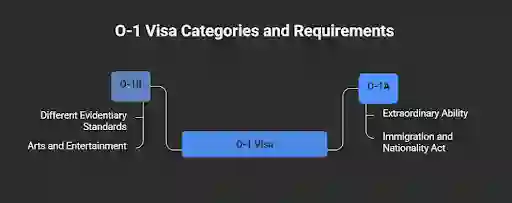
The O-1A is a nonimmigrant work visa authorized under Section 101(a)(15)(O)(i) of the Immigration and Nationality Act for individuals who have demonstrated extraordinary ability in the sciences, education, business, or athletics. The O-1B subcategory covers arts and motion picture and television entertainment under different evidentiary standards. Here’s a direct comparison.
Extraordinary ability for O-1A purposes means a level of expertise indicating that the individual is among the small percentage who have risen to the very top of the field nationally or internationally. This is evidenced through sustained recognition by peers, organizations, and the broader professional community, not simply through years of competent professional work.
The O-1A is widely used by startup founders and entrepreneurs with funded ventures and documented recognition, software engineers and AI researchers with documented technical impact, STEM researchers with publication and citation records, business executives with quantified strategic outcomes, and medical professionals with documented specialized achievements.
For country-specific planning, researchers, founders, and tech professionals from China can also review our O-1 visa guide for Chinese professionals.
For a structural comparison of the O-1A against the H-1B across cap, lottery, and evidentiary requirements, see the O-1 vs H-1B guide.

O-1A eligibility criteria require satisfying at least three of eight USCIS regulatory standards listed at 8 CFR 204.5(h)(3), or demonstrating receipt of a major internationally recognized award such as a Nobel Prize, Olympic medal, or equivalent.
Awards or prizes for excellence. National or internationally recognized prizes awarded through a competitive selection process judged by experts in the field. The competitive nature and selectivity of the award must be documented.
Membership in associations requiring outstanding achievement. Membership in organizations where admission is determined by recognized experts and requires demonstrated professional achievement, not simply payment of dues or open enrollment.
Published material about the applicant in professional publications. Coverage in recognized professional publications, major trade journals, or established general media that discusses the applicant's specific contributions. Editorial selection is required; self-published content and company press releases do not satisfy this criterion independently.
Participation as a judge of the work of others. Serving as a peer reviewer, editorial board member, grant panel reviewer, conference program committee member, or competition judge when selection as a judge was merit-based. For the full judging evidence framework, see the O-1 judging evidence guide.
Original contributions of major significance. Technical innovations, research findings, business methodologies, or frameworks that have been adopted by others or influenced the field beyond their immediate context. Adoption and documented impact are the key evidentiary requirements.
Authorship of scholarly articles or publications. Published work in professional journals, recognized technical publications, or major media with editorial standards. Conference papers accepted through competitive review, books from recognized publishers, and widely read engineering or research publications satisfy this criterion.
Employment in a critical or essential capacity. Holding a leading or critical role at an organization with a distinguished reputation where both the role's criticality and the organization's standing can be independently documented.
High salary or remuneration relative to others in the field. Total compensation (base, equity, and bonus combined) significantly above the field average for comparable career stage and geography, supported by industry compensation data from a recognized source.
The final merits review: Satisfying three criteria is the threshold, not the endpoint. USCIS then conducts a holistic review of whether the totality of evidence demonstrates sustained national or international acclaim at the very top of the field. Concentrated strength across fewer criteria consistently performs better than thin evidence distributed across many.
Who files: The O-1A cannot be self-petitioned. A U.S. employer or authorized agent must file Form I-129. For applicants who work across multiple employers, a U.S.-authorized agent can file a single petition covering all qualifying engagements with a detailed itinerary. This structure is commonly used by founders, consultants, and researchers with multiple institutional affiliations.
Advisory opinion: Most O-1A petitions require a consultation letter from an appropriate peer group, labor organization, or recognized industry association. USCIS may waive this in limited circumstances where no appropriate peer group exists. Advisory opinions typically take one to two weeks and cost between zero and five hundred dollars.
Evidence package: The complete petition includes the Form I-129 with the O supplement, the advisory opinion, an employment contract or itinerary of qualifying work, and the evidentiary record covering the satisfied criteria. Expert recommendation letters support the criteria claims and explain why the specific achievements demonstrate extraordinary ability. For guidance on how to structure effective recommendation letters, see the O-1 visa reference letter guide.
Filing timeline: Form I-129 may be filed up to six months before the intended start date. Filing with adequate lead time under standard processing, or using premium processing for time-sensitive employment arrangements, is the standard planning approach.
O-1A visa processing time under standard USCIS adjudication runs approximately 11 months as of 2026. Service center workload and petition complexity determine where within that range a specific case falls. For a service center-by-service center analysis and what factors affect processing time, see the O-1A visa processing time guide.
Premium processing via Form I-907 costs $2,965 effective March 1, 2026 and guarantees USCIS action within 15 business days. If USCIS issues an RFE, the premium clock pauses until the response is received and restarts for a new 15 business day period.
(Source: USCIS fee schedule effective April 1, 2024; Form I-907 updated March 1, 2026)
O-1A visa validity: Initial approval is granted for up to three years, based on the duration needed to complete the qualifying event or activity. Following the January 2025 USCIS policy update, extensions of up to three years are appropriate when new qualifying activities commence. Extensions are available in one-year increments with no statutory maximum as long as the qualifying extraordinary ability work continues.

The O-1A is a dual intent visa. Pursuing permanent residence concurrently does not jeopardize O-1A status, and USCIS policy confirms that pending I-140 petitions and I-485 applications are not grounds for O-1A denial or extension refusal.
O-1A to EB-1A: The O-1A and EB-1 Green Card (EB-1A extraordinary ability) share the same legal standard and overlapping O-1A eligibility criteria. Evidence from the O-1A petition, awards, publications, judging invitations, expert letters, and compensation data, transfers directly into the EB-1A I-140 without rebuilding from scratch. Many practitioners recommend filing both simultaneously. For the full transition strategy, see the O-1 to EB-1A pathway guide. For a comparison of the two evidentiary standards, see the O-1A vs EB-1A guide.
O-1A to EB-2 NIW: Professionals whose work addresses documented U.S. national priorities, particularly in STEM, healthcare, and economic competitiveness, may qualify for the EB-2 NIW self-petition as an alternative or parallel track. For this pathway, see the O-1 to EB-2 NIW guide.
For a full overview of green card options available to O-1A holders including timelines and priority date considerations by country, see the green card options for O-1A visa holders guide.
Generic or pay-to-join memberships. Associations that accept all applicants regardless of professional achievement do not satisfy the membership criterion. The organization's selection criteria must be documented and must require demonstrated outstanding achievement.
Team achievements presented as individual accomplishments. USCIS evaluates individual extraordinary ability. Evidence must isolate the petitioner's specific contributions through authored documents, independent attestation, and clear causal attribution.
Missing advisory opinion. The advisory opinion is mandatory for most O-1A petitions. Starting the consultation process early, at least two to three weeks before the planned filing date, prevents this common delay.
Thin evidence across multiple criteria. Meeting three criteria with strong, well-documented evidence and credible expert letters is more persuasive than meeting five or six criteria with minimal documentation for each.
Incomplete or vague recommendation letters. Letters that describe the petitioner positively but do not explain specifically why their achievements demonstrate extraordinary ability at the national or international level do not advance the petition. For guidance on what letters should include, see the O-1 visa reference letter guide.
Beyond Border is an immigration firm focused on employment-based high-skilled visa and green card pathways. For O-1A petitions, the firm assesses which of the eight O-1A eligibility criteria the applicant's record most strongly supports, structures the advisory opinion and expert letter strategy around those specific criteria, and builds the petition as a legal argument rather than a document assembly.
For founders, see the O-1A for startup founders guide. For the 2026 USCIS policy changes that affect O-1A adjudication, see the O-1A extraordinary ability 2026 USCIS changes guide.
Clients include professionals from Google, Salesforce, JP Morgan, Chime, Visa, and Mastercard. A money-back guarantee applies if the petition is unsuccessful.
To evaluate your O-1A eligibility and identify which criteria your professional record most strongly satisfies, book a free consultation with Beyond Border.
O-1A visa requirements 2026 require demonstrating extraordinary ability in sciences, business, education, or athletics through either a major internationally recognized award or at least three of eight USCIS evidentiary criteria. The employer or agent must also file Form I-129 and obtain an advisory opinion from a relevant peer group.
O-1A visa processing time under standard adjudication runs approximately 11 months. Premium processing at $2,965 guarantees USCIS action within 15 business days.
O-1A visa cost 2026 in government fees includes the I-129 base fee ($1,055 standard, $530 small employer), Asylum Program fee ($300 to $600), and Visa Integrity fee ($250). Premium processing adds $2,965. Total government fees without premium range from $1,155 to $1,905.
No. An O-1A petition must be filed by a U.S. employer or authorized agent. However, founders can use their own U.S. company as the petitioner with appropriate corporate governance, and agents can file covering multiple engagements simultaneously.
No. The O-1A is a dual intent visa. Pending I-140 petitions and I-485 applications are not grounds for O-1A denial or extension refusal. Filing O-1A and EB-1A simultaneously is standard practice.
No. O-1A has no degree requirement. Qualification is based entirely on extraordinary ability demonstrated through achievements and recognition, not educational credentials. Many successful O-1A holders don't have advanced degrees.
USCIS data show an overall approval rate of approximately 94% for O-1 petitions. Approval depends on the strength of the evidence and on clearly demonstrating that you meet the extraordinary ability standard through quality documentation.
Yes. O-1A is dual intent, meaning you can pursue permanent residency while on O-1A status. Most holders transition to EB-1A or EB-2 NIW green cards. Much of the O-1A evidence can be reused for green card applications.
O-1A is for sciences, education, business, and athletics. O-1B is for arts, motion picture, and television. They have different criteria and evidence requirements. Tech professionals, scientists, business executives, and athletes use O-1A. Artists, actors, and musicians use the O-1 B visa.
Yes. Spouse and unmarried children under 21 can receive O-3 dependent visas. However, O-3 holders cannot work in the U.S. They can study, but need separate work authorization to be employed.

Address: 4 W 4th Ave, San Mateo, CA 94402, United States
Email: info@beyondborderglobal.com