
The O-1 visa for climate tech professionals can be a strong option for founders, researchers, engineers, sustainability leaders, energy experts, and technical operators whose work shows recognized achievement in their field. Climate technology is broad. It may include renewable energy, battery storage, grid modernization, carbon removal, clean manufacturing, sustainable materials, climate risk modeling, energy efficiency, environmental engineering, or carbon removal technology.
A strong O-1 visa case must show outstanding achievements through evidence of achievement, recognition, leadership, original work, or measurable impact. According to USCIS, the O-1 category is for individuals with extraordinary ability in sciences, education, business, or athletics, among other fields, which is why many climate tech and energy professionals may fit under O-1A when the evidence is properly framed.
Yes. Climate tech and energy professionals can qualify for the O-1 visa if they can prove extraordinary ability through strong evidence. The O-1A category can apply to professionals in science, technology, engineering, business, and related fields.
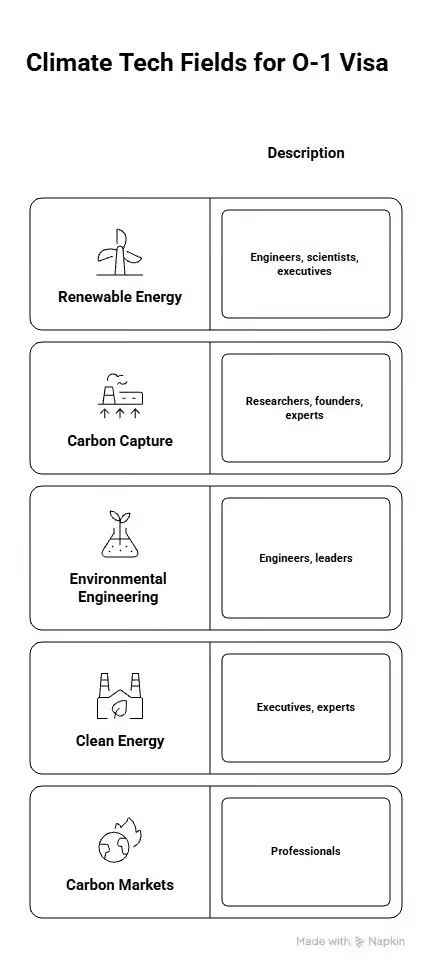
This may include the O-1 visa for renewable energy professionals, battery scientists, carbon capture researchers, climate software founders, environmental engineers, grid optimization experts, sustainability leaders, and clean energy executives.
It can also cover professionals working in carbon capture and storage, nature-based and tech-based climate solutions, battery storage, clean hydrogen, climate risk analytics, sustainable materials, circular economy, carbon markets, energy efficiency, and grid modernization.
The key is not the job title. USCIS needs evidence that the applicant stands out in their field. Strong proof may include patents, publications, grants, product adoption, venture backing, major customers, press coverage, expert letters, awards, judging roles, or critical leadership.
A strong O-1 case should clearly explain what the applicant built or led, why it mattered, and how others in the field recognized or used that work.
The O-1 visa for climate tech professionals may be eligible if applicants can demonstrate that their work is beyond the normal scope of a job. For USCIS, the focus is not only on whether the company is promising or whether the mission is important. The case must show what the applicant personally built, led, improved, or helped bring to market.
For climate tech founders, strong evidence may include venture funding, selective accelerator acceptance, climate grants, major customers, pilot programs, partnerships, press coverage, pitch competition wins, speaking invitations, judging roles, advisory roles, and expert letters.
Patents, grants, product adoption, and public-interest impact can also be useful when they show real traction. For example, a founder may show that their technology was deployed by customers, supported by a selective climate grant, tested in pilot programs, or connected to measurable results such as emissions reduction, energy savings, or improved climate risk analysis.
The evidence should always reflect the founder’s personal role. If a Scope 3 emissions platform gained enterprise customers, the case should explain whether the founder built the technical framework, shaped the product strategy, secured early users, led partnerships, or drove market adoption.
Applicants building or scaling climate startups should also review Beyond Borders’ guide to the O-1A visa for startup founders, because founder cases often need a careful petitioner structure, a strong evidence strategy, and a clear explanation of company traction.
Technical leaders can also build strong O-1 cases if their work resulted in a major product, platform, research program, or deployment. This may include a CTO, principal engineer, research lead, energy systems architect, or head of product who helped solve difficult technical problems or bring climate technology into real-world use.
Useful evidence may include patents, technical documentation, deployment records, product metrics, research outputs, grants, and expert letters. For CTOs and senior technical executives, the case should show how their leadership shaped product architecture, engineering direction, commercialization, or deployment. Read our guide on the O-1 visa for CTOs to better understand how technical leadership evidence can be framed for O-1.
The strongest evidence shows how the applicant’s technical work led to real results, such as better system performance, lower operating costs, improved reliability, stronger energy efficiency, or successful product deployment.

Most climate professionals do not need to focus on every O-1 criterion. The strongest cases usually center on the criteria that best match the applicant’s work, evidence, and field.
This is often one of the strongest criteria for an O-1 visa for climate tech professionals. It may include a carbon removal method, battery optimization system, clean energy platform, climate risk model, grid analytics tool, sustainable materials process, or emissions measurement technology.
The evidence should show that the work was used, adopted, funded, commercialized, cited, or recognized beyond the applicant’s own team. For founders, this should also connect to personal contribution, not just company progress. Beyond Border explains this further in its guide to O-1 original contribution evidence for founders.
This may apply if the applicant played an important role at a recognized climate startup, energy company, research institute, venture-backed company, government-backed program, or sustainability organization.
Examples include leading a battery deployment, building a carbon accounting product, managing a renewable energy platform, or driving a major climate partnership. This type of evidence is strongest when the applicant can show they were essential to a major project, product, or business outcome. Beyond Border’s guide to O-1 critical role evidence explains how to frame this clearly.
Scholarly articles and citations can support the case for an O-1 visa for climate tech professionals in research fields. For founders and industry leaders, published material may help if credible outlets discuss the applicant, their company, product, or climate work.
Examples include research on carbon capture, renewable energy systems, battery chemistry, climate modeling, sustainable materials, or media coverage about a clean energy project the applicant managed. If the case relies on media or industry coverage, it helps to understand what counts as O-1 published material and how to connect that coverage to the applicant’s recognition.
For startup founders, the evidence may need extra explanation because company achievements and personal achievements can overlap. Beyond Border’s guide to O-1 visa criteria for startup founders explains how founder evidence can be organized without relying only on company traction.

The O-1 and EB-2 NIW can both work for climate professionals, but they serve different goals. O-1 is usually better for temporary U.S. work authorization. EB-2 NIW is usually better for a long-term green card strategy.
For many climate professionals, the best approach is to use O-1 for near-term work in the U.S. and consider EB-2 NIW for permanent residence planning.
Beyond Border helps manage O-1 visas for climate tech professionals, energy leaders, sustainability experts, researchers, and founders to turn complex achievements into a clear O-1 strategy.
We help identify the strongest criteria, organize evidence, explain technical impact in plain English, and connect patents, grants, product metrics, deployments, and leadership achievements to immigration standards.
If you work in renewable energy, carbon removal, climate software, battery systems, energy infrastructure, sustainability, or environmental technology, a focused evidence strategy can strengthen your O-1 case.
Schedule your free consultation and profile evaluation.
Yes. Climate tech founders may apply for the O-1 visa if they can show extraordinary ability through evidence such as funding, awards, press, technical innovation, product adoption, judging, speaking, partnerships, or critical leadership. The key is proving the founder’s personal role, not just the company’s mission.
A patent can help, but it is rarely enough by itself. Stronger evidence shows whether the patent was used, cited, licensed, commercialized, adopted, or recognized by experts. USCIS will want to understand why the invention matters and how the applicant contributed to it.
Yes. Renewable energy engineers may qualify if they can show recognized achievement in areas such as solar, wind, battery storage, grid systems, energy optimization, hydrogen, carbon capture, or infrastructure modernization. Strong cases usually include measurable technical impact and independent recognition.
It depends on the applicant’s goal. O-1 may be better for temporary U.S. work authorization, while EB-2 NIW may be better for a long-term green card strategy. Many climate professionals consider both, especially if their work has national importance and strong evidence of impact.
Strong evidence may include awards, major projects, measurable emissions reduction, enterprise adoption, public-sector partnerships, industry recognition, speaking engagements, publications, grants, and expert letters. The evidence should show that the applicant’s work is recognized and meaningful beyond routine sustainability duties.
Media coverage can help, but it is not mandatory. Some applicants build strong cases through patents, publications, judging, grants, critical roles, product impact, high compensation, or expert letters. The best evidence depends on the applicant’s field and career history.


Address: 4 W 4th Ave, San Mateo, CA 94402, United States
Email: info@beyondborderglobal.com