
The O-1 visa for gaming professionals can be a strong option for esports players, streamers, creators, game developers, game designers, and gaming industry leaders who have built a recognized record in their field. Gaming is now a global industry built around competition, technology, design, audience growth, brand partnerships, and commercial impact.
For O-1 purposes, the most important aspect is having strong evidence to support your case. Strong evidence may include tournament results, rankings, awards, press, audience growth, revenue, game credits, technical contributions, sponsorships, platform recognition, or leadership in important projects.
Yes. Gaming and esports professionals can qualify for the O-1 visa if they have a standout in their field. This includes O-1 visas for gamers, esports players, streamers, gaming creators, game developers, studio founders, gaming executives, coaches, analysts, casters, and creative directors.
USCIS needs to understand their achievement and how it stands out in the gaming or esports industry. For example, an esports player may rely on tournament rankings, while a streamer may use platform growth and sponsorships, and a game developer may show their technical contributions and gaming products they have developed.

In the gaming industry, applicants may be suitable for both the O-1 visa for gaming categories. It depends on the role, what they do, and the evidence they can provide.
In general, O-1A is more suitable for gaming professionals involved in business, technology, and entrepreneurship. This may include esports players, founders, executives, technical game developers, and gaming platform builders.
O-1B is usually more suitable for professionals whose work is more related to entertainment such as creative, artistic, design-based, or creator-led. This may include streamers, creators, game artists, animators, narrative designers, composers, visual designers, and creative directors.
Game designers, UI/UX designers, visual designers, and creative directors should be positioned carefully because many gaming cases involve both creative and technical evidence.
A strong O-1 visa for gaming professionals should focus on the evidence that best proves recognition, personal contribution, and measurable impact. The strongest evidence will depend on the applicant’s role.
The O-1 visa for esports players, the strongest evidence usually comes from real competitive results. This may include tournament wins, high placements, international rankings, team contracts, prize money, sponsorships, press coverage, and invitations to selective competitions.
USCIS may not know whether a tournament is elite, regional, amateur, or globally recognized. That is why the petition should clearly explain the level of competition, the prize pool, the number of competitors, the viewership, and the event's reputation.
The O-1 visa for streamers and gaming creators, the strongest evidence usually comes from audience growth and industry recognition. This includes subscriber count, watch hours, engagement rate, platform recognition, sponsorships, brand deals, revenue, creator awards, collaborations, and media coverage.
A large audience can help, but it is stronger when there is outside proof that the creator is recognized. Press coverage, platform features, sponsorship income, awards, and brand partnerships can show that the creator’s reach and influence stand out in the gaming field.
The most relevant evidence for an O-1 visa for game developers and creative professionals usually includes shipped titles, official credits, player adoption, downloads, revenue, reviews, awards, patents, technical innovations, design work, production leadership, and expert letters.
If a game reached millions of users or earned major revenue, the petition should explain what the applicant personally built, improved, designed, led, or created. Press evidence should focus on independent articles that discuss the applicant, their work, or their contribution. Beyond Border’s guide on O-1 visa published material explains how USCIS looks at press and media coverage.
USCIS may not understand gaming terms, esports rankings, platform analytics, tournament structures, or creator economy metrics without explanation. A strong petition for an O-1 visa for gaming professionals should not assume that the officer knows why a Twitch metric, esports title, tournament result, or game credit matters.
The evidence should be explained in simple terms. For example, instead of only saying the applicant ranked highly in a game, explain how many players competed, how selective the ranking is, whether the competition was national or international, and why the result shows recognized achievement.
The same applies to streamers and developers. A large audience, major game credit, or platform feature can help, but the petition must connect the evidence to recognition, impact, and the applicant’s specific role.
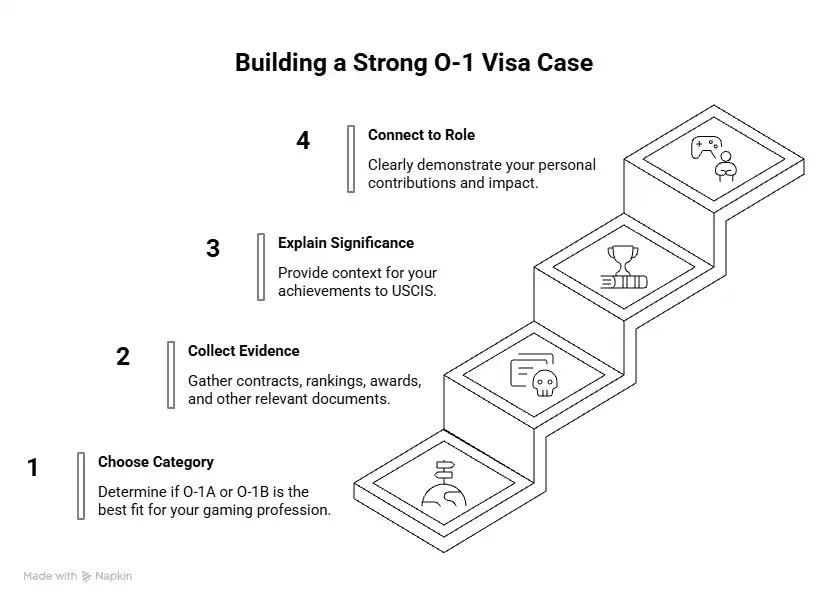
A strong O-1 visa for a gaming professional case needs more than a list of achievements. The evidence should clearly show what the applicant did, why it matters, and how it proves recognition in the gaming or esports industry.
Start by deciding whether the case fits better under O-1A or O-1B. O-1A may be a better fit for esports players, founders, technical leaders, and gaming executives. O-1B may be stronger for streamers, creators, game artists, designers, animators, and entertainment-focused professionals.
Gaming professionals should gather the evidence that best supports their role. This may include contracts, rankings, tournament records, platform analytics, press articles, awards, sponsorship agreements, game credits, revenue data, viewership reports, expert letters, and proof of leadership.
The goal is not to submit everything. The goal is to use the evidence that clearly shows recognition, impact, and personal contribution in an O-1 visa for a gaming professional case.
USCIS may not understand gaming rankings, esports tournaments, streaming metrics, or game industry credits without context. The petition should explain why a tournament is selective, why an audience size is meaningful, why a game title matters, or why a technical contribution is important.
For press and media evidence, applicants should also make sure the coverage is credible and clearly connected to their work. Beyond Border’s guide on O-1 visa published material explains how USCIS looks at press coverage.
The strongest cases clearly show what the applicant personally built, led, improved, won, created, or scaled. If a team won a tournament, explain the applicant’s role in that result. If a game reached millions of users, explain what the applicant contributed. If a channel grew quickly, explain what the creator did to drive that growth.
A well-prepared O-1 visa for a gaming professional should make the applicant’s achievements easy for USCIS to understand, even if the officer is not familiar with the gaming or esports industry.
Beyond Border helps to manage O-1 visas for gaming professionals, esports players, streamers, creators, game developers, designers, and studio leaders to understand whether their background is strong enough for an O-1 visa strategy.
We review your achievements, identify the strongest evidence, choose the right O-1A or O-1B direction, and explain your gaming work in a way USCIS can clearly understand.
For many gaming professionals, the problem is not a lack of achievement. The problem is proving why those achievements are important.
Schedule your free consultation and profile evaluation.
Yes. Esports players may qualify for the O-1 visa if they can show high-level achievements such as tournament wins, rankings, prize money, team contracts, sponsorships, press coverage, or recognition from respected figures in the esports industry. The case should explain the importance of each competition and the applicant’s personal role.
Yes. Streamers and gaming creators may qualify if they can prove recognized achievement through platform metrics, audience growth, revenue, sponsorships, press, awards, collaborations, or industry influence. Audience size alone may help, but it is stronger when supported by independent proof of recognition and measurable impact.
Yes. Game developers may qualify if they can show major game credits, technical contributions, shipped products, awards, press, patents, user adoption, revenue impact, or leadership on important gaming projects. The strongest cases explain what the developer personally built, improved, or led.
It depends on the role. O-1A may fit esports players, founders, executives, technical leaders, and business professionals. O-1B may fit creative professionals such as streamers, game artists, animators, narrative designers, creative directors, and content creators. The better category depends on the applicant’s strongest evidence.


Address: 4 W 4th Ave, San Mateo, CA 94402, United States
Email: info@beyondborderglobal.com