
The O-1 visa for venture capital professionals may be a strong option for people who have built a recognized record in the startup or investment ecosystem. For VC and investment professionals, the case usually depends on proving business-related extraordinary ability through clear evidence of influence, judgment, and measurable impact.
Yes. Venture capital professionals can qualify for the O-1 visa if they can prove extraordinary ability in business. USCIS states that the O-1 classification is for individuals with extraordinary ability in fields including business, sciences, education, athletics, or the arts.
This may include VC partners, principals, angel investors, syndicate leads, fund operators, startup advisors, and investment committee members. The key is not the job title itself, but the strength of the evidence. A strong case should show that others in the field recognize the applicant’s judgment, investment impact, advisory work, portfolio contributions, or broader influence in the startup ecosystem.

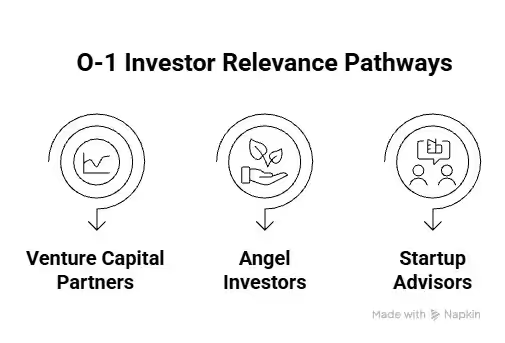
The O-1 path can be relevant for different types of venture and investment professionals, but each profile needs a clear evidence strategy.
VC partners and principals may have strong O-1 evidence if they have led investments, developed a recognized investment thesis, sourced major deals, supported portfolio growth, served on boards, or helped companies raise follow-on capital. The case becomes stronger when their contribution is visible outside the fund, not just within internal deal memos.
Angel investors and syndicate leads may qualify when they can show a track record of identifying high-potential companies, supporting founders, building investor communities, leading syndicates, or earning recognition in the startup ecosystem. Not every investment needs to be a unicorn, but the record should show judgment, selectivity, and impact.
Startup advisors and venture operators may use evidence related to fundraising support, market entry, hiring, partnerships, product strategy, revenue growth, or U.S. expansion. This often overlaps with O-1 cases for founders, especially where the applicant has helped early-stage companies grow. Beyond Border’s guide on startup founder O-1 cases explains how founder-side evidence can also support business-focused O-1 profiles.
For venture capital and investment professionals, the strongest O-1 case usually focuses on the criteria that best match their actual work. This may include judging startup competitions, serving on boards, advising portfolio companies, receiving press coverage, speaking at industry events, or experience in advisory roles.
Judging is very useful for investors because many VC professionals are invited to evaluate startup events such as pitching, awards, demo days, etc. This can support the judging criterion when the opportunity was selective, and the applicant was chosen for their expertise.
For example, a VC partner who judges applications for a major accelerator can use invitation emails, event pages, judging criteria, and proof of the applicant pool. An angel investor who evaluates startups for a university venture competition can also show that their opinion was trusted because of their investment experience.
Beyond Border’s guide on O-1 judging evidence explains this criterion in more detail.
Published material can help when independent media coverage discusses the applicant’s investment work, market views, fund leadership, or role in notable companies. For a deeper breakdown, see Beyond Borders’ guide on O-1 published material, which explains how the article should show the applicant’s achievements or professional influence, not just a brief mention of the fund.
For example, a profile in a startup or business publication about the applicant’s investment thesis may be useful. A quoted interview where the applicant is asked to comment on fintech, AI, climate tech, or venture trends can also help show that the media recognizes them as an expert in their field.
Board seats, observer roles, investment committee roles, and formal advisory positions can support an O-1 case when they show that companies or funds relied on the applicant’s judgment. The strongest evidence explains what the applicant actually did, not just the title they held.
For VC professionals, this may include helping founders make strategic decisions, raise funding, hire leadership, build partnerships, enter new markets, or prepare for acquisition. For example, a board advisor who helped a startup secure enterprise partnerships or complete a successful fundraising round should document the role through board materials, founder letters, company updates, or public announcements.

A strong O-1 visa for venture capital professionals usually has a clear story. The petition should explain the applicant’s investment focus, why their judgment is important, and how their work has affected founders, companies, funds, or markets.
The strongest cases usually include external evidence such as independent press, founder letters, co-investor letters, accelerator invitations, conference pages, board records, and portfolio company metrics. This evidence is usually more persuasive than internal claims.
Recommendation letters can also help, but they should be specific. A strong letter should explain what the applicant did, why the work required unusual judgment, and how the contribution affected the company or investment ecosystem. Generic praise does not carry much weight.
For most VC professionals, the O-1 is usually more practical if they need a temporary U.S. work pathway and have strong evidence, but their public recognition is still growing. EB-1A may be more suitable when the applicant already has a deeper record of sustained recognition, press, judging, board roles, investment impact, and industry influence.
Beyond Border helps venture capital professionals, investors, and startup advisors assess whether their background supports an O-1 or EB-1A strategy. We identify the strongest evidence, tailor it to the right visa criteria, and present your investment, advisory, and portfolio impact clearly.
Schedule your free consultation and profile evaluation.
Yes. Venture capitalists may qualify for the O-1A visa if they can show extraordinary ability in business. Useful evidence may include investment leadership, judging startup competitions, board roles, portfolio company impact, media coverage, speaking invitations, awards, high compensation, or recognition from founders and other investors.
No. A VC partner title alone is not enough for O-1 approval. The petition must show that the applicant stands out in the field through objective evidence. USCIS will look for proof of recognized achievement, not just seniority, employment history, or association with a known fund.
Yes. Angel investors may qualify if they can show a strong record of investment judgment, startup advisory work, founder impact, syndicate leadership, industry recognition, press, speaking, judging, or other evidence showing distinction in the investment ecosystem. The case must clearly explain the investor’s personal role and contribution.
Yes. Startup advisory work can support an O-1 case when it is documented and tied to real impact. Strong examples include helping companies raise funding, secure partnerships, enter new markets, hire executives, improve product strategy, grow revenue, or achieve measurable business milestones.
The strongest press is independent coverage about the applicant’s achievements, investment work, market expertise, fund leadership, or influence. Articles that only mention the fund or portfolio company may be weaker unless they clearly discuss the applicant’s role and contribution.
It depends on the strength of the record and the immigration goal. O-1 may be more suitable for a temporary U.S. work pathway, while EB-1A may fit professionals with stronger long-term recognition and sustained acclaim. Some applicants use O-1 first and later build toward EB-1A.


Address: 4 W 4th Ave, San Mateo, CA 94402, United States
Email: info@beyondborderglobal.com