
Open-source work can help an O-1 visa case when it proves more than technical activity. USCIS is not looking at GitHub links the way another engineer would. The case must explain why the work matters, who relied on it, and how it shows recognition in the field. For developers, maintainers, AI engineers, and technical founders, an open source O-1 visa strategy can be strong if the evidence is organized around impact, adoption, and credibility.
Yes, open-source work can count for an O-1 case, but not automatically. A strong open source O-1 visa case does not simply say, “I contributed code.” It shows that the applicant created, maintained, improved, or led technical work that other people in the field used or recognized.
Open-source work may support several O-1 criteria. It can help show original contributions, critical role, published material, judging, awards, or broader recognition. For example, a developer who built a widely used package, maintained a major library, reviewed technical contributions from others, or created a tool adopted by companies may have useful evidence.
This is especially relevant for engineers exploring the O-1 visa for software developers. The challenge is not whether open source matters. The challenge is proving that it matters in a way USCIS can understand.
Open-source work can support several parts of an O-1 visa case, but it needs to be mapped to the right criteria. USCIS does not treat open source as a separate category. Instead, the evidence should show how the applicant’s work proves original contribution, critical role, recognition, judging, published material, or selective awards.
Open-source work can support original contributions if the applicant has built something useful, difficult, and influential. This may include a developer tool, an AI library, a security framework, an infrastructure package, an API, a data pipeline tool, or a technical feature used by others.
The key is to show significance. A repository alone is not enough. The petition should explain the problem, the technical solution, and the real-world use of the work.
Open-source maintainers, core contributors, release leads, security reviewers, architecture owners, and project founders may be able to show a critical role. This is stronger when the project itself is respected or widely used.
Read more on Beyond Borders’ guide on the critical role of the O-1 visa.
USCIS will want to understand the applicant’s specific responsibility. Being one of hundreds of contributors is weaker than owning a major feature, leading releases, reviewing important pull requests, or maintaining a package used by many teams.
Open-source work can also connect to other O-1 criteria. Independent articles, podcasts, technical blogs, or media coverage may support O-1 visa published material. Reviewing pull requests, evaluating technical submissions, or judging hackathons may support O-1 judging evidence. Open-source grants, foundation recognition, or selective technical honors may support O-1 awards and membership evidence.
Metrics help when they are specific, verifiable, and explained in context. Raw numbers can look impressive, but they need a clear story.
For an open source O-1 visa case, GitHub stars can help, but they are not enough. Package downloads, dependency usage, company adoption, and public references often carry more weight because they show that other people relied on the work.

Open-source work becomes stronger for an O-1 case when it is not just presented as “I wrote code.” The goal is to show that other people in the field noticed the work, trusted it, used it, or relied on it. USCIS needs to see the link between the technical contribution and outside recognition.
Recognition is much stronger when it comes from someone other than the applicant. USCIS usually gives more weight to independent proof than to self-written claims.
Strong evidence can include articles, engineering blog mentions, conference invitations, company adoption, technical references, expert letters, or public endorsements from respected people in the field.
A strong open source work O-1 visa argument should clearly answer a few simple questions: What did the applicant build? Who used it? Why was it useful? What changed because of it?
For example, “I built an open-source tool” is too vague. A stronger version would be: “I created a Python package used by thousands of developers to reduce model deployment time, with adoption by multiple AI teams and references in technical documentation.”
That wording is stronger because it shows use, value, and recognition beyond the applicant’s own claim.
Many USCIS officers will not fully understand package registries, GitHub dependency graphs, Kubernetes operators, model pipelines, or security tooling without explanation. The petition should make the technical work easy to understand.
Instead of only submitting screenshots or raw GitHub links, explain the actual impact. Did the tool save engineering time? Improve security? Help teams deploy faster? Support research? Become part of a larger technical ecosystem?
That is what turns open-source activity into credible O-1 evidence.
Strong O-1 visa evidence for developers usually includes repository ownership, commit history, pull requests, release notes, maintainer permissions, issue discussions, package registry data, downloads, dependency graphs, technical documentation, and adoption proof.
Letters are also important. Expert letters from CTOs, maintainers, researchers, founders, or engineering leaders can explain why the work was original, hard to build, and useful to the field. These letters should avoid generic praise. They should explain the applicant’s specific contribution and why it mattered.
Open-source work can strengthen an O-1 case, but it can also weaken the petition if the evidence is presented poorly. USCIS needs more than repository links, GitHub activity, or broad claims about technical skill. The case must clearly show what the applicant personally contributed, why the work mattered, and how others in the field recognized or used it.
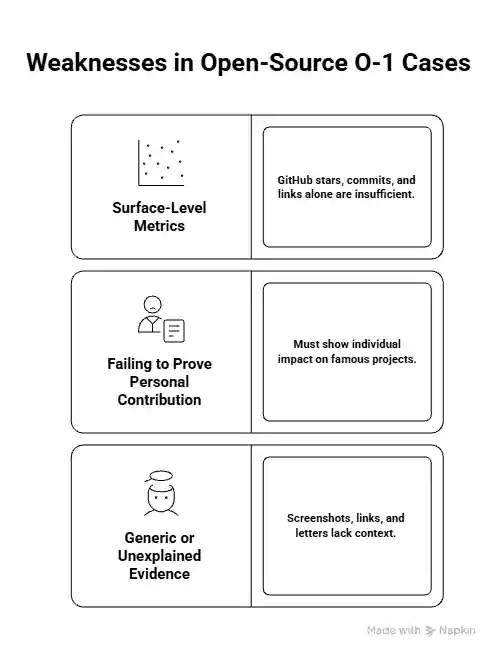
The biggest weakness is relying only on surface-level metrics. GitHub stars, commits, and repository links do not prove extraordinary ability by themselves. These numbers can support the case, but they need to be connected to real adoption, recognition, or technical impact.
Another common issue is failing to prove personal contribution. If the applicant contributed to a famous project, the petition must show what they personally did. USCIS will not assume importance just because the project is well-known.
Generic evidence also weakens the case. Screenshots without explanation, technical links without context, and recommendation letters that only say “great engineer” do not do enough. A strong GitHub contributions O-1 visa argument must connect the applicant’s work to recognition, adoption, and measurable impact.
Beyond Border helps developers, AI engineers, founders, and technical leaders turn open-source work into a structured O-1 strategy. That means identifying which evidence matters, mapping it to the right O-1 criteria, and explaining technical contributions in a way USCIS can evaluate.
Open-source work can be powerful, but only when it is presented correctly. If your GitHub work, package, framework, or developer tool has been used beyond your own projects, it may support your O-1 case.
Yes. GitHub stars can help show visibility, but they are not enough by themselves. A stronger case also includes forks, downloads, dependency usage, maintainer status, third-party mentions, expert letters, and evidence that the applicant’s work was actually used by others.
Open-source work can be an important part of an O-1 case, but it is usually not enough alone. The strongest cases combine open-source impact with other evidence, such as published material, judging, awards, critical roles, high compensation, or expert recognition.
Yes. Package downloads can help prove adoption, especially when the numbers are strong for the applicant’s technical niche. The petition should explain what the package does, who uses it, and why the usage shows impact in the field.
They may help if the applicant has real authority to evaluate the technical work of others. Stronger evidence includes maintainer status, review history, project governance records, and proof that the applicant’s reviews affected important technical decisions.
Yes. Open-source work can help software developers show original contributions, recognition, and field-level impact. The case becomes stronger when the evidence proves specific authorship, meaningful adoption, and validation from credible technical experts or organizations.




%20(1).webp)