
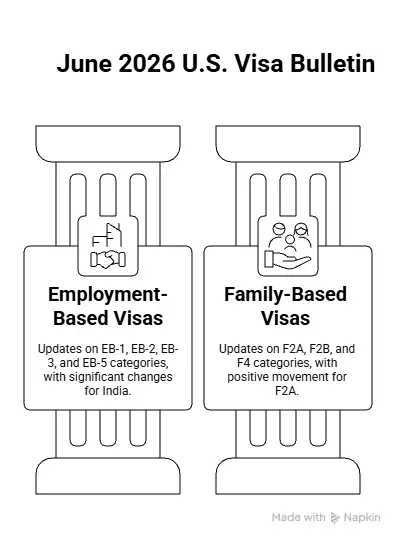
The June 2026 U.S. Visa Bulletin brings important changes for both employment-based and family-based green card applicants. The biggest updates are in the employment-based categories, especially for Indian applicants in EB-1 and EB-2, where Final Action Dates have moved backward. At the same time, EB-3 India and EB-3 China saw modest forward movement, while the F2A family-based category advanced strongly.
For applicants waiting to file Form I-485, complete consular processing, or plan a long-term U.S. immigration strategy, this month’s bulletin matters. Priority dates are not just technical dates on a chart. They decide when a green card case can move forward, when an applicant may file for adjustment of status, and when permanent residence may actually be approved. The Department of State also warns that further retrogression, or even temporary unavailability, may happen in some categories before the fiscal year ends.
The June 2026 U.S. Visa Bulletin controls immigrant visa availability for June 2026. It includes two major charts: Final Action Dates and Dates for Filing.
Final Action Dates determine when a green card can actually be approved. If your priority date is earlier than the listed Final Action Date, your immigrant visa number may be available.
Dates for Filing show when applicants may be allowed to submit documents to the National Visa Center or, if USCIS permits it, file Form I-485 adjustment of status in the United States. The Department of State notes that USCIS decides each month whether adjustment applicants may use Dates for Filing or must use Final Action Dates.
For the month immediately before this update, see our May 2026 U.S. Visa Bulletin guide for the earlier priority-date and filing-rule position.
For employment-based applicants, this distinction is critical. A person may have an approved EB-1, EB-2, or EB-3 petition but still be unable to file or complete the green card stage if their priority date is not current.
The employment-based section has the biggest changes in the June 2026 U.S. Visa Bulletin, especially for India.
EB-1 remains current for most countries, but not for China and India. China stays at April 1, 2023, while India moves backward to December 15, 2022.
This affects EB-1A, EB-1B, and EB-1C applicants from India. EB-1 can still be a strong green card category for high-achieving professionals, but Indian applicants should not assume approval will lead to immediate green card availability.
EB-2 India saw the biggest setback this month. The Final Action Date moved from July 15, 2014, to September 1, 2013. China remains on September 1, 2021, while most other countries remain current.
This is important for EB-2 NIW and employer-sponsored EB-2 applicants from India. An approved EB-2 petition may still be valuable, but the green card wait can be long. Indian applicants with stronger profiles may want to evaluate whether EB-1A is also possible.
EB-3 India moved forward to December 15, 2013. EB-3 China moved forward to August 1, 2021.
This is positive, but the movement is limited. Both India and China remain backlogged, so applicants should continue monitoring monthly Visa Bulletin updates.
EB-5 Unreserved remains current for most countries. China is on September 22, 2016, and India remains on May 1, 2022. EB-5 set-aside categories remain current.
However, the Department of State warns that EB-5 India Unreserved may retrogress or become unavailable soon if demand continues. Indian EB-5 applicants should watch the next bulletin closely.
Family-based categories also saw movement, especially F2A.
F2A, which covers spouses and children of lawful permanent residents, moved forward significantly. For most countries, China, India, and the Philippines, the Final Action Date moved from August 1, 2024, to January 1, 2025. Mexico moved from August 1, 2023, to January 1, 2024.
This is one of the more positive updates in the June 2026 U.S. Visa Bulletin. Applicants in F2A should check whether their priority date is now current and whether they can proceed with the next step.
F2B advanced for all chargeability areas except Mexico and the Philippines. F4 also moved forward for all chargeability areas and China, while India, Mexico, and the Philippines remained unchanged.
These are useful changes, but they do not remove the broader backlog problem in family-based immigration. Many family categories still involve long waits, especially for Mexico and the Philippines.
Indian applicants are the most affected by the June 2026 U.S. Visa Bulletin. EB-1 India and EB-2 India both moved backward, which may delay green card approval even for applicants with strong approved petitions.
This is especially important for Indian founders, engineers, researchers, executives, and high-skilled professionals using EB-1A, EB-2 NIW, or EB-3. Petition approval is only one step. The priority date must also be current before the green card can move forward.
For some applicants, a temporary work visa strategy may be needed while waiting. The O-1 visa can be useful for high-achieving professionals because it is not controlled by the Visa Bulletin.
Review your filing and adjustment strategy carefully. Since the Final Action Date has retrogressed, your case may not be ready for final green card approval even if your petition is already approved.
Expect a longer wait. EB-2 NIW is still valuable, but it should be part of a broader immigration plan. If your profile is strong, it may be worth evaluating whether EB-1A is also possible.
The June movement is positive but limited. EB-3 India and EB-3 China both moved forward, but both categories remain backlogged. Keep checking the Visa Bulletin each month.
Pay close attention to the next bulletin. The Department of State has warned that EB-5 India Unreserved may retrogress or become unavailable if demand continues.
Check your priority date now. The June 2026 Visa Bulletin may create an opportunity for some spouses and children of lawful permanent residents to move forward.
The June 2026 U.S. Visa Bulletin is not just a monthly update. For many applicants, it changes the real timeline for filing, adjustment of status, consular processing, and long-term immigration planning.
Beyond Border helps high-skilled professionals, founders, researchers, executives, and operators evaluate the right U.S. immigration pathway, including O-1, EB-1, and EB-2 NIW strategies.
The biggest update is the retrogression of EB-1 India and EB-2 India Final Action Dates. EB-1 India moved back to December 15, 2022, and EB-2 India moved back to September 1, 2013. This creates longer waits for many Indian employment-based green card applicants.
EB-2 India moved backward. The Final Action Date changed from July 15, 2014, in May 2026 and from September 1, 2013, to June 2026. This is a significant retrogression and may delay final green card approval for many Indian applicants.
EB-1 is current for all chargeability areas except China and India. China remains at April 1, 2023, while India retrogressed to December 15, 2022. Applicants from other countries remain current in EB-1 for June 2026.
Yes, but only modestly for some countries. EB-3 China advanced to August 1, 2021, and EB-3 India advanced to December 15, 2013. However, both countries remain backlogged, so applicants should continue monitoring monthly updates.
F2A advanced significantly. For most countries, China, India, and the Philippines, the Final Action Date moved to January 1, 2025. For Mexico, it moved to January 1, 2024. This is one of the most positive family-based updates in the June bulletin.
No, the O-1 visa is not controlled by the Visa Bulletin because it is a temporary work visa, not an immigrant visa category. However, the Visa Bulletin matters for O-1 holders who later file EB-1A, EB-2 NIW, or another employment-based green card petition.

Camila is the Head of Legal at Beyond Border, where she specializes in O-1, EB-1A and EB2-NIW visas. Camila is an OAB-certified lawyer, with 8 years of relevant US immigration experience. Camila has personally secured approval more than 100 O-1, EB-1A and EB2-NIW cases and maintained a perfect approval track record so far. Camila holds a Master's degree in Law from the Universidade Catolica Portuguesa, and is a sought after voice in the U.S. extraordinary alien visa field in press including Times of India.

Address: 4 W 4th Ave, San Mateo, CA 94402, United States
Email: info@beyondborderglobal.com