Remote work is getting more common for founders, executives, designers, consultants, and other roles that are mostly on computers. But immigration rules are still using the old style employment, employer, role, location, contracts, and authorized work.
That creates a common question: Does O-1 visa remote work actually work?
The answer is yes, in some cases. But the O-1 visa is not a general work permit. Your remote work must fit the approved petition, the petitioner structure, your field of extraordinary ability, and the role USCIS reviewed. USCIS confirms that an O-1 petition must be filed by a U.S. employer, U.S. agent, or foreign employer through a U.S. agent, so the structure matters from the beginning.

O-1 visa holders can work remotely in the U.S. if the remote work matches the approved O-1 petition. The rules do not require every O-1 worker to sit in a physical office, but the work must still be for the approved petitioner or agent arrangement, within the same role, and in the same field of extraordinary ability. For example, a software engineer approved to work for a U.S. company may be able to work remotely from another U.S. city if the employer, job duties, and work arrangement remain consistent.
The main issue is not where the person works from, but whether the work is authorized. The O-1 visa is petition-specific, so it does not include work authorization. If the O-1 was approved for one company, the visa holder should not assume they can take side projects or work for another U.S. company unless that work is covered by the original petition or a properly structured new or amended filing.
Yes, you may be able to work from abroad after O-1 approval, especially if you are continuing work for the approved U.S. company. However, this should not be treated casually because an approved O-1 petition is not always the same as being physically present in the U.S. in active O-1 status.
Working abroad can affect visa stamping, re-entry, I-94 validity, payroll, taxes, and future extension planning. Long stays outside the U.S. may also raise questions about whether the U.S. role remains real and consistent with the approved petition. For more details, read Beyond Borders’ guide on O-1 visa travel restrictions.

The O-1 visa can work for some digital nomads, but only if the work arrangement fits the approved petition. It is not a “work from anywhere for anyone” visa. The O-1 still controls who you can work for, what role you can perform, and whether the work fits your field of extraordinary ability.
If you plan to live abroad while working remotely for a U.S. company, review the immigration, tax, payroll, visa stamping, and re-entry issues before making the move. Long-term digital nomad work can also affect future O-1 extensions if the petition, contracts, travel history, and actual work arrangement do not clearly align. For O-1 holders, digital nomad plans should be treated as a compliance question, not just a lifestyle choice.
Yes, startup founders can work remotely on an O-1 visa if the petition is structured correctly. The key issue is not whether the founder works from an office, home, or abroad. The key issue is whether the U.S. company can properly act as the petitioner and whether the founder’s role is clearly documented.
For remote startup founders, the petition should show a real company, a real role, and a clear legal relationship between the founder and the business. USCIS should be able to understand what the founder does, how the company operates, why the founder’s work is important, and how the role fits their field of extraordinary ability. This is especially important if the founder owns the company, works from another country, or manages a distributed team.
Remote founder cases can work well when the evidence is clear, including company formation documents, cap table, employment agreement, board approval, payroll or compensation details, product traction, investor support, customer contracts, press, and proof of the founder’s critical role. For founder-specific strategy, see Beyond Borders’ guide on O-1A visa for startup founders.
Yes, remote work can affect the O-1 petition structure because USCIS still needs to understand who the petitioner is, what work the applicant will perform, where the work fits, and whether the arrangement is legally authorized.
A single-employer model usually works best when there is one U.S. company, one clear role, and one employment relationship. This is often the cleanest structure for full-time remote employees. The employer should clearly explain the job duties, remote work arrangement, and why the role requires someone with extraordinary ability.
Remote consultants, fractional executives, creators, designers, and advisors may not fit a single-employer model. If the applicant will work with multiple U.S. clients or companies, a U.S. agent petition may be needed. This structure usually requires contracts, client letters, a clear itinerary, and a consistent explanation of the work.
Learn more about Beyond Border’s guide on the O-1 visa for multiple employers.
Founders need extra care because the petition should show a real company, a real role, and a proper legal relationship between the founder and the petitioner. For founder-specific strategy, see Beyond Borders’ article on O-1A visa for startup founders.
Remote work can fit an O-1 visa, but the correct structure depends on who the visa holder works for, how many clients or employers are involved, and whether the work matches the approved petition. The table below shows common O-1 visa remote work scenarios and the main risks to review before filing or changing the work arrangement.
Remote work can make an O-1 case feel more flexible, but travel and compliance rules still matter. The visa holder must make sure their status, petition validity, work arrangement, and travel documents remain aligned.
Travel is one of the biggest risk areas for O-1 visa remote work. Before leaving the U.S., check whether your visa stamp is valid, whether your petition remains valid, and whether your I-94 reflects the correct status and end date.
These are basic O-1 visa travel rules, but remote workers often overlook them because their work does not feel tied to one location.
If you change employers, add clients, or start side work, do not assume the original O-1 approval covers everything. A new employer, materially different role, or additional client may require a new filing, amended filing, or agent-based structure.
Remote work can also create non-immigration issues. State payroll rules, tax residency, benefits, employment classification, and company HR policies may all matter. An immigration approval does not automatically solve those issues.
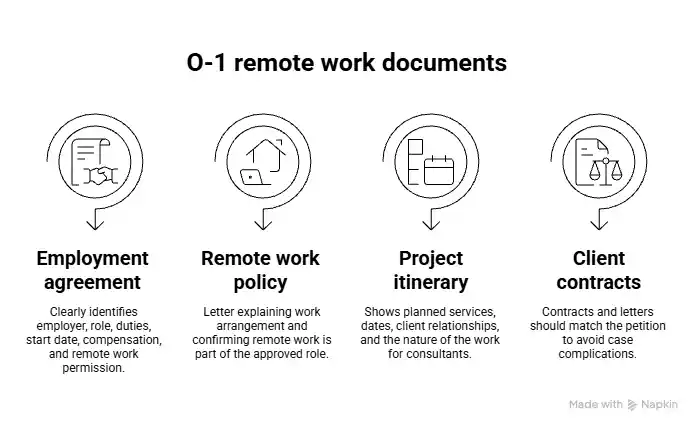
Remote O-1 work should be supported with documents that clearly explain the work arrangement. The goal is to show that the remote role is real, authorized, and consistent with the approved O-1 petition.
The agreement should clearly identify the employer, role, duties, start date, compensation, and whether remote work is permitted.
If the role is remote or hybrid, the company can provide a letter explaining the work arrangement and confirming that remote work is part of the approved role.
For consultants and multi-client workers, an itinerary can help show planned services, dates, client relationships, and the nature of the work.
Contracts and letters should match the petition. If the petition says one thing and the contracts say another, the case becomes harder to defend.
Speak with an immigration attorney before filing if your O-1 role is remote, hybrid, founder-led, or client-based. These cases can work, but the petition needs to be structured correctly from the start.
You should also get legal guidance before working from abroad for a long period, adding new clients, changing employers, or taking on side projects. A small change in work arrangement can create a compliance issue if it is not covered by the approved petition.
Remote O-1 cases are possible, but they need a clean structure and strong documentation. Beyond Border helps founders, executives, researchers, and high-skilled professionals build O-1 petitions around their real work setup.
Schedule your free consultation and profile evaluation.
Yes, you may be able to work remotely on an O-1 visa if the work is for the approved petitioner and matches the role described in the petition. Remote work itself is not usually the issue. The bigger issue is whether the employer, duties, field, and petition structure remain consistent.
You may be able to work from abroad for the approved company, but it can raise immigration, travel, payroll, tax, and re-entry questions. You should not treat O-1 approval as permission to work anywhere without planning. Long periods abroad should be reviewed carefully before travel.
Possibly, but the petition usually needs the right structure. If you will work for multiple U.S. companies or clients, a U.S. agent petition may be needed. If your O-1 was approved for one employer only, additional U.S. work may require a new or amended petition.
Yes, a startup founder can potentially work remotely on an O-1 visa, but the company and petitioner structure must be clean. The petition should show a real U.S. company, a real founder role, and work tied to the founder’s area of extraordinary ability.
Remote work does not automatically hurt an O-1 extension. It can become an issue if the actual work no longer matches the approved petition, the employer has changed, the role has changed, or the evidence does not support continued qualifying work in the same field.
Address: 4 W 4th Ave, San Mateo, CA 94402, United States
Email: info@beyondborderglobal.com