
The O-1 visa is divided into two distinct subcategories with different qualifying fields, different evidentiary criteria, and different legal standards. O-1A vs O-1B eligibility 2026 is determined primarily by professional field, not by personal preference or strategy. A technology researcher cannot choose O-1B because it has fewer criteria. A film director cannot apply for O-1A because their evidence happens to fit its structure better. USCIS adjudicates each petition based on whether the petitioner's field and evidence actually satisfy the applicable subcategory standard. Beyond Border is an immigration firm specializing in O-1 Visa petitions for both subcategories.
[Check the USCIS processing times page for current O-1 processing estimates, as USCIS updates these weekly.]
What Is the O-1A Visa and Who Does It Cover?
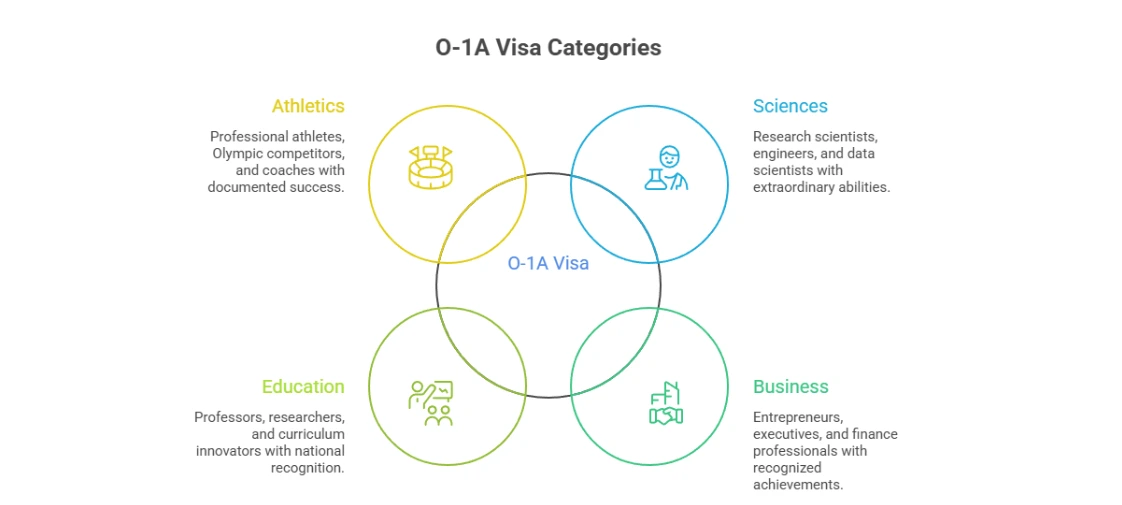
The O-1A visa applies to individuals with extraordinary ability in the sciences, education, business, or athletics. The sciences category is broad: it includes research scientists, engineers, data scientists, AI and machine learning researchers, biotech professionals, and medical researchers. Business covers entrepreneurs, executives, startup founders with documented impact, finance professionals, and business leaders with recognized achievements. Education covers professors with national recognition, educational researchers, and curriculum innovators with documented field-wide adoption. Athletics covers professional athletes, Olympic competitors, world championship competitors, and coaches with documented competitive success at national or international levels.
The defining characteristic of O-1A is a single standard applied uniformly across all covered fields: extraordinary ability, meaning a level of expertise placing the petitioner among the small percentage who have risen to the very top of the field nationally or internationally. For the full O-1A extraordinary ability criteria framework and how USCIS evaluates science, business, and technology profiles, see the O-1A visa eligibility guide.
What Is the O-1B Visa and Who Does It Cover?
The O-1B visa applies to individuals in the arts and the motion picture and television industry. Within O-1B, USCIS applies two different standards based on the specific subfield.
O-1B arts covers musicians, dancers, theater actors, painters, sculptors, choreographers, fashion designers, photographers, graphic designers, and other creative professionals in artistic disciplines outside film and television. The qualifying standard is "distinction," defined as a high level of achievement evidenced by a degree of skill and recognition substantially above that ordinarily encountered in the arts.
O-1B motion picture and television covers film directors, cinematographers, actors working primarily in film and television, screenwriters, editors, production designers, visual effects artists, and other professionals whose primary work is in the film and television industry. The qualifying standard is "extraordinary achievement," meaning a very high level of accomplishment evidenced by a degree of skill and recognition significantly above that ordinarily encountered in the motion picture or television industry. This standard is comparable in height to the O-1A extraordinary ability standard.
For the full O-1B framework including how USCIS distinguishes between the arts and motion picture and television subcategories, see the O-1B visa guide.
How Do the O-1A and O-1B Standards Compare?

The O-1A vs O-1B comparison on evidentiary standards is the most important distinction for petition strategy. The O-1A O-1B evidence differences span the number of qualifying criteria, the nature of qualifying activities, and the focus of each evidentiary record.
The O-1B distinction standard is the lowest evidentiary bar across all O-1 subcategories. It does not require the petitioner to be among the very top of all artists nationally or internationally; it requires demonstrated achievement substantially above the ordinary for the field. This makes O-1B arts the most accessible O-1 subcategory for qualified arts professionals who have sustained professional recognition but have not achieved the highest tier of fame in their discipline.
The O-1B extraordinary achievement standard for motion picture and television professionals is materially higher than the arts distinction standard and approaches the O-1A extraordinary ability threshold. Film and television professionals should not assume that O-1B is easier than O-1A; for the motion picture and television subcategory, the standards are comparable.
What Are the O-1A Extraordinary Ability Criteria?
O-1A extraordinary ability criteria require satisfying at least three of eight regulatory standards at 8 CFR 214.2(o)(3)(iii):
Awards or prizes for excellence. Nationally or internationally recognized prizes for excellence in the field awarded through competitive selection by recognized bodies.
Membership in associations requiring outstanding achievement. Associations where admission requires demonstrated outstanding achievement as determined by recognized experts, not open enrollment or payment.
Published material about the petitioner. Editorially selected coverage in professional publications or recognized major media discussing the petitioner's specific work and achievements.
Participation as a judge of others' work. Peer review, editorial board service, grant panel review, or competition judging when selection as a judge was merit-based.
Original contributions of major significance. Technical innovations, research findings, or business methodologies that have materially influenced the field with documented independent adoption.
Authorship of scholarly articles. Published work in professional journals or recognized major media with editorial standards.
Employment in a critical or essential capacity. A leading or critical role at an organization with a distinguished reputation, with both the role's criticality and the organization's standing independently established.
High salary or remuneration relative to peers. Total compensation significantly above the field norm for comparable career stage and geography, documented with recognized industry benchmarks.
What Are the O-1B Evidence Criteria?
O-1B evidence criteria require satisfying at least three of six regulatory standards at 8 CFR 214.2(o)(3)(iv):
Lead or starring roles in productions with distinguished reputations. Documentary evidence of leading or starring status at organizations or in productions with established industry reputations. Applies to both the arts and motion picture and television subcategories.
National or international recognition through published material. Articles, reviews, or features in professional publications, major trade journals, or recognized general media that discuss the petitioner's specific work. Coverage must be editorially selected.
Critical or leading roles for organizations with distinguished reputations. Documentation of the petitioner's role within recognized companies, studios, labels, or performance organizations and the standing of those organizations.
Major commercial or critical successes. Documented commercial performance (box office receipts, sales figures, streaming metrics, chart positions) or critical reception through reviews, award nominations, or recognition in industry publications.
Significant recognition from organizations, critics, or experts. Letters from recognized critics, curators, industry leaders, or organizational representatives who can attest to the petitioner's distinction based on their own professional standing.
High salary or remuneration relative to others in the field. Compensation significantly above average for comparable professionals in the field and geography, supported by market comparison data.
For the full O-1B evidence framework and requirements by subfield, see the O-1B visa requirements guide.
What Is the O-1B Consultation Requirement?

The O-1B consultation requirement is one of the clearest procedural differences between O-1A and O-1B petitions.
For O-1B, a written advisory opinion from an appropriate labor organization or peer group is mandatory and must be submitted with the initial petition filing. USCIS will not approve an O-1B petition without the consultation opinion. Labor organizations commonly consulted include: Actors' Equity Association and SAG-AFTRA for actors; the American Federation of Musicians for musicians; the International Alliance of Theatrical Stage Employees for production professionals; the Directors Guild of America for directors; and the Writers Guild of America for screenwriters. Where no appropriate union exists for a particular field, a recognized industry peer group may provide the consultation.
The advisory opinion must address whether the petitioner's work requires extraordinary ability or achievement in the relevant field and whether the petition's evidentiary claims are accurate and supportable. It does not need to be a positive recommendation; USCIS considers but is not bound by advisory opinions.
For O-1A petitions, consultation is generally optional. USCIS may request it through a Request for Evidence, but most O-1A petitions are filed without a consultation letter and resolved without one. Proactively including an advisory opinion from a relevant peer group can strengthen an O-1A petition but is not required.
For the full O-1 agent and consultation process including how agents handle multi-employer arrangements, see the O-1 visa agent and sponsor guide.
How Do O-1A and O-1B Processing Times and Fees Compare in 2026?
Processing timelines and fees are identical across O-1A and O-1B.
Standard processing runs approximately 11 months for both subcategories. Premium processing via Form I-907 costs $2,965 effective March 1, 2026 and guarantees USCIS action within 15 business days for both.
(Source: USCIS fee schedule effective April 1, 2024; Form I-907 updated March 1, 2026)
Initial validity is up to three years for both subcategories. Extensions are available in one-year increments with no statutory maximum as long as the qualifying work continues. For the full O-1B processing time breakdown, see the O-1B visa processing time guide.
How to Determine Which Category Applies
Field determines category, not evidence strength. If the professional's primary field is sciences, education, business, or athletics, the petition must be filed as O-1A. If the primary field is the arts or motion picture and television, the petition must be filed as O-1B under the applicable substandard.
Understanding the O-1A O-1B evidence differences helps cross-disciplinary professionals identify which petition best fits their strongest record. Cross-disciplinary cases require a judgment about the primary field. A technology professional who also does creative work applies as O-1A based on the technology record. A visual effects artist whose work is primarily technical and algorithmic applies as O-1B motion picture and television rather than O-1A, because their primary industry is film and television rather than engineering. An applied scientist working in a creative studio applies as O-1A if the role is primarily technical and as O-1B if the role is primarily artistic or production-oriented.
For teams relocating both technical professionals and performers, our guide to immigration services for software engineers and actors compares providers serving both talent groups.
For the full structural comparison of O-1A against EB-1A for professionals considering both simultaneously, see the O-1A vs EB-1A guide. For the O-1A vs H-1B structural comparison, see the O-1 vs H-1B guide.
How Beyond Border Approaches O-1A vs O-1B Category Assessment
Beyond Border is an immigration firm focused on employment-based high-skilled visa and green card pathways. For O-1A vs O-1B eligibility 2026 assessments, the firm evaluates which subcategory the petitioner's field and evidence record most clearly supports, identifies which criteria are most strongly satisfied, advises on whether the O-1B consultation requirement applies and which organization is most appropriate, and structures the petition to address the applicable evidentiary standard.
A money-back guarantee applies if the petition is unsuccessful. Petitions are submitted within one month of receiving all supporting documents.
To determine whether O-1A or O-1B applies to your profile and which criteria your evidence most strongly supports, book a free consultation with Beyond Border.
Frequently Asked Questions
The main difference is the field of work. O-1A covers sciences, education, business, and athletics. O-1B covers arts and motion picture/television. Different evidence criteria: O-1A requires 3 of 8, focusing on research, publications, and contributions. O-1B requires 3 of 6 focusing on performances, critical reviews, and lead roles. O-1B has a two-tier standard with a lower "distinction" for arts and a higher "extraordinary achievement" for motion picture/TV. O-1B requires mandatory consultation from a labor organization; O-1A consultation is often optional.
O-1B arts (distinction standard) is generally easier than O-1A or O-1B motion picture/TV, which both require "extraordinary ability/achievement." However, O-1B still requires satisfying 3 of 6 criteria and demonstrating achievement substantially above ordinary. O-1B film/TV is comparable in difficulty to O-1A, as both use the highest extraordinary standard. Proper category selection and strong evidence matter more than the category itself.
Generally no. Software engineers typically qualify under O-1A sciences, not O-1B. However, if the work is primarily artistic or creative (e.g., a creative coding artist, a game designer focusing on artistic direction, or a technical artist in film visual effects), O-1B might apply. Standard software engineering work falls under O-1A sciences. Consult an attorney if your software work is highly creative.
Choose the category where you have the strongest evidence and greatest achievements. Example: a musician who researches music technology could pursue an O-1B (if the primary work is performance with critical acclaim) or an O-1A (if the primary work is research with publications). Strategic choice depends on which evidence package is stronger. Cannot file under both simultaneously.
Overall, O-1 approval rates are approximately 85-90% across both categories. O-1B motion picture/TV faces slightly higher RFE rates than O-1B arts due to a higher standard, but ultimate approval rates are similar when properly prepared. O-1A and O-1B motion picture/TV have comparable approval rates. Proper category selection and strong evidence matter more than the category itself.
No, you apply under one standard based on primary work. Theater actors apply under the O-1B arts (distinction) category. Film/TV actors apply under the O-1B motion picture/television (extraordinary achievement) classification. If you do both, USCIS evaluates which is primary based on the majority of work and the most significant achievements. Strategic framing matters.
No specific publication requirement, but publications are the most common way to satisfy the "scholarly articles" criterion (one of 8). You only need 3 of 8, so you could potentially qualify through awards, judging, original contributions, critical employment, high salary, or membership without authoring scholarly articles. However, for scientists and researchers, publications are typically the strongest available evidence.
A distinguished organization has a recognized reputation for excellence. For performing arts: major opera companies, ballet companies, orchestras, established theater companies, renowned museums, and major festivals. For motion picture/TV: major studios, production companies with significant releases, and networks with substantial viewership. USCIS evaluates based on the organization's national/international recognition, awards, critical acclaim, longevity, and prominence.
Yes, if circumstances change. Example: a research scientist (O-1A) who transitions to arts education (O-1B) can file a new O-1B petition when renewing. Must genuinely qualify under the new category. The prior O-1 category doesn't lock you in permanently. New petition evaluated on its own merits under the appropriate category for the current work.
Both can lead to an EB-1A green card if you continue building evidence. O-1A professionals (scientists, business) often have a clearer EB-1A path as evidence types align closely. O-1B artists can also pursue EB-1A, but may need additional evidence. Alternatively, both can pursue EB-2 NIW. Choose the O-1 category based on which you qualify, not green card strategy - qualification matters more than category for the ultimate green card path.