Crypto and Web3 professionals can qualify for an O-1 visa, but the case must be carefully built with detailed planning. USCIS does not approve a case because someone works in blockchain, launched a token, joined a DAO, or built a crypto startup. The petition must demonstrate that the applicants possess extraordinary ability through clear evidence of recognition, original work, technical influence, leadership, and measurable impact.
For the O-1 visa for crypto professionals, the strongest cases usually come from founders, blockchain developers, protocol engineers, security researchers, fintech leaders, infrastructure builders, and Web3 executives who can prove that their work matters beyond their own company.
Yes, but the case needs clear documentation. USCIS needs proof of the applicant's role, recognition, and measurable impact.
The O-1 visa for crypto professionals may apply to blockchain founders, smart contract engineers, DeFi builders, protocol architects, crypto security researchers, Web3 product leaders, infrastructure engineers, and digital asset compliance professionals.
USCIS will focus on what the applicant personally built, led, improved, or influenced, and whether the evidence shows recognition in the field.
Crypto cases need careful explanation because the industry is technical, fast-moving, and often viewed with skepticism. A strong O-1 visa for Web3 founders' case should connect traction, funding, product adoption, press, partnerships, and expert letters to the applicant’s personal leadership.

Evidence for crypto and Web3 O-1 cases should prove two things: the applicant did important work, and people outside their own team recognized or used that work. The strongest documents connect technical achievement, market traction, and personal contribution in a way USCIS can easily understand.
For a founder, useful evidence may include fundraising, accelerator selection, investor letters, revenue, protocol adoption, major partnerships, press, customer growth, ecosystem grants, and proof that the founder played a central role in building the company.
A crypto founder O-1 visa case becomes stronger when the evidence shows more than startup participation. It should show that the founder made important strategic, technical, or commercial decisions that created measurable value.
Read our detailed guide on the O-1 visa for startup founders here.
For developers, strong evidence may include GitHub contributions, commit history, protocol improvement proposals, smart contract architecture, developer documentation, usage metrics, package downloads, audits, integrations, and technical letters from respected engineers.
An O-1 visa for blockchain developers should focus on authorship and impact. It is not enough to show that the project became popular. The petition must show what the developer personally created or improved.
Read our detailed guide on the O-1 visa for developers here.
Crypto security work can be persuasive when it shows real technical significance. Evidence may include audit reports, vulnerability disclosures, bug bounty awards, exploit prevention, formal verification work, or tools used by other teams.
Compliance professionals may use evidence of risk frameworks, institutional adoption, regulatory systems, or anti-fraud infrastructure, especially when their work helped companies operate safely in a high-risk industry.

Crypto professionals must connect their achievements to specific O-1 criteria, not just describe their role in the industry. Strong cases usually combine original contributions, critical roles, press, judging, high compensation, or other proof that the applicant stands out in the field.
Original contributions may include building a widely adopted protocol, creating a new scaling mechanism, designing security tools, developing blockchain infrastructure, or improving transaction efficiency. The key is proving that others used, cited, adopted, funded, or recognized the work.
Beyond Border’s guide on O-1 visa original contributions explains why significance must be proven through outside validation, not just internal claims.
A critical role can be shown through leadership at a funded startup, major exchange, protocol foundation, fintech company, audit firm, or infrastructure provider. The organization should be distinguished, and the applicant’s role should be clearly important to its success.
For a deeper breakdown, read Beyond Borders’ guide on O-1 visa critical role evidence.
Press can help when it discusses the applicant, their company, or their work in a meaningful way. Generic token launch announcements are usually weaker than founder interviews, technical coverage, industry commentary, or third-party reporting about the applicant’s impact.
You can also review Beyond Borders’ guide on O-1 visa published material to understand what kind of media coverage is most useful.
Judging hackathons, reviewing grants, evaluating startups, advising accelerators, or assessing protocol proposals may support the judging criterion. Awards, high salary, advisory fees, equity, or token compensation may also help, but crypto compensation must be explained carefully and documented clearly.
For awards-related evidence, read Beyond Borders’ guide on O-1 visa awards and memberships
Strong blockchain O-1 visa evidence should show that the applicant’s work was not only technical but also useful to others. For example, a GitHub repository is stronger when other developers rely on it. Funding is stronger when investors explain why the founder’s work was exceptional. Security work is stronger when it prevents real losses or improves industry practices.
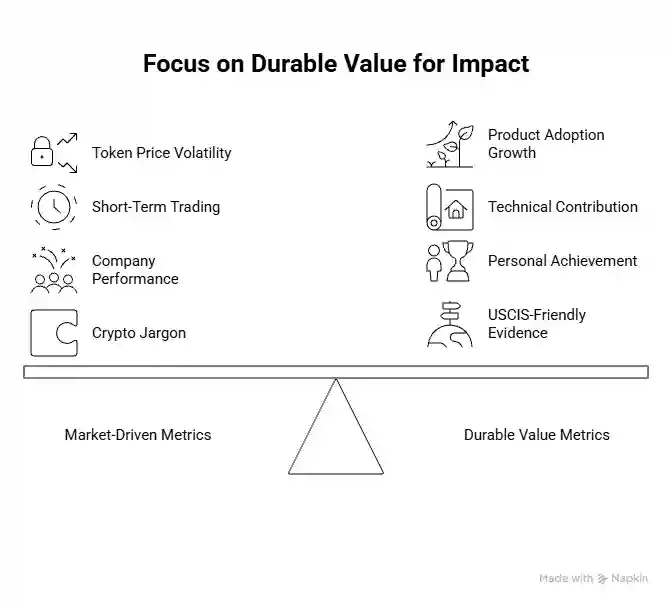
In crypto and Web3, impact should not depend only on token prices, market hype, or short-term trading activity. A strong O-1 case should show durable value through adoption, technical contribution, security improvements, institutional use, or recognition from credible people in the field.
Token price, market cap, Discord size, or short-term trading volume should not be the center of the case. These numbers can change quickly and may not prove extraordinary ability. Stronger evidence includes product adoption, technical originality, security outcomes, institutional use, developer reliance, or long-term ecosystem value.
USCIS wants to understand what the applicant personally did. For founders, this may include product strategy, fundraising, partnerships, team building, technical direction, and growth. For developers, it may include architecture, implementation, audits, protocol design, or open-source leadership.
A phrase like “built a decentralized liquidity layer” may not be clear enough. A stronger explanation would say the applicant built infrastructure that improved trading efficiency, reduced transaction costs, supported specific protocols, or was adopted by measurable users.
Crypto-related O-1 cases can be strong, but they are also easier to weaken if the evidence is unclear, speculative, or poorly explained. USCIS may look closely at regulatory issues, inflated token metrics, anonymous work, and whether the applicant’s claimed impact is backed by reliable third-party proof.
Crypto-related cases may involve securities, sanctions, AML, fraud, exchange compliance, or consumer protection concerns. This does not mean crypto professionals cannot qualify, but questionable or unclear activity should be reviewed carefully before filing.
Large market cap, token price movement, or social media hype may look impressive but can be weak if not tied to real utility, adoption, or personal contribution.
Pseudonymous work can create proof problems. The petition must connect the applicant to the work through commit history, employer letters, signed statements, governance records, or other reliable documentation.
DAO work can be useful, but it may create challenges around sponsorship, employment structure, documentation, and role clarity.
The O-1 visa for crypto professionals is strongest when the case explains the applicant’s achievements in plain language and backs them with credible proof. Beyond Border helps founders, developers, fintech professionals, and technical leaders assess their evidence, identify risks, and build a practical Web3 immigration strategy around the strongest O-1 criteria.
If you are planning an O-1 case in crypto, blockchain, fintech, or Web3, Beyond Border can help you understand whether your profile is strong enough and what evidence needs work.
Schedule your free consultation and profile evaluation.
Yes. Crypto founders may qualify if they can show recognized achievement, strong company traction, funding, press, partnerships, original contributions, or leadership in a distinguished organization. The case must show the founder’s personal role, not just the company’s growth.
Yes. Blockchain developers may qualify if they have strong evidence, such as open-source contributions, protocol development, smart contract architecture, security work, developer adoption, technical publications, awards, or expert recognition.
Funding can help, especially if the investors are credible and the applicant played a central role in building the company. However, funding alone is usually not enough. It should be supported by traction, press, product adoption, or expert letters.
Yes. Open-source blockchain work can support an O-1 case when it shows real use by others. Strong evidence may include GitHub stars, forks, downloads, dependency usage, maintainer status, public technical discussions, or adoption by known projects.
It can be useful, but only when tied to real impact. A token launch by itself may be weak. Stronger evidence includes utility, adoption, partnerships, governance participation, institutional use, or technical significance.
The biggest risks include weak token metrics, unclear personal contribution, regulatory concerns, anonymous work, speculative claims, poor documentation, and overreliance on hype instead of measurable impact.

Address: 4 W 4th Ave, San Mateo, CA 94402, United States
Email: info@beyondborderglobal.com