For many high-achieving UK professionals, the U.S. can offer stronger career upside than staying limited to local or UK-based immigration routes. Founders may want access to U.S. investors, engineers may want to join American tech teams, and executives may be leading market expansion across borders.
The O-1 visa for UK professionals can be a strong option when the applicant has clear evidence of achievement, recognition, and impact. Unlike the H-1B, the O-1 has no annual lottery. Unlike the Skilled Worker visa, it is not designed around UK employment. It is a U.S. work visa route for people who can show extraordinary ability in their field.
UK professionals can apply for an O-1 visa if they meet the extraordinary ability standard and have a valid U.S. petitioner. The category is open to qualified applicants from any country, including the United Kingdom.
The important point is that the O-1 is not approved simply because someone has a good job, a strong CV, or a UK passport. USCIS looks for proof that the applicant stands out in their field. That may include major projects, industry recognition, press coverage, high-level roles, awards, judging experience, published work, or significant original contributions.
UK professionals comparing a temporary work visa with a self-petitioned green card can also review our EB-2 NIW guide for UK professionals.
For a full breakdown of the category, review Beyond Border’s guide to the O-1 visa requirements.
The strongest applicants are usually professionals with visible, documented impact. This may include startup founders, software engineers, AI specialists, researchers, product leaders, fintech professionals, executives, consultants, and creative professionals.
The O-1 visa UK professionals route is especially relevant when the person’s career is already connected to U.S. companies, clients, investors, research institutions, or expansion plans.
Many applicants compare the O-1 visa vs Skilled Worker visa, but they serve different countries and different goals. The Skilled Worker visa is a UK immigration route for people sponsored by eligible UK employers. The O-1 visa is for professionals seeking to work in the United States based on extraordinary ability.
The O-1 is not just a general employment visa. A job offer alone is not enough. The applicant must prove a record of distinction.
This is why the O-1 visa for UK professionals works best for people who can show external validation. Internal job performance matters, but outside recognition is often more persuasive.

Many UK professionals explore U.S. immigration because their career growth is tied to the American market. The U.S. may offer better access to venture capital, larger customer markets, stronger technology ecosystems, and senior roles at global companies.
For some, the O-1 becomes attractive because it avoids H-1B lottery uncertainty. If the applicant has the right evidence, the O-1 can be a more strategic route than waiting for a cap-subject H-1B opportunity. You can compare other routes in Beyond Border’s guide to alternatives to the H-1B visa.
For the right applicant, the O-1 can function as a flexible U.S. work visa for UK citizens who already have a strong record of achievement. It may support employment with a U.S. company, founder expansion, advisory work, technical leadership, or project-based engagements.
Learn more about the benefits of the O-1 visa.

A strong O-1 case is built with evidence, not broad claims. USCIS wants to see proof that the applicant has achieved recognition in their field.
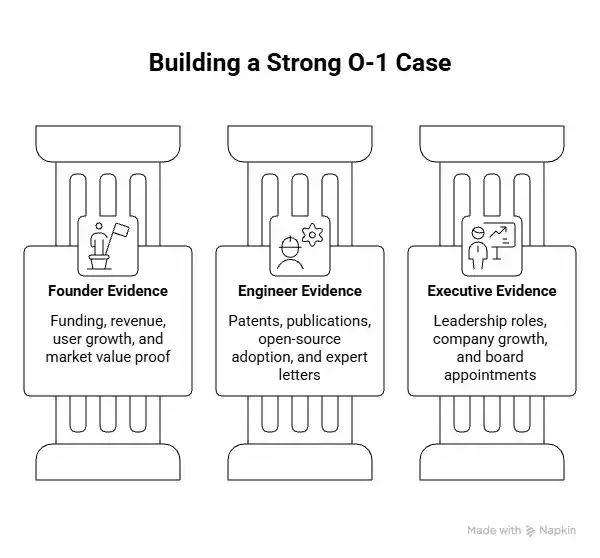
An O-1 visa for UK founders may be supported by funding, revenue, user growth, accelerator acceptance, press coverage, investor letters, major customers, strategic partnerships, or proof that the founder created a product with market value.
Founder cases also need careful petitioner planning. A founder usually cannot treat the O-1 as a simple self-sponsored route.
An O-1 visa for UK engineers may include patents, technical publications, open-source adoption, major product architecture, critical infrastructure work, speaking invitations, peer review, GitHub traction, high compensation, or letters from recognized experts.
For engineers, the case should explain why the work mattered, not only what tools or languages the applicant used.
Executives may rely on evidence such as senior leadership roles, company growth, revenue responsibility, market expansion, major partnerships, board appointments, press mentions, awards, or influence within a distinguished organization.
The best cases connect the person’s leadership directly to measurable business outcomes.
A UK applicant usually needs a U.S. petitioner. This may be a U.S. employer, U.S. company, or U.S. agent. The petitioner's structure must match the actual work arrangement.
A single full-time role may use an employer petitioner. A founder expanding a company into the U.S. may use a properly structured company petitioner. A consultant, advisor, or fractional executive with multiple engagements may need an agent model.
Read more about O-1 visa sponsor requirements.
The O-1 visa for UK professionals may be a better fit when the applicant has strong evidence, needs a cap-free U.S. route, and has real U.S. work planned.
It may be especially useful for UK founders expanding into the U.S., engineers joining American tech companies, executives leading U.S. growth, or researchers moving into high-impact roles.
However, it may not be right if the applicant has limited external recognition, no U.S. petitioner, or only standard employment experience without proof of distinction.
Beyond Border helps UK professionals assess whether their achievements can support an O-1 petition. The work includes evidence review, case strategy, petitioner structure, recommendation letters, petition narrative, and filing support.
A strong O-1 case should not read like a resume. It should explain why the applicant is recognized, why their work matters, and why their U.S. role fits the O-1 standard.
Yes. UK citizens can apply for an O-1 visa if they meet the extraordinary ability standard and have a valid U.S. petitioner. The category is based on achievement, not nationality.
It depends on the goal. The Skilled Worker visa is for working in the UK. The O-1 visa is for highly accomplished professionals seeking to work in the United States.
Yes. UK founders usually need a U.S. company, employer, or agent petitioner. The structure must show real U.S. work and proper petitioning authority.
No. The O-1 visa does not have an annual lottery or cap, which makes it attractive for qualified professionals who want a U.S. work visa route without H-1B lottery timing.
Useful evidence may include awards, press, funding, major roles, judging, published work, high salary, technical impact, original contributions, and expert recommendation letters.

Address: 4 W 4th Ave, San Mateo, CA 94402, United States
Email: info@beyondborderglobal.com