
European founders and tech talent can use the O-1 visa if they can prove extraordinary ability through documented achievement, recognition, and impact. For founders, this may include funding, accelerator admission, press, revenue growth, product traction, awards, patents, partnerships, or expert letters. For CTOs, AI specialists, software engineers, and other European tech professionals, strong evidence may include original technical contributions, patents, publications, open-source adoption, high compensation, judging, or critical roles. For startup applicants, the O-1 visa for startup founders works best when the case clearly connects company milestones to the founder’s personal role.

European founders and technology professionals often move to the U.S. because the market can be important for fundraising, enterprise sales, hiring, partnerships, and category leadership. For many founders, being physically present in the U.S. makes it easier to meet investors, close customers, build a local team, attend industry events, and manage U.S. operations.
A European company may be born in Berlin, Paris, Amsterdam, Stockholm, Lisbon, Tallinn, or London, but its largest customers, investors, or strategic partners may still be in the United States. This is especially true in sectors like AI, SaaS, fintech, biotech, healthtech, robotics, climate technology, cybersecurity, enterprise software, and developer tools.
For tech specialists, the U.S. can offer a larger product scope, deeper research ecosystems, higher-growth companies, and more opportunities to work on frontier systems. Senior AI engineers, infrastructure leaders, product builders, and research-heavy specialists may move because their work requires proximity to U.S. labs, customers, founders, investors, or technical teams.
The immigration issue is that not every European professional fits into a clean visa category. H-1B can be limited by the lottery and employer sponsorship. L-1 requires a qualifying foreign and U.S. company relationship. E-2 depends on nationality, treaty eligibility, investment, and business structure. EB-1A is a green card route, but not every applicant is ready for that standard immediately. This is where the O-1 can become a serious option.

A strong O-1 case is built around evidence, not job titles. European founders may qualify when they can show that their work has been recognized through funding, selective accelerator admission, revenue growth, product traction, press, awards, patents, partnerships, speaking invitations, judging roles, or expert letters. European tech specialists may rely on original technical contributions, patents, publications, open-source adoption, critical roles, peer review, high compensation, or major systems they helped build.
The key is not just collecting documents, but explaining why each piece of evidence matters. For example, the press should show meaningful recognition, not just a company announcement. Awards should show selectivity and field relevance. A critical role should explain why the applicant’s work was essential to a distinguished company, product, or project. For a deeper breakdown, Beyond Borders’ guide on O-1 visa evidence explains how different evidence categories can support a petition. You can also review specific guides on O-1 visa awards and memberships, O-1 visa critical role, and O-1 visa published material if your case depends heavily on those criteria.
Petitioner structure is one of the most important issues for European founders. The O-1 is not a pure self-petition. USCIS requires an O-1 petition to be filed by a U.S. employer, U.S. agent, or foreign employer through a U.S. agent.
Many European founders want to expand their own company into the U.S. rather than work for a traditional employer. This is possible in some cases, but the structure must be handled carefully. For entrepreneurs, USCIS explains that while O-1 beneficiaries may not self-petition, a separate legal entity owned by the entrepreneur may be able to file in certain circumstances.
A founder may be able to use a U.S. company structure, but the petition should clearly explain the founder’s U.S. role, business purpose, work to be performed, company structure, and relationship between the petitioner and beneficiary. If the founder owns part or all of the company, the case should not casually be described as “self-sponsored.” That wording can create confusion. The better approach is to show a valid petitioner arrangement supported by contracts, corporate documents, work plans, and evidence of business activity.
A U.S. agent structure may be useful for some founders, fractional executives, consultants, creative professionals, or specialists working across multiple U.S. engagements. This can work when the applicant has a real U.S. work plan and documentation supporting the proposed employment or business activities.
Many strong applicants focus only on awards, press, funding, or technical achievements, then treat the petitioner structure as an afterthought. That is risky. A strong O-1 case needs both: evidence of extraordinary ability and a clean filing structure.
If you are planning U.S. expansion as a European founder or senior tech professional, Beyond Border can review your evidence, petitioner structure, and long-term visa strategy before you file.
European founders often compare O-1 with L-1, E-2, and EB-1A because each route serves a different purpose. The best option depends on company structure, nationality, evidence strength, timeline, and long-term U.S. plans.
For many European founders, O-1 can be a practical first step when they have strong individual recognition but do not fit the L-1 or E-2 structure. It may also help them work in the U.S., grow the company, and strengthen the evidence record for a future EB-1A green card. However, O-1 approval does not automatically mean EB-1A approval. The green card case must be built separately.
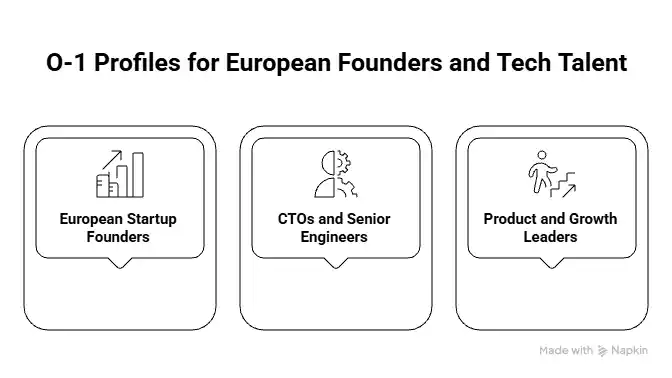
The best O-1 profiles usually have clear proof that the applicant has done something beyond normal professional work. A strong resume is not enough. The evidence must show that others in the field noticed, used, recognized, awarded, funded, selected, or relied on the applicant’s work.
European founders may have strong O-1 profiles when they can show VC funding, accelerator admission, press, product traction, major customers, awards, patents, revenue growth, or market expansion results. The industry does not need to be limited to software. Strong cases can come from AI, biotech, climate, robotics, healthtech, consumer brands, fintech, education, logistics, or deeptech.
For CTOs and senior engineers, strong evidence may include building core infrastructure, leading technical teams, creating original systems, filing patents, contributing to widely used open-source projects, publishing research, or solving technical problems at scale. The petition should explain the technical work in plain language so a non-technical reviewer can understand why it matters.
For product and growth leaders, useful evidence may include major revenue impact, successful market launches, user growth, category-defining work, leadership at recognized companies, press, awards, or expert validation. These cases need careful framing because USCIS may not immediately understand product or growth work unless the impact is clearly documented.
Beyond Border helps European founders and technology professionals assess whether their background may align with the O-1 visa, O-1 visa for startup founders, L-1 visa, or EB-1A green card.
For founders, the review should cover evidence strength, petitioner structure, U.S. expansion plans, and future green card strategy. For tech professionals, the review should focus on technical impact, recognition, compensation, original contributions, and whether the evidence is strong enough for O-1 or better suited for another route.
The O-1 visa for European founders can be powerful, but it is not automatic. The strongest cases are built with a clear story, strong documents, credible evidence, and a filing structure that matches the applicant’s real U.S. plans.
Schedule your free consultation and profile evaluation→
Yes. European founders can qualify for the O-1 visa if they can show extraordinary ability through strong evidence of achievement, recognition, and impact. Useful evidence may include funding, awards, press, product traction, patents, revenue growth, accelerator admission, judging, high compensation, or expert letters.
No. The O-1 visa is not only for technical founders. Non-technical founders may also qualify if they have strong evidence of business achievement, market impact, press, awards, revenue growth, partnerships, or industry recognition. Technical founders often have clearer evidence through products, patents, systems, or research, but they are not the only applicants who can qualify.
Possibly, but the structure must be handled carefully. The O-1 is not a direct self-petition. USCIS states that a U.S. employer or U.S. agent must file the petition, and that a separate legal entity owned by the entrepreneur may be able to file in certain circumstances.
It depends. L-1 may be better when the founder has a qualifying foreign company and U.S. office structure. O-1 may be better when the founder has strong personal achievements but does not fit the L-1 transfer requirements. The right route depends on evidence, company structure, and timing.
Not always. E-2 may work well for treaty-country entrepreneurs who are making a qualifying investment in a U.S. business. O-1 may be stronger when the main argument is the founder’s extraordinary ability, recognition, and field-level impact rather than investment alone.
Yes, but O-1 approval does not automatically lead to EB-1A approval. O-1 is a temporary work visa, while EB-1A is a green card category. A founder may use O-1 to work in the U.S. and continue building evidence before later pursuing EB-1A.
Strong evidence may include patents, publications, citations, open-source adoption, major technical systems, critical roles, high compensation, awards, peer review, conference speaking, or expert letters. The evidence should show that the applicant’s work had an impact beyond normal employment.
Yes, European awards and press can count if they are credible and relevant. The petition should explain why the award, media outlet, accelerator, investor, or institution matters. USCIS may not automatically understand the reputation of every European organization, so context is important.


Address: 4 W 4th Ave, San Mateo, CA 94402, United States
Email: info@beyondborderglobal.com