Cybersecurity experts can qualify for the O-1 visa if they can prove extraordinary ability through recognized achievement, technical impact, and evidence that sets them apart from others in the field. For most cybersecurity professionals, the relevant category is O-1A, which covers extraordinary ability in sciences, education, business, or athletics.
Cybersecurity fits this category because it involves computer science, engineering, infrastructure protection, risk management, and national security. Strong applicants may include security engineers, threat researchers, cloud security architects, AppSec specialists, incident response leaders, penetration testers, cybersecurity founders, or AI security experts.
The key point is simple: USCIS does not approve an O-1 case based on job title alone. The petition must show what the applicant built, discovered, protected, improved, or influenced through evidence such as CVEs, responsible disclosures, security architecture, publications, speaking, awards, high compensation, open-source tools, or expert letters.

The strongest evidence for the O-1 visa for cybersecurity experts usually shows that the applicant has made a measurable contribution to security systems, research, infrastructure, products, or industry practice. The evidence should not read like a resume. It should show why the applicant’s work is important and how others in the field recognized it.
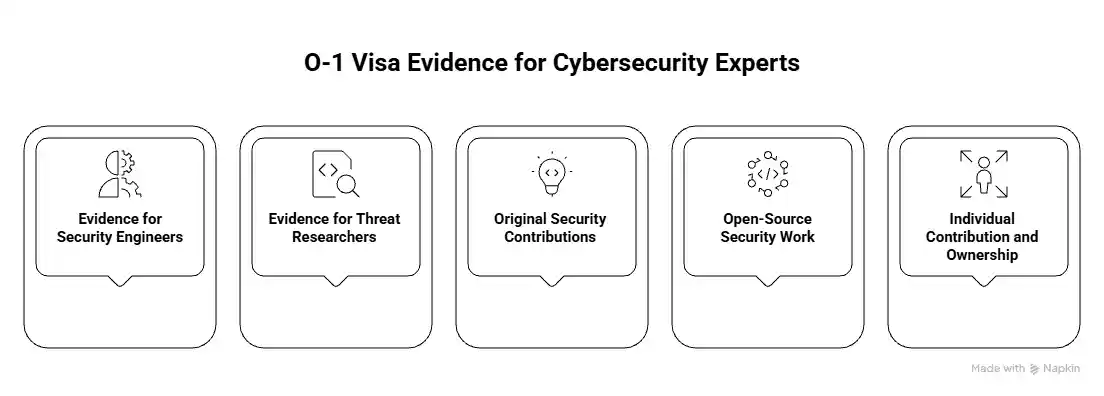
For security engineers, strong evidence may include designing secure infrastructure for high-scale platforms, building internal security automation, reducing vulnerabilities across production systems, leading cloud security architecture, improving identity and access management, or developing tools used by engineering teams.
If the work protected major customer data, supported compliance, reduced breach risk, or became part of a company-wide security standard, those details should be clearly documented.
For threat researchers, strong evidence may include vulnerability discoveries, malware research, threat intelligence reports, responsible disclosures, CVEs, vendor acknowledgments, public advisories, or research cited by other security teams.
A threat researcher who identifies a significant vulnerability and helps a company remediate it may have stronger evidence than someone who only performs routine scanning or internal monitoring.
Original contribution evidence is especially important. USCIS recognizes original scientific, scholarly, or business-related contributions of major significance as one possible O-1A criterion.
For cybersecurity professionals, this can include original security tools, detection methods, vulnerability research, secure system architecture, incident response frameworks, or technical research that others adopted or relied on. Applicants can learn more about this evidence category in Beyond Border’s guide to O-1 original contributions.
Open-source security work can also support a case when it shows real adoption. Useful proof may include GitHub stars, forks, package downloads, named enterprise users, maintainer status, citations in technical documentation, or evidence that other teams use the tool in real environments.
This overlaps with the kind of evidence often used by software professionals, which is why cybersecurity applicants with engineering-heavy backgrounds should also review the O-1 visa for software developers.
The petition should also separate the applicant’s individual contribution from the company’s general success. USCIS needs to understand what the cybersecurity expert personally did.
That may require architecture documents, code contribution records, internal security memos, leadership communications, performance reviews, expert letters, or product documentation that shows ownership.
Confidentiality is one of the biggest challenges in an O-1 visa for cybersecurity experts case. Many cybersecurity professionals work on private systems, regulated environments, enterprise security programs, incident response matters, or sensitive infrastructure where full details cannot be disclosed.
That does not make the evidence unusable. It means the petition needs a careful documentation strategy. The goal is to prove the importance of the work without exposing private systems, attack details, customer data, source code, or confidential business information.
Redacted evidence can help support the petition while protecting sensitive details. This may include redacted vulnerability reports, incident summaries, architecture diagrams, internal security reviews, risk assessments, compliance records, Jira tickets, deployment records, leadership emails, or product documentation.
The redactions should still preserve enough context to show the applicant’s role, responsibility, and impact.
The petition can describe the scale and importance of the work without exposing confidential systems. For example, it may describe “a cloud security framework used across multiple production environments handling regulated customer data” instead of naming private systems or disclosing exploit details.
This helps USCIS understand the importance of the work without putting sensitive information at risk.
Expert letters are especially useful when the strongest work cannot be fully disclosed. A strong letter should explain what problem the applicant solved, why the work mattered, how it compared to ordinary cybersecurity responsibilities, and what changed because of the applicant’s contribution.
The letter should focus on technical value, measurable impact, and the applicant’s personal role.
The strongest strategy is not to hide confidential work. It is to translate it safely so USCIS can understand the achievement without exposing private systems, customer data, source code, or security vulnerabilities.
Awards, speaking, publications, and responsible disclosures can all strengthen an O-1 visa for cybersecurity experts when they show recognition beyond ordinary employment. These evidence types are useful because they create an external record of the applicant’s standing in the cybersecurity field.
Cybersecurity awards may include security research awards, bug bounty rankings, hackathon wins, vendor recognition, internal excellence awards from distinguished companies, industry honors, innovation awards, or recognition from respected cybersecurity programs.
Not every award carries the same weight. A selective award judged by recognized experts is usually stronger than a participation certificate or a general workplace award.
Speaking at cybersecurity conferences, OWASP events, BSides chapters, cloud security summits, technical webinars, university seminars, company-hosted expert panels, or industry events may support the petition if the opportunity was selective or invited.
The evidence should include the event page, the speaker profile, the agenda, the selection process, if available, the audience size, and the topic summary.
Publications can include peer-reviewed research, technical blogs, white papers, security advisories, malware analysis, vulnerability writeups, threat intelligence reports, documentation, or articles in respected trade publications.
The strongest publications usually show technical depth, industry relevance, citation by others, or adoption by security teams.
Responsible disclosures can be powerful evidence when handled correctly. CVE records, vendor acknowledgments, Hall of Fame listings, public advisories, bounty confirmations, remediation notes, and disclosure timelines can help show that the applicant identified meaningful security issues and followed accepted professional standards.
A single low-impact bug report may not carry much weight. Repeated high-quality disclosures to recognized companies or widely used platforms can support a much stronger record.
Cybersecurity professionals working in AI security, model risk, adversarial testing, or secure AI infrastructure may also have overlapping evidence with AI engineers. Those applicants should review Beyond Borders’ guide on the O-1 visa for AI engineers to understand how technical innovation, research, and implementation can be framed.

Different cybersecurity professionals need different evidence strategies. A threat researcher’s petition will not look the same as a cloud security architect’s petition. A cybersecurity founder will not rely on the same evidence as an incident response lead. The petition should match the applicant’s actual work.
The most important point is that evidence should not be generic. “Managed security risks” is weak. “Built a detection system that reduced false positives by 40% across a production cloud environment” is much stronger. “Worked on incident response” is weak. “Led remediation after a critical vulnerability affecting thousands of enterprise users” is more useful if supported by documents and expert letters.
Beyond Border helps cybersecurity professionals turn technical work into a clear O-1 strategy. For the O-1 visa for cybersecurity experts, the goal is to identify which achievements support the O-1 criteria and explain them in a way USCIS can understand.
For security engineers, this may include architecture, tooling, incident reduction, and critical roles. For threat researchers, it may include CVEs, disclosures, vendor acknowledgments, and research impact. For cybersecurity founders, it may include product adoption, funding, press, customers, and technical originality.
If your work involves sensitive systems, confidential projects, or technical contributions that are hard to explain, the right evidence strategy matters.
Schedule your free consultation and profile evaluation.
Yes. Cybersecurity experts can qualify for the O-1 visa if they can prove extraordinary ability through strong evidence of achievement and recognition. This may include original security contributions, responsible disclosures, CVEs, publications, awards, speaking, critical roles, high compensation, or expert validation.
Strong evidence may include vulnerability discoveries, CVEs, responsible disclosures, security research, conference speaking, awards, open-source tool adoption, critical roles, expert letters, and measurable security impact.
Yes. Confidential cybersecurity work can often be used if it is documented carefully. The petition may include redacted reports, expert letters, internal records, architecture summaries, security reviews, incident summaries, or evidence of impact without exposing sensitive systems.
CVEs can help when they show meaningful vulnerability research and a recognized technical contribution. A CVE may support an O-1 case if it involved a significant vulnerability, a widely used product, vendor acknowledgment, remediation, or broader industry relevance.
Yes. Bug bounty work can support an O-1 visa petition when it shows repeated success, high-impact findings, strong payouts, top researcher rankings, vendor recognition, or accepted disclosures from major platforms.
No. Certifications can support the applicant’s technical background, but they are usually not enough by themselves for an O-1 visa. USCIS is looking for evidence of extraordinary ability, not just professional qualifications.
Yes. A cybersecurity founder may qualify for the O-1 visa if they can show strong evidence such as product innovation, customer adoption, funding, press, awards, enterprise contracts, original technology, or expert recognition.
The biggest mistake is presenting cybersecurity work as a list of job duties instead of a record of impact. USCIS needs to understand why the applicant’s work is above ordinary professional performance.


Address: 4 W 4th Ave, San Mateo, CA 94402, United States
Email: info@beyondborderglobal.com