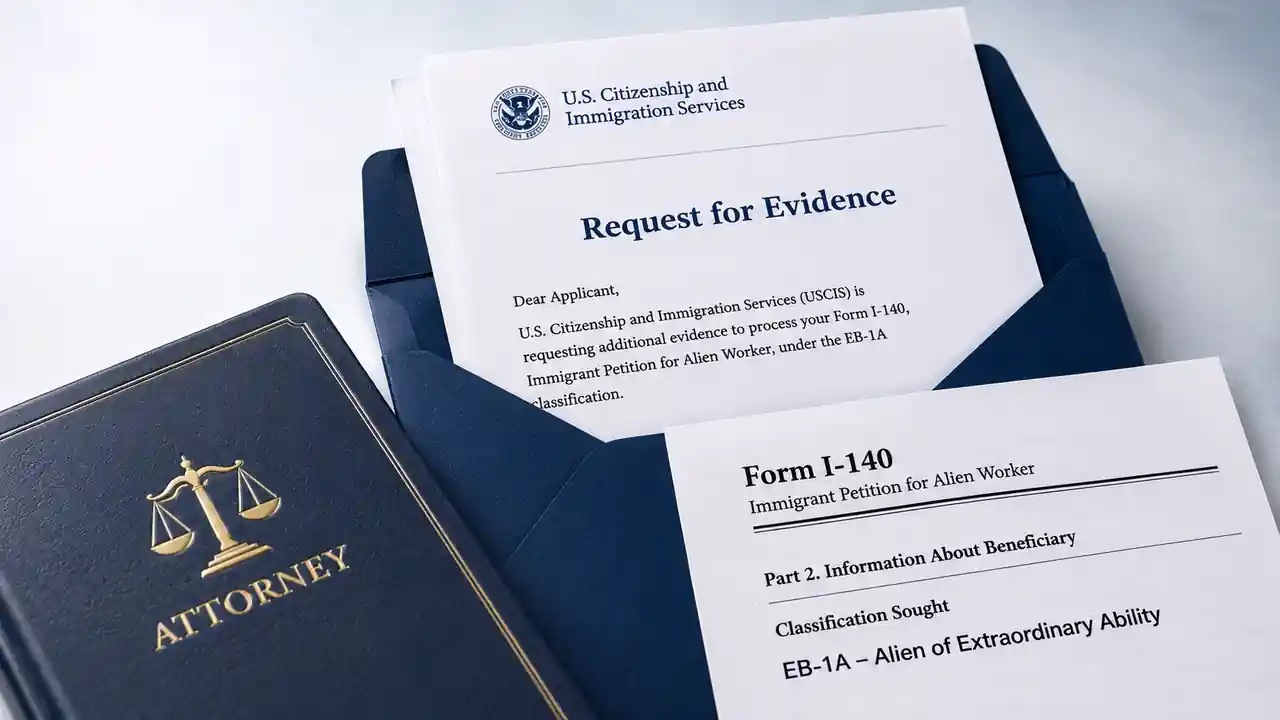
Getting an RFE for your EB-1A is not a denial, and it is not bad. USCIS officers issue RFEs if they determine that the evidence already submitted does not fully establish eligibility for the EB-1A.
To resolve this, you will need to identify what the notice asks for and how many days you have to respond.
Beyond Border attorneys have collectively handled 4,000+ immigration cases across O-1, EB-1, and EB-2 NIW categories. The guidance below reflects how these notices are read in practice, and it is organized so that you can understand the notice in front of you before deciding how to answer it.
Getting an RFE means the officer has not decided against you because the evidence submitted does not wholly prove eligibility. USCIS has discretion to issue a Request for Evidence, a Notice of Intent to Deny, or in some circumstances straight denial.
In fact, in a recent Policy alert, USCIS now directs its officers to issue a denial if a petition or application does not include the required initial evidence, or does not establish eligibility at the time of filing. Prior to this, officers could issue an RFE before denying a case, even where the required initial evidence was missing. This new policy changes things.
If an officer thought your petition was a lost cause, they would have already issued a denial. The fact that you received a notice instead means they have not reached that conclusion yet. That’s the positive side.
The other reality is that an RFE means your current filing did not meet the "preponderance of the evidence" standard. In simple terms, this standard means you need to prove with more evidence that you meet the criteria. Since the burden of proof is on you, the notice is essentially pointing out exactly where the officer is not convinced yet.
An RFE notice should do four things:
The RFE notice cannot just say your evidence is not good enough. Officers are required to explain what is lacking in your petition and, whenever they can, give you specific examples of the kind of persuasive evidence you need.
Read your notice for the specific eligibility requirement it names, and the specific reason it gives for finding your evidence insufficient. That tells you what to fix.
Not every notice carries the same weight; a Notice of Intent to Deny is more serious.
Generally, USCIS sends an RFE when only a few pieces of evidence are missing or unconvincing, but they may send a NOID if they feel most of the required proof is missing. You might also get a NOID if the officer agrees you meet the basic requirements but is not convinced you deserve a favorable decision.
USCIS looks at your EB-1A petition in two distinct stages. Firstly is whether you meet all the criteria for which you’ve added evidence, and secondly is whether, when evaluated as a whole, your record demonstrates that you are in the top percent of your field.
In the first stage, USCIS is simply checking if the receipts for all the criteria you’ve selected are there. If your RFE is focused here, it’s usually a documentation problem. You just need to find the missing proof or better explain how your documents fit the rules.
Step two is when the officer zooms out and assesses the overall strength and impact of your career. Even if you checked every box in step one, the officer can still deny the case if they are not convinced that you are truly at the very top of your field. They want to see sustained acclaim and success that set you apart from your peers.
If your RFE is issued in step two, it’s an argument problem. Sending more paperwork won’t help. Instead, you have to change the narrative. You need to provide context that shows why your work matters to the field as a whole and proves that you have achieved national or international recognition.
Before responding to an RFE, review your notice carefully. Is the officer asking for a missing document (Step 1), or are they questioning whether you’re actually a leader in your industry (Step 2)?
The maximum response time for an RFE is 12 weeks (84 days). There is no extension. But there are three main things that can alter the timeline:
Take the date printed on your notice, work backwards from it, and set your internal deadline at least two weeks before the printed date.
From handling over 4,000 EB-1A cases, we’ve seen that the primary reasons RFEs turn into denials stem from how the notice is handled. Here are the patterns we’ve seen.
Use these questions to determine how to respond to an RFE;
Answer those, and the shape of the work will be clear. What remains is the harder question of whether your record can provide the response.
Receiving an RFE is a difficult moment that forces you to make some hard choices very quickly. It is incredibly difficult to evaluate your own petition objectively because the officer is looking at your life’s work through a lens you likely did not anticipate when you first filed.
Before you decide whether to stand your ground, withdraw, or start over with a stronger case, you need an honest assessment of whether your current record can actually bridge the gap the officer has identified.
Beyond Border attorneys will read your notice against your filed record and tell you what it is actually asking, which of your concerns are documented and which are arguments, and whether the response can realistically be built in the days you have left. Request an RFE assessment, or review the criteria against your profile with the EB-1A eligibility checker.
No, an RFE is not a denial of any kind. USCIS instructs officers not to issue a notice where the record already establishes ineligibility, and to deny outright where no additional evidence could establish a legal basis for approval. Receiving an RFE indicates the officer has not reached that conclusion about your petition.
A NOID is the more serious notice. It states an intention to deny and gives you 30 days to respond. USCIS guidance indicates a NOID may be issued where all or most of the required evidence is missing, while an RFE typically issues where some required evidence is missing or unpersuasive.
No extension is available. The regulations prohibit officers from granting additional time to respond to an RFE. Mailing adds a small number of days to the calculation, and petitioners residing outside the United States receive additional time as a matter of policy, but neither is an extension you can request.
USCIS can issue a follow-up notice. Where your response raises eligibility questions the officer did not identify earlier or opens new lines of inquiry, a second RFE or a NOID may be issued. Officers are directed to include everything they anticipate needing in a single notice; a second notice should not be expected.
USCIS may deny the petition as abandoned, deny it on the record, or both. You cannot appeal a denial due to abandonment. The only route is a motion to reopen, and the circumstances of the abandoned petition may be material to a new filing.
An RFE does not by itself indicate an error. You can receive an RFE for many reasons, including the officer's interpretation of how the evidence should be presented. What you should focus on is whether the concern raised was foreseeable and whether the original petition addressed it.
Yes, you can. You do not need an attorney to represent you. The primary challenge, however, is that your answer has to address the legal question the officer raised rather than the factual one, particularly where the notice concerns the final merits determination, and you have one submission to do it.
Your priority date is established when the petition is properly filed and does not change because a notice is issued. An RFE affects when your petition is decided, not where you sit in the queue.

Address: 4 W 4th Ave, San Mateo, CA 94402, United States
Email: info@beyondborderglobal.com