
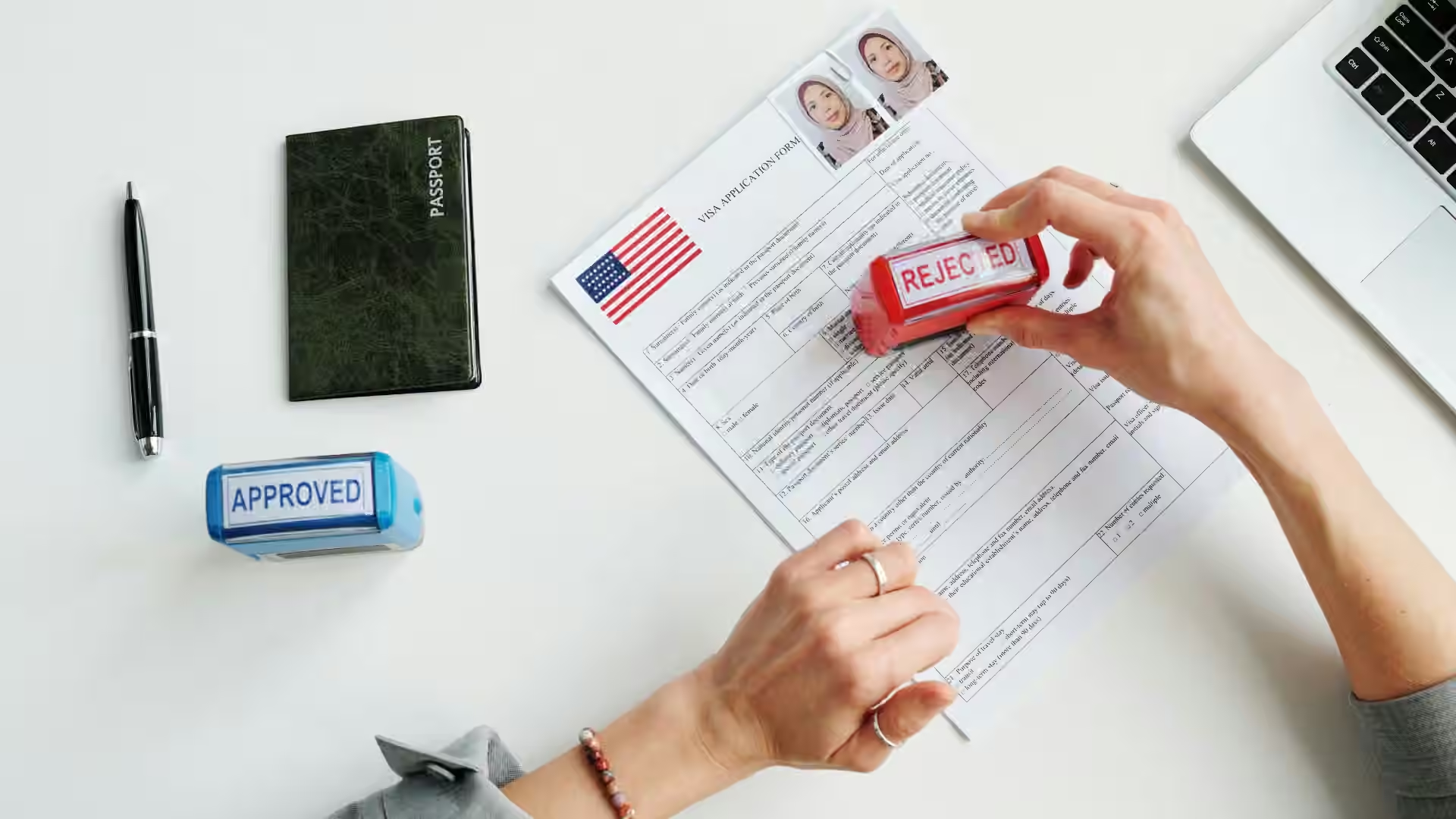
On August 5, 2026, USCIS issued a Policy Alert that says if a petition or application does not include the required initial evidence, or does not establish eligibility at the time of filing, an officer may deny it without first issuing a Request for Evidence or a Notice of Intent to Deny.
This Alert revises the agency's guidance on initial evidence, RFEs, and NOIDs, updating Volume 1, Part E of the USCIS Policy Manual.
The guidance took effect the day it was issued. It applies to benefit requests filed on or after August 5, 2026, and to requests already pending on that date, unless a regulation or other USCIS policy provides otherwise.
Officers still have discretion to issue an RFE where appropriate, and many will continue to. What has changed is that it is no longer the default.
Before this alert was issued, officers were encouraged to request evidence before denying a case, including where required initial evidence was missing.
USCIS says the earlier approach allowed incomplete filings to slow processing. They also said applicants filed placeholder submissions just to get work permits while their actual cases were in line.
The agency frames this as restoring adjudicator discretion that already existed, not creating new authority.
The good news is that this is a solvable problem. Nothing here changes what makes a petition approvable. It changes when the record needs to be complete, and that is something you and your counsel control.
The alert also changes how officers set deadlines once an RFE or NOID is issued.
The limits haven't moved. You still have up to 12 weeks for an RFE and 30 days for a NOID. But officers aren't required to give you the full window anymore, and can set tighter deadlines.
The extra 14 days people used to get for international mail is also gone. Now, everyone gets the same three-day mailing buffer, no matter where you are in the world.
Another change: if you send back a partial response to buy more time, USCIS will treat it as your final submission and decide on what you sent. The placeholder strategy no longer works. A complete response is now the only response worth sending.
The alert also cleans up which documents count as "initial" versus "additional" and how affidavits are weighed. If you can't get a required document, you need to show it's unavailable and provide a solid backup. That clarity is useful. It tells you what a complete file looks like before you submit.
Here is what we see as the practical effect for these categories.
Required initial evidence is easy to identify in some contexts. An adjustment of status application missing the Form I-693 medical examination lacks a required document.
The O-1A and O-1B nonimmigrant visa categories and the EB-1A immigrant category work differently. Their regulations define required initial evidence as evidence satisfying a minimum number of listed criteria, and whether a given petition satisfies a given criterion is a judgment call.
The EB-2 National Interest Waiver has no criteria list at all. Eligibility there runs through the three-prong framework in Matter of Dhanasar, which is analytical rather than documentary.
"It is important to remember that the right to issue straight denial in absence of required evidence has always been there. The memo serves the purpose of reminding USCIS officers their right to exercise so. How aspirants should read this news is that it is a reflection of a stricter stance from USCIS on visa and green card applications - a continuation of the theme under the current Trump administration.
The recent movement points to the importance of working with a legal counsel to put together your application. This will avoid submissions where the basic requirements for a visa pathway not being met in the first place," Frederick Ng, Co-founder of Beyond Border explains.
The open question is how broadly officers will read this. If you submit evidence addressing the right number of criteria and the officer is not persuaded, is that a straight denial, or still an RFE? The alert does not answer that.
If they take the broad view, it would take away the "second chance" that many people rely on to fix their petitions. In early 2026, EB-1A approval rates dropped to about 42%, declining from the 67% we saw in 2025. EB-2 NIW approvals are also down from last year, sitting at around 48%.
Even for O-1 visas, which have a high approval rate of 91%, the number of people getting a Request for Evidence (RFE) has been dipping. While this trend started before the new policy, it shows that the window for fixing a petition was already narrowing.
An incomplete filing used to mean a delay. Now it can mean a denial, and denials have real costs: no return of filing fees, and for someone relying on a timely extension, a denial can interrupt work authorization.
That is the reason to front-load the work, and the reason front-loading works. Your petition simply needs to be complete the first time.
If your case is already pending, it is worth a second look. A petition assembled in June on the assumption that an RFE would catch any gaps is now being reviewed under different expectations. This is a good moment to review the file with counsel and decide whether to supplement the record before an officer reviews it.
We also expect some legal scrutiny. USCIS issued this policy as guidance rather than through notice and comment, and it affects cases already in the system, so there’s a good chance this policy will end up in court.

