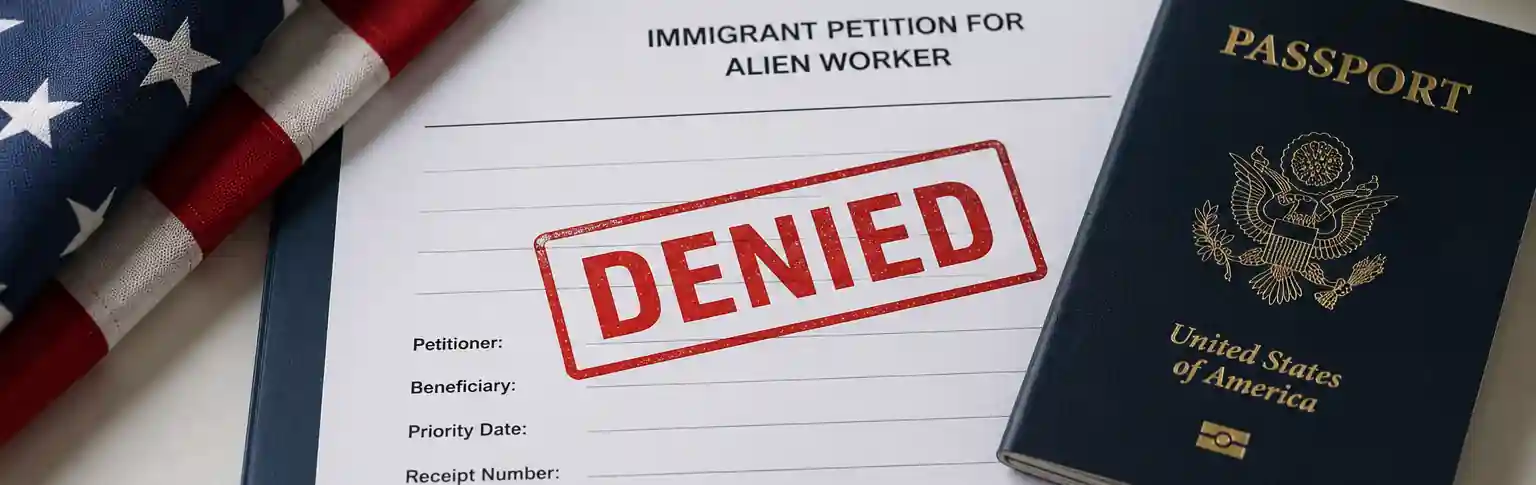
The I-140 denial notice tells you which regulatory criteria or policy standards USCIS concluded you failed to meet. For EB-1A, that means whether you fell short at the criteria count step, the final merits determination, or both. For EB-2 NIW, it identifies which Dhanasar prong was not met.
However, it does not always explain why the evidence you submitted was insufficient in a fixable way, or whether the officer applied the law correctly.
You have 30 calendar days from the date USCIS mailed the notice to file Form I-290B. Reading the denial correctly before those 30 days expire is the most important.
Beyond Border attorneys have collectively handled 4,000+ immigration cases across EB-1A and EB-2 NIW categories. This article is written with that practical experience, providing guidance on what to do if you receive an I-140 denial.
USCIS evaluates EB-1A petitions under two frameworks: first, whether the evidence meets at least three of the ten regulatory criteria; then, whether the totality of the evidence establishes sustained national or international acclaim and that the petitioner is among the small percentage at the very top of the field.
Here are some common I-140 denial reasons on an EB-1A visa application;
Meeting three criteria is a threshold, but it does not guarantee approval. According to Beyond Border attorneys, the most important thing is that your evidence, when taken as a whole, shows you belong at the very top of your field. Petitions that pass the criteria but fail at establishing you as among the top per cent in your field contain evidence that lacks sustained, field-wide recognition. For example, citations concentrated in one paper, judging invitations from panels USCIS found insufficiently distinguished, or press coverage that mentions you as part of a company story rather than for individual achievement.
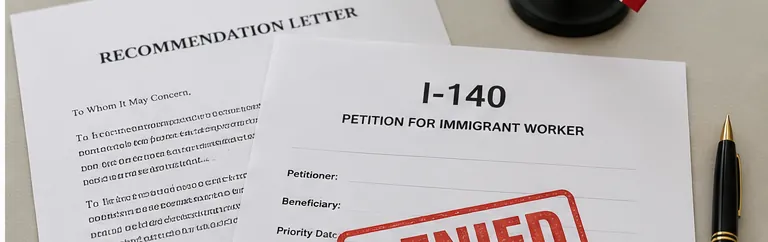
Recommendation letters that merely sing the praises of the beneficiary or come from individuals with a clear, direct relationship with the beneficiary lack any weight. The best recommendation letters are from independent experts with no supervisory or collaborative relationship with you, who explain in specific terms why your work has had measurable significance in the field. If a denial is primarily due to weak letters, the fix is to engage different independent expert writers.
A single award, a single highly cited paper, or recognition concentrated at a single institution does not establish the ongoing, field-wide recognition the visa requires. USCIS looks for evidence that recognition has been maintained, not just once achieved. A career with strong credentials two years ago, but no recent evidence of standing in the field is a problem.
If your denial followed an RFE, the officer already identified the gap. A motion to reopen based on the same type of evidence you submitted in the RFE will not lead to an approval. You must include new, documented evidence that was not available or not submitted at the time of the RFE response.
For criteria such as original contributions of major significance or judging, USCIS requires that the significance and quality be documented with independent evidence. Stating that a contribution was significant without citation to data, evidence of industry adoption, or independent expert commentary does not meet the standard.
EB-2 NIW petitions are evaluated under the three-prong framework established in Matter of Dhanasar, 26 I&N Dec. 884 (AAO 2016). USCIS has also updated the Policy Manual to clarify how officers apply the framework, with particular effect on what qualifies under the first prong.
A proposed endeavor described in broad terms without identifying specific work, timelines, and national-level impact gives the officer nothing concrete to evaluate. Your proposed endeavor must be distinct enough that an officer can assess whether it carries national importance.
According to Beyond Border attorneys, this prong fails when a petition describes credentials without connecting them directly to the specific proposed endeavor. The question is not just whether you have qualifying credentials, but whether you have the track record to advance your specific work. Publications, patents, industry implementation evidence, and documented past successes relevant to the stated endeavor are what USCIS looks for here.
Peer review letters that simply sing your praises without addressing the three Dhanasar prongs fail for the same reason as EB-1A letters. Each letter should address at least one prong explicitly, with specific knowledge of the proposed endeavor and specific claims about the petitioner's track record relative to it.
Prong 3 requires you to show that waiving the job offer and labor certification requirements benefits the United States. It is not automatically satisfied by having strong Prongs 1 and 2. Denials that cite Prong 3 as deficient are due to the petition focusing on Prong 1 and 2, rather than independently addressing why the national interest is better served by a self-petition than by the employer-sponsorship process.
If you receive a denial, you have four options. Which one you pursue depends on your unique situation and whether it applies. Here’s a side-by-side comparison;
If your nonimmigrant status is valid and independently maintained, you can continue working and living in the United States while an appeal or motion is pending.
The appeal does not independently accelerate or degrade your status. If your H-1B is approaching the six-year cap and your I-140 (or PERM) has been pending for 365+ days, you may be eligible for one-year extensions under AC21. Use the waiting period to track the USCIS Visa Bulletin monthly if priority dates are relevant to your category.
Most I-140 appeals to the AAO are not sustained. USCIS publishes official AAO decision data, including sustain, dismiss, and remand counts by form type and fiscal year.
According to USCIS, eligible applicants with strong petitions receive approval when their petitions are initially reviewed. Those with appealed cases almost always have evidentiary challenges, which have lower success rates compared to what a well-prepared appeal can achieve.
When you file a Form I-290B, the office that denied the petition conducts an initial field review within approximately 45 days before the case reaches the AAO. During that review, the denying office may reverse its own decision and approve the petition.
USCIS notes that "a significant number of appeals are favorably resolved during initial field review." Submitting a complete, well-argued brief concurrently with the I-290B, rather than waiting the optional 30 additional days, gives the field office the best opportunity to act favorably at that stage.
Here’s what drives success on the different response options;
A pending I-140 appeal does not automatically protect your nonimmigrant status, and it does not mean you should depart the country.
Your nonimmigrant status continues, or does not continue, based on the validity of your underlying visa category, different from any I-140 appeal. For example, if you're on an H-1B visa during an appeal, your visa status remains unchanged while the appeal is pending.
However, if your status expires before your appeal is resolved, you can apply for an extension of your status, change to another nonimmigrant category, or depart the United States and re-enter on a valid visa. The appeal does not grant an authorization of your stay.
According to Beyond Border attorneys, here’s a four-factor framework to help you make the right choice;
Getting an I-140 denial is a situation nobody wants to find themselves in. But if it happens, you want to make sure that you submit a stronger petition, whether for refiling or appeal. The best way to do this is to work with a specialist who can evaluate your profile honestly and map out a strong petition strategy.
Beyond Border handles EB-1A and EB-2 NIW petitions for Founders, researchers, engineers, and senior professionals. We start with an honest read of where the case stands and guide you in building a strong case for your petition. We have processed over 4,000 cases with a 98% approval rate across the board and promise to file your petition within one month of receiving your documents.
Book a free consultation today for an honest review of your profile.
The i-140 denial rate varies between 15-25% depending on the employment category and service center, with EB-2 and EB-3 cases showing the highest scrutiny especially for ability-to-pay and job requirement issues.
i-140 denial appeal time through the Administrative Appeals Office typically ranges from 12-18 months, while motions filed with the original service center usually process within 3-6 months depending on workload.
Read the denial notice completely to understand specific grounds, consult an immigration attorney within days, and decide between appeal, motion to reopen, motion to reconsider, or refiling before the 30-day deadline expires.
The i-140 appeal success rate through AAO ranges from 10-15%, while motions to reconsider show 25-35% success when properly prepared with evidence directly addressing the stated denial reasons.
Yes, refiling a new i-140 denial appeals petition is often faster and more cost-effective than appeals when the denial identifies fixable problems, and in many cases you can preserve your original priority date through porting.
Address: 4 W 4th Ave, San Mateo, CA 94402, United States
Email: info@beyondborderglobal.com