
The I-140 vs PERM distinction is the most consequential strategic decision in the employment-based green card process. Form I-140 is the Immigrant Petition for Alien Worker filed with USCIS to establish eligibility for a specific employment-based preference category. Some categories allow direct I-140 filing without PERM, based solely on the petitioner's qualifications, organizational relationship, or national-interest justification. Others require PERM labor certification from the Department of Labor as a prerequisite, adding 15 to 30 months to the process before the I-140 can even be filed. Beyond Border is an immigration firm specializing in EB-2 NIW and EB-1 Green Card petitions.
[Check the USCIS processing times page for current I-140 processing estimates, as USCIS updates these weekly.]
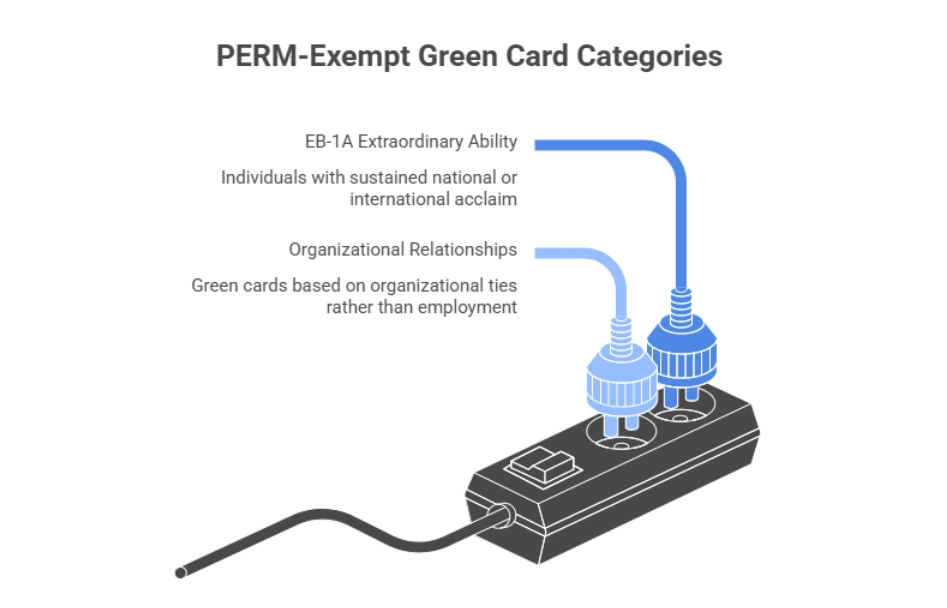
PERM-exempt green card categories allow I-140 direct filing without PERM because USCIS recognizes that applicants in these categories benefit U.S. interests without displacing qualified domestic workers, or because the qualifying relationship is organizational rather than occupational.
EB-1A Extraordinary Ability. Self-petition. No employer, no job offer, no PERM. The petitioner demonstrates extraordinary ability through sustained national or international acclaim by satisfying at least three of the ten USCIS evidentiary criteria. The premise is that individuals at the very top of their fields inherently benefit the United States. For the full criteria framework, see the EB-1A requirements guide.
EB-1B Outstanding Professor or Researcher. Employer-sponsored but PERM exempt. Requires international recognition for outstanding academic achievements, at least two of six criteria, three years of teaching or research experience, and a permanent position at a qualifying institution. Labor certification is waived because outstanding researchers are considered to advance U.S. academic and research interests regardless of available domestic candidates. For the full EB-1 requirements, see the EB-1 requirements guide.
EB-1C Multinational Executive or Manager. Employer-sponsored but PERM exempt. Requires one year of qualifying managerial or executive employment with the foreign entity within the past three years and a qualifying corporate relationship. Labor certification is waived because the qualifying capacity is organizational and specific to the employer relationship.
EB-2 NIW (National Interest Waiver). Self-petition. No employer, no job offer, no PERM. Requires the EB-2 base qualification (advanced degree or exceptional ability) and satisfaction of the Dhanasar three-prong test: the proposed work has substantial merit and national importance; the petitioner is well-positioned to advance it; and the United States benefits from waiving labor certification. For the full EB-2 NIW vs standard EB-2 comparison, see the EB-2 vs EB-2 NIW guide.
PERM labor certification required 2026 applies to: standard employer-sponsored EB-2 without a National Interest Waiver; and all EB-3 petitions (skilled workers, professionals, and unskilled workers) regardless of circumstances.
The PERM process requires the employer to: obtain a prevailing wage determination from the Department of Labor establishing the minimum salary for the role and location; conduct a mandatory recruitment campaign, including specific print advertisements and job postings over a defined period; interview U.S. worker applicants who respond; document lawful reasons for rejecting any qualified applicants; and submit the completed PERM application to DOL for adjudication.
PERM timeline 2026 green card: standard non-audited PERM processing runs 15 to 20 months. Approximately 25 to 30% of PERM applications are randomly audited, which can extend processing to 30 months or more. When the prevailing wage determination (currently 3 to 6 months) and the mandatory recruitment period (60 to 180 days) are included, total PERM process time from initiation to certification runs 18 to 30 months before the I-140 can be filed.
For detailed PERM timeline data and audit risk analysis, see the PERM approval time guide and the PERM EB-2 green card guide.

The PERM timeline 2026 green card delay of 15 to 30 months before I-140 filing directly affects the priority date position. Because the priority date is established at I-140 filing (for PERM exempt categories) or at PERM filing (for PERM-based categories), a petitioner who can file I-140 directly through EB-1A or EB-2 NIW establishes their priority date 15 to 20 months earlier than one who begins the same process through a PERM-based employer-sponsored route.
For Indian and Chinese applicants in backlogged categories, this priority date difference is not merely theoretical. In the India EB-2 queue, the current cutoff sits at approximately November 2014 as of April 2026. An applicant who establishes a priority date six months earlier through direct I-140 filing without PERM reaches I-485 eligibility six months sooner, in a queue that advances by one to three months per Visa Bulletin cycle. The compounding value over a decade-long wait is significant.
Employment flexibility is the other major advantage of PERM-exempt pathways. EB-1A and EB-2 NIW petitions remain valid regardless of job changes. The petitioner can change employers, start a company, or pursue new opportunities without the green card application. Standard PERM-based petitions are tied to a specific employer and position; layoffs, company financial problems, or deterioration in the employment relationship can derail the entire green card process at any stage. For the full comparison of how EB-1 vs EB-2 timing works alongside PERM timelines, see the EB-1 timing and Visa Bulletin guide.
Many professionals assume all employment-based green cards require PERM. Several major categories skip it entirely. Similarly, professionals often underestimate their EB-1A or EB-2 NIW eligibility, assuming the extraordinary ability or national interest standards are out of reach when a comprehensive evidence assessment might identify that the qualifying criteria are already met.
EB-2 NIW vs PERM green card is also frequently misunderstood as being limited to medical doctors in underserved areas or groundbreaking researchers. Technology professionals, educators, entrepreneurs, and diverse specialists regularly qualify for NIW through well-documented cases showing national importance. The Dhanasar test is flexible enough to cover many STEM disciplines, as well as public health, economic development, and infrastructure improvement work.
Employer involvement does not automatically mean PERM applies. EB-1B and EB-1C both involve employers but skip labor certification, demonstrating that the PERM requirement is category-specific rather than triggered by employer sponsorship alone. For how the difference between EB-1A and EB-2 NIW affects the choice of pathway, see the difference between EB-1A and EB-2 NIW guide.
To determine whether your credentials qualify for a PERM-exempt green card category, book a free consultation with Beyond Border.
i-140 vs PERM + i-140 distinction determines whether labor certification is required before filing immigrant petitions, with PERM-exempt categories allowing direct i-140 filing while traditional EB-2 and all EB-3 petitions require prior DOL labor certification approval.
EB-1A extraordinary ability, EB-1B outstanding researchers, EB-1C multinational executives, and EB-2 National Interest Waiver all skip PERM labor certification, allowing direct i-140 filing based on qualifications, achievements, or national interest justifications without labor market testing.
Skipping PERM saves 12-18 months of labor certification processing before i-140 filing even begins, significantly accelerating total green card timelines while establishing earlier priority dates that determine eventual visa number availability for adjustment of status.
Yes, EB-1A extraordinary ability and EB-2 NIW allow complete self-petitioning without employer involvement or sponsorship, while EB-1B and EB-1C require employer petitions but still skip PERM labor certification based on outstanding achievements or multinational executive qualifications.
PERM is mandatory for traditional employer-sponsored EB-2 petitions without National Interest Waiver and for all EB-3 skilled worker, professional, and unskilled worker petitions, requiring Department of Labor certification before USCIS accepts i-140 submissions.

Camila is the Head of Legal at Beyond Border, where she specializes in O-1, EB-1A and EB2-NIW visas. Camila is an OAB-certified lawyer, with 8 years of relevant US immigration experience. Camila has personally secured approval more than 100 O-1, EB-1A and EB2-NIW cases and maintained a perfect approval track record so far. Camila holds a Master's degree in Law from the Universidade Catolica Portuguesa, and is a sought after voice in the U.S. extraordinary alien visa field in press including Times of India.

Address: 4 W 4th Ave, San Mateo, CA 94402, United States
Email: info@beyondborderglobal.com