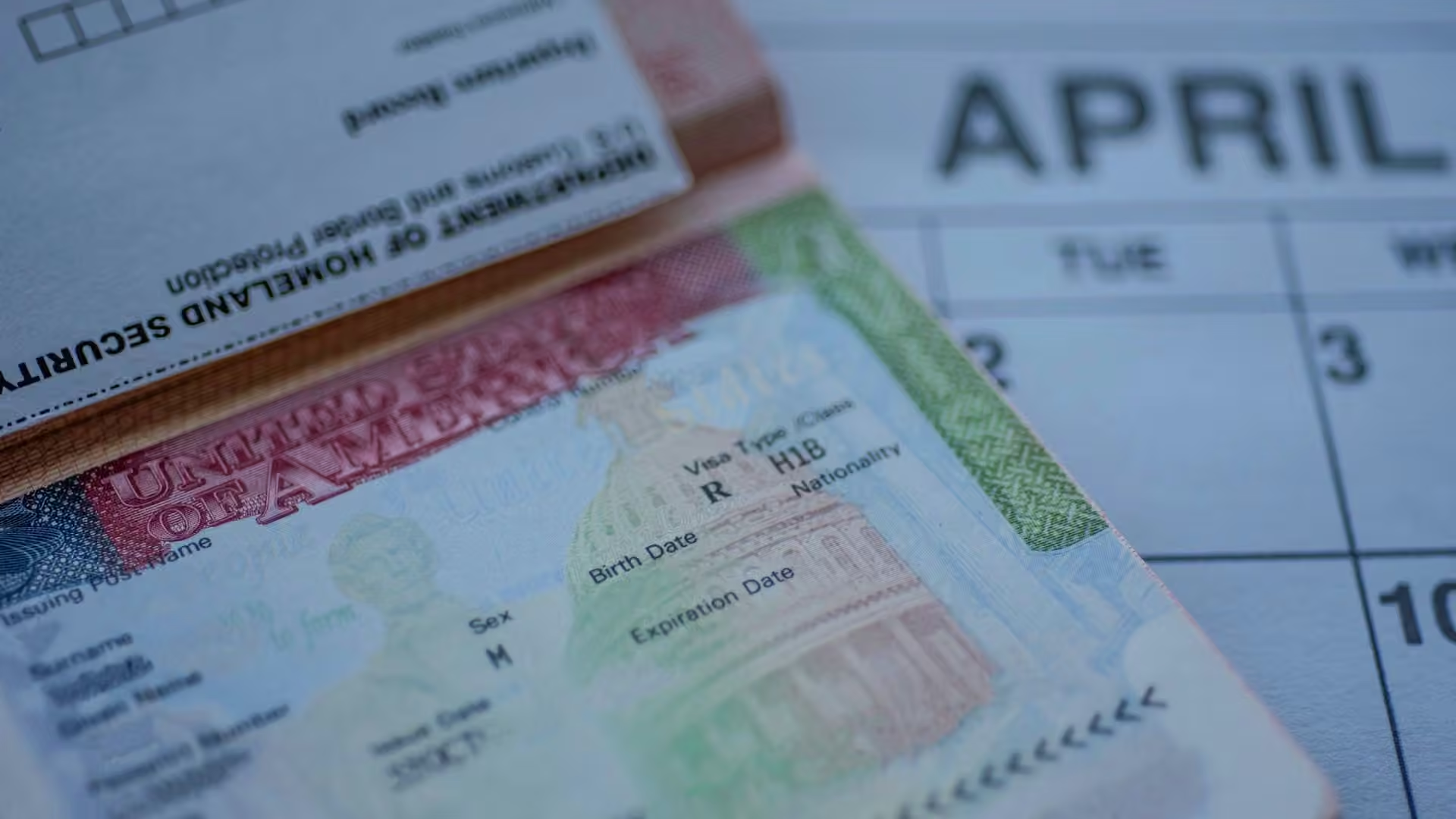
If your right to work in the United States rides entirely on someone else's visa case, every news cycle about H-1B policy probably feels personal, even when your name is nowhere on the petition. For H-4 spouses, it’s worse because your status is tied to that of your principal H-1B partner.
H-4 and H-4 EAD eligibility have not actually gotten more complicated this year. What changed is what happens around them: how your renewal gets processed, whether you need an interview, and what gets reviewed before a decision. This guide explains these updates and how you can navigate them in practice.
What Is an H-4 Visa, and Who Qualifies?
H-4 is the dependent nonimmigrant category for the immediate family of certain H visa holders, most commonly H-1B speciality occupation workers. Eligible dependents are your spouse and any unmarried children under 21.
A child who turns 21 or marries ages out of H-4 eligibility and needs a different status to remain in the country. H-4 status is granted to each dependent individually, not as a household, so a spouse and each child file their own extension when the time comes.
You can file for H-4 status at the same time as your spouse's H-1B petition, or afterwards once your spouse already holds H-1B status, sometimes called following to join.
Either way, your H-4 status is tied to your spouse's H-1B validity period. In practice, this means your paperwork timeline always follows your spouse's, not the other way around.
H-4 lets you live in the United States and attend school, but it does not, on its own, let you work. That distinction between the visa and the work permit built on top of it causes the most confusion.
H-4 EAD Eligibility: Do You Qualify?
Not every H-4 holder is eligible for an H-4 EAD. Employment authorization for H-4 spouses is its own eligibility category, 8 CFR 274a.12(c)(26), and only two situations qualify you for it.
- Your spouse has an approved Form I-140. If USCIS has approved an immigrant petition for your H-1B spouse, meaning they are already recognized as eligible for a green card in principle, you can apply for an H-4 EAD regardless of how long they have held H-1B status.
- Your spouse has an H-1B extension under AC21 sections 106(a) and (b). This is the extension that lets someone stay in H-1B status past the normal six-year limit because a PERM labor certification or I-140 has been pending for 365 days or more. If your spouse qualifies for that extension, you qualify for the EAD too.
You may see a third pathway mentioned: an extension under AC21 section 104(c), which covers H-1B holders blocked by per-country green card limits after their I-140 is approved. But it does not create another route.
Section 104(c) already requires an approved I-140, which means anyone who qualifies through it also qualifies under the first pathway above. The EAD is for spouses only. H-4 children, even those still under 21, are not eligible to apply for their own employment authorization under this category.
How to Apply for H-4 and H-4 EAD: Fees and Documents
If you are applying for H-4 status, you or your spouse file Form I-539, Application to Extend or Change Nonimmigrant Status. For the EAD, you file Form I-765, Application for Employment Authorization, under category (c)(26).
Below are the current fees, as of September 2026:
You can file the I-765 at the same time as your spouse's H-1B extension petition, or after it is approved. Filing concurrently does not guarantee a faster combined decision, but it avoids a second round of gathering documents once you already have them assembled.
You may be required to submit proof of your spouse's qualifying H-1B status (the I-797 approval notice or the I-140 approval), your own H-4 approval notice or pending application, your marriage certificate, and a government-issued photo ID.
Requirements can vary slightly by service center, so confirm the current checklist on your Form I-765 instructions before filing.
How Long Does H-4 and H-4 EAD Processing Take?
As of September 2026, H-4 EAD processing runs about 4.5 to 11 months. The actual timeline depends on the service center handling your case and whether you filed concurrently with your spouse's H-1B extension or on its own.
H-4 status, filed on Form I-539, typically follows a timeline similar to the H-1B extension it is tied to, especially when both are filed together.
Is There Premium Processing For H-4 EAD I-765?
There is no premium processing option for Form I-539 or for the H-4 EAD category itself. But it is available for your spouse's underlying H-1B petition. Premium processing costs US$2,965 and guarantees a USCIS decision in 15 business days. That can indirectly help your timeline if you file concurrently, since your EAD cannot be approved before your spouse's H-1B extension.
Given that a gap in work authorization is now a real possibility, file your renewal as early as USCIS allows rather than waiting until your card is close to expiring.
Recent Rules That Changed H-4 and H-4 EAD
Three rules implemented in 2026 now affect how USCIS handles your case.
- You can no longer count on an automatic EAD renewal extension. Before October 30, 2025, a timely filed EAD renewal automatically extended your existing card for up to 540 days while USCIS decided your case. For renewals filed on or after that date, that automatic extension no longer applies. The major category affected is the H-4 spouse EAD, category C26. If your renewal is still pending when your current card expires, your work authorization ends on that date, not when USCIS finally decides.
- An in-person interview is now required. Effective October 1, 2025, nearly every nonimmigrant visa applicant abroad now requires an interview, regardless of age. H-4 is not among the narrow categories that have a waiver option, so plan for an interview if you are applying for your visa stamp at a consulate.
- Your online presence is part of the review. Since December 15, 2025, the State Department has required an online presence review for all H-1B applicants and their H-4 dependents, and it instructs applicants to set their social media privacy settings to public before applying.
Together, these three changes make getting or renewing H-4 and H-4 EAD status slower than it was two years ago, even though the underlying eligibility rules haven't changed.
What Happens to Your Status If Your Spouse's H-1B Changes
Your H-4 status and your H-4 EAD both depend on your spouse's H-1B case. If your spouse's H-1B ends, whether from a layoff, a denied extension, or a revoked petition, your own status and work authorization end as well.
A layoff does not end your spouse's H-1B status the same day, and grace periods can apply, but the timeline is short and often stressful to navigate under pressure.
A denial on your spouse's extension can also leave your own pending EAD application without the approved status it depends on.
This is not a reason to avoid H-4 status if it fits your situation right now. It is a reason to know, clearly, that your own ability to work in the United States is only as secure as someone else's employment.
For some H-4 spouses, especially those with independently strong professional credentials, that is worth weighing against other options.
You Do Not Have to Wait on Someone Else's Visa
If you have strong professional achievements in your own right, O-1 status does not require a labor certification, a cap, or a lottery. If you are already committed to staying permanently, EB-2 NIW lets qualifying professionals self-petition for a green card without an employer.
Neither path fits every H-4 spouse, and we will tell you honestly if yours does not, yet. Request a case evaluation to find out whether your own record supports a status that does not depend on your spouse's H-1B.
Frequently Asked Questions
No. A 2018 proposal to eliminate the program never became a final rule, and the category is still active today. However, a pending renewal no longer automatically extends an expiring card.
Yes, if you filed on or after October 30, 2025. Without the automatic extension that used to apply, your work authorization ends on your card's printed expiration date even if USCIS has not decided your renewal yet. File as early as possible to reduce that risk.
An H-4 EAD is not tied to a single employer, so you can generally hold more than one job or take on additional work, the same way any other unrestricted EAD holder can. Confirm any specific arrangement, including self-employment, against your card's terms and current USCIS guidance before relying on it.
No. Employment authorization under this category is available to the H-4 spouse only. H-4 children, even those under 21, do not qualify for their own EAD through this route.
No. H-4 status itself does not carry an independent path to permanent residence. Any green card outcome flows through your spouse's employment-based case, which is also why some H-4 spouses look at whether their own credentials support a separate, independent filing.