

H-1B international travel is allowed, but it should be planned carefully. The main question is not only whether you can leave the United States. The bigger question is whether you can return without visa, status, I-94, or employment-related problems.
For most H-1B workers, travel is lower risk when they have an approved H-1B petition, a valid visa stamp, a valid passport, continued employment with the petitioning employer, and no pending extension, transfer, or amendment issue. Travel becomes more sensitive when your visa stamp is expired, your I-94 is close to expiring, your employer recently changed, or your green card case is pending.
What Does H-1B International Travel Mean?
H-1B international travel means leaving the U.S. while in H-1B status and returning to continue working for your H-1B employer. This may sound simple, but H-1B travel depends on several documents working together.
Your H-1B status is your legal classification while you are inside the U.S. Your H-1B visa stamp is the visa in your passport used to request entry at the border. Your Form I-797 approval notice shows that USCIS approved your employer’s H-1B petition. Your I-94 record controls how long you are admitted after entering the U.S.
These are not the same thing. You can have an approved H-1B petition but an expired visa stamp. You can also have a valid visa stamp but a shortened I-94. That is why H-1B workers should review travel documents before leaving the U.S., not after they are already abroad.
Can H-1B Workers Travel Outside the U.S.?

Yes, H-1B workers can travel outside the U.S. and return if they have the required documents and remain eligible for H-1B status.
The cleanest travel situation is when you have a valid passport, valid H-1B visa stamp, valid Form I-797, active employment with the sponsoring employer, recent pay stubs, and no pending USCIS issue.
If you are still at the earlier stage of the process and have not yet secured H-1B approval, start with our H-1B lottery registration guide to understand how selection, petition filing, and approval timing work before international travel becomes relevant.
Travel becomes more complicated if your H-1B extension, transfer, or amendment is pending. It can also be risky if your visa stamp has expired, your job has changed, your worksite has changed, or your I-94 is close to expiring.
Travel can also be a good time to review your longer-term U.S. immigration plan. If you are tired of H-1B lottery limits, employer dependency, or repeated visa stamping concerns, you may want to explore whether the O-1 visa or a U.S. green card strategy could provide a stronger path.
If you are considering the O-1 visa, read our guide here to understand the differences between the O-1 and the H-1B visa.
What H-1B Travel Documents You Should Carry?
For H-4 dependents, carry valid passports, valid H-4 visa stamps unless exempt, proof of family relationship, and copies of the H-1B worker’s I-797 approval notice and employment documents.
Do You Need a Valid H-1B Visa Stamp to Reenter the U.S.?
In most cases, yes. If you are not visa-exempt, you need a valid H-1B visa stamp to return to the U.S.
Your I-797 approval notice is not the same as a visa stamp. It proves your H-1B petition was approved, but it usually does not allow reentry by itself.
If your H-1B visa stamp is expired, you may need to complete visa stamping at a U.S. consulate before you can return.
There are a few exceptions. Canadian citizens generally do not need visa stamps. Some travelers may qualify for automatic visa revalidation after short trips to Canada or Mexico, but the rules are strict.
If you changed employers, you may often use a valid H-1B visa stamp from your previous employer with your new employer’s approved I-797. Just make sure your current employment documents match your new H-1B petition.
Can You Travel While Your H-1B Extension Is Pending?

Travel while an H-1B extension is pending depends on your current I-94, visa stamp, filing type, and return date.
If your current H-1B status and visa stamp are still valid, travel may be possible in some cases. But if your I-94 is expired or will expire before you return, travel can create problems. Leaving the U.S. while an extension of stay is pending may affect whether USCIS approves the stay extension inside the U.S.
Premium processing may help with USCIS timing, but it does not solve visa appointment delays, administrative processing, or port-of-entry review.
Can You Travel While an H-1B Transfer Is Pending?
Travel during an H-1B transfer can be risky. A transfer is a new employer petition, so your travel plan depends on whether the petition is pending or approved and which employer you plan to work for after returning.
The safer option is usually to travel after the new employer’s H-1B petition is approved. Then you can return with the new employer’s I-797 approval notice, employment letter, and pay or onboarding documents.
If you travel while the transfer is pending, you may face questions about which employer you are returning to work for. This does not mean travel is always impossible, but it should be reviewed before departure.
Can You Travel While an H-1B Amendment Is Pending?
An H-1B amendment is usually filed when there is a material change in employment, such as a new work location, major role change, or significant job duty change.
Travel while an amendment is pending can be sensitive because your documents may not match your current job details. At reentry, CBP may ask about your employer, job title, work location, and duties. If your approval notice, employment letter, and actual job do not line up, reentry may become more difficult.
If the amendment involves an important job change, waiting for approval may be safer.
What Happens at the U.S. Port of Entry?
When you return to the U.S., CBP reviews your documents and decides whether to admit you in H-1B status. A visa stamp lets you request admission, but it does not guarantee entry.
CBP may ask who your employer is, what your job title is, where you work, and whether you are still working for the petitioning employer. Your answers should match your H-1B documents.
After entry, check your I-94 record immediately. This is one of the most important steps in H-1B international travel. Your I-94 controls your admitted-until date. If the I-94 is shorter than expected or shows the wrong status, address it quickly.
What are Common H-1B International Travel Problems?
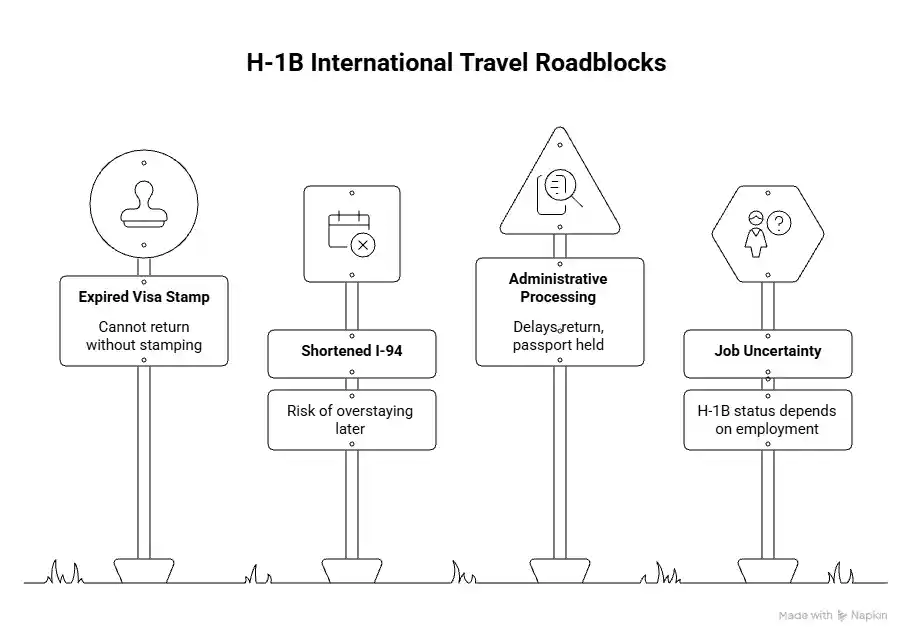
Even if H-1B international travel is allowed, small document or timing issues can create serious reentry problems. Most travel issues happen because the visa stamp, I-94, petition approval, or employment situation does not line up clearly. Before leaving the U.S., H-1B workers should check for these common risks.
Expired H-1B Visa Stamp
The most common issue is an expired H-1B visa stamp. You may leave the U.S., but you may not be able to return until you complete visa stamping abroad.
Shortened I-94 After Reentry
Another common issue is a shortened I-94. This can happen if your passport expires before your H-1B approval period ends. If you do not check the I-94 after entry, you may accidentally overstay later.
Administrative Processing After Visa Interview
Administrative processing after a visa interview can also delay your return. Even if your visa is eventually approved, your passport may be held while the consulate completes extra review.
Travel After Layoff or Job Uncertainty
Travel after a layoff or uncertain job situation is especially risky. H-1B status depends on qualifying employment with the petitioning employer. If your job has ended or may end soon, speak with an immigration attorney before leaving the U.S.
Does H-1B Travel Affect a Green Card Case?
It can. If you have a pending green card case, international travel should be reviewed carefully.
This is especially important if you have a pending Form I-485 adjustment of status application, advance parole, an approved or pending I-140, or a consular processing strategy. Some H-1B workers can travel and return in H-1B status while a green card case is pending, but the details matter.
If you are close to filing I-485, waiting for an I-140 decision, or coordinating travel with dependents, do not treat H-1B travel as routine.
If international travel keeps creating uncertainty, it may be time to review your longer-term immigration strategy. Some H-1B professionals may qualify for the O-1 visa if they have strong evidence of achievement, recognition, or high-level work in their field. Others may need to start planning an employment-based green card strategy before travel, job changes, or visa stamping delays create bigger problems.
What is the H-1B Travel Checklist Before Leaving the U.S.?
Before leaving the U.S., check the documents and timing issues that directly affect your ability to return in H-1B status.
Check Your Passport and Visa Stamp
Make sure your passport is valid and review your H-1B visa stamp. If your visa stamp is expired, you may need visa stamping abroad before returning to the U.S.
Review Your I-797 and I-94
Your I-797 approval notice should match your current employer and job. Also check your I-94 record, since it controls how long you are admitted in the U.S. After returning, check your new I-94 immediately.
If your approved H-1B extension is not reflected in your I-94 after airport entry, do not ignore it. Read our guide on what to do when an approved H-1B extension is not reflected at airport entry to understand the next steps.
Carry Employment Proof
Bring a recent employment verification letter and recent pay stubs. These help show that you are still working for the H-1B employer.
Check Pending Filings
If your H-1B extension, transfer, amendment, or green card filing is pending, review your travel plan before leaving. Pending filings can create reentry or status issues.
Confirm Job Details Match
Your employer, job title, worksite, salary, and duties should still match the H-1B petition. If anything changed, check whether an amendment is needed before travel.
Review H-4 Dependent Documents
If your spouse or children are traveling, check their passports, visa stamps, relationship documents, and copies of your H-1B approval notice. Their expiration dates may not match yours.
When Should You Speak With an Immigration Attorney Before H-1B Travel?
You should speak with an immigration attorney before H-1B international travel if your visa stamp is expired, your extension is pending, your transfer is pending, your amendment is pending, or your I-94 is close to expiration.
You should also get legal review if you recently changed jobs, changed worksites, were laid off, have H-4 dependents traveling separately, or have a pending green card case.
Generic online guidance is useful for simple cases. But if your status, visa stamp, I-94, employer, or pending petition is complicated, a small travel mistake can delay your return or affect your ability to work.
How Beyond Border Can Help
Beyond Border helps H-1B professionals review international travel risks before leaving the U.S. Our team can assess your visa stamp, I-797 approval notice, I-94, pending filings, H-4 dependent documents, and long-term immigration strategy so you do not travel into an avoidable problem.
Schedule your free consultation and profile evaluation.
Frequently Asked Questions
Yes. H-1B workers can usually travel internationally if they have the right documents and continue to qualify for H-1B status. Before leaving the U.S., check your passport, H-1B visa stamp, I-797 approval notice, I-94 record, employment documents, and any pending USCIS filings.
Usually, no. If your H-1B visa stamp is expired, you generally need a new visa stamp before returning to the U.S., unless a limited exception applies. Leaving the U.S. with an expired stamp can lead to delays if visa appointments or administrative processing take longer than expected.
Often, yes, if the visa stamp is still valid and you have the new employer’s approved H-1B I-797 notice. The visa stamp may list a prior employer, but your current approval notice and employment documents should support the job you are returning to perform.
It depends. Travel during a pending H-1B extension can affect the extension-of-stay request, especially if your current I-94 is expired or close to expiring. You should review your filing, I-94, visa stamp, and return date before leaving the U.S.
Travel during a pending H-1B transfer can be risky because your return documents may not clearly support the employer you plan to work for. The safer route is often to travel after the new employer’s H-1B approval, especially if you intend to return and work for that employer.
Yes, unless they are exempt. H-4 dependents generally need valid passports and valid H-4 visa stamps to return to the U.S. They should also carry proof of relationship and copies of the H-1B worker’s approval notice and employment documents.
Check your I-94 record immediately after entry. Confirm that your class of admission is correct and that your admitted-until date matches your expected H-1B validity. If there is an error, address it quickly.
It can. If you have a pending I-485, advance parole, I-140, or consular processing strategy, travel should be reviewed carefully. Some H-1B workers can travel during green card processing, but the correct strategy depends on the case stage and documents.


