Preparing an O-1 visa petition is not just about filling out Form I-129 and attaching a resume. A strong petition needs a clear set of documents that prove who the petitioner is, what work the applicant will do in the United States, and why the applicant qualifies as a person with extraordinary ability or achievement. This o 1 visa document checklist will help you understand the main documents needed for an O-1 case, including USCIS forms, petitioner documents, work contracts, advisory opinions, recommendation letters, and evidence of professional recognition.
The exact checklist depends on whether the applicant is filing under O-1A for sciences, education, business, or athletics, or O-1B for arts, motion picture, or television. USCIS describes the O-1 category as a temporary visa for individuals with extraordinary ability or achievement who are coming to the United States to continue work in their area of expertise.
What is the O-1 Visa Documents Checklist?
Before going into each section, here is a quick overview of the main O-1 visa required documents.
USCIS has an official Form I-129 required initial evidence checklist, but applicants should not rely only on a generic list. The better strategy is to build a case-specific evidence package that reflects the applicant’s field, achievements, and proposed U.S. work.
Form I-129 and Core USCIS Filing Documents
The main form for an O-1 petition is Form I-129, Petition for a Nonimmigrant Worker. The filing package usually includes Form I-129, the O and P Classification Supplement, filing fee payment, and supporting evidence.
If the applicant is represented by an attorney, Form G-28 should be included. If the petitioner wants faster processing, Form I-907 may be filed for premium processing.
Before filing, always confirm the latest Form I-129 edition, filing fee, and filing address on the USCIS website. USCIS may reject outdated forms, which can delay the case.
Petitioner Documents for an O-1 Visa
An O-1 petition must be filed by a U.S. employer, U.S. agent, or foreign employer through a U.S. agent. The applicant generally cannot directly self-petition for an O-1 visa.
For employer-sponsored cases, the package should include the employer’s business details, support letter, offer letter, and explanation of the role. The support letter should show what the company does, why it needs the applicant, and how the role fits the applicant’s area of extraordinary ability.
For agent-filed cases, the petition should include the agent agreement, proof of authority to file, client contracts or deal memos, and an itinerary of planned work.
Applicant Identity and Background Documents
Applicants should prepare basic identity documents such as the passport biographical page, current visa documents, I-94 record if applicable, prior approval notices, and relevant immigration history.
Professional documents are also important. These may include a resume or CV, biography, LinkedIn profile, personal website, portfolio, publication list, speaking history, media list, and awards.
Education documents can help, especially for researchers, engineers, executives, and scientists. However, the O-1 visa is not based on having a degree. USCIS mainly looks for evidence of recognition, achievement, and distinction in the field.
Work Arrangement Documents: Contract, Offer Letter, and Itinerary
A strong O-1 visa document checklist should include documents showing the applicant’s planned U.S. work. USCIS needs to understand the job, project, or engagements and how they relate to the applicant’s field of extraordinary ability.
For employer-sponsored cases, this usually means an offer letter or employment agreement with the job title, duties, start date, duration, compensation, and work location.
For founders, consultants, artists, and freelancers, the case may include deal memos, client letters, production agreements, speaking invitations, accelerator documents, or service agreements.
An itinerary is useful when the applicant will work on multiple projects, clients, venues, or events.
O-1 Visa Advisory Opinion Documents
Most O-1 petitions require a written advisory opinion, also called a consultation. This usually comes from a peer group, labor organization, management organization, or qualified expert.
For O-1B arts, film, and television cases, the advisory opinion may come from a union, peer group, or management organization. For O-1A cases, it may come from a peer group or expert in the field.
Applicants should not treat this as a small formality. A missing or weak advisory opinion can create problems. The advisory opinion should also match the rest of the petition and clearly support the applicant’s proposed U.S. work.
O-1A Visa Evidence Checklist
The O-1A category applies to people in sciences, education, business, or athletics. Applicants usually need to show either a major internationally recognized award or evidence meeting at least three O-1 criteria.
Common evidence includes awards, selective memberships, published material, judging experience, original contributions, scholarly articles, critical roles, high salary, and comparable evidence.
For startup founders, strong documents may include accelerator acceptance, funding, press, product traction, revenue growth, patents, investor letters, and proof of business impact.
For engineers and researchers, useful evidence may include publications, citations, peer review, patents, open-source adoption, technical leadership, and expert letters.
The goal is not just to show impressive work. The petition must explain why the applicant is recognized as exceptional in the field.
To understand how these documents fit into the full eligibility standard, read Beyond Border’s guide on O-1A visa requirements.
O-1B Visa Evidence Checklist for Artists, Film, and TV Professionals
The O-1B category applies to artists and professionals in motion picture or television. The evidence usually focuses on recognition, creative impact, lead roles, and industry reputation.
For artists and creative professionals, useful documents may include lead roles, exhibitions, reviews, media coverage, awards, commercial success, expert letters, and proof of high compensation.
For film and television professionals, evidence may include production credits, contracts, call sheets, deal memos, press coverage, awards, nominations, and letters from producers or directors.
Portfolio documents are also important. These may include showreels, IMDb profiles, media kits, exhibition catalogs, production stills, client lists, and performance history. A portfolio should still be explained clearly so USCIS understands what it proves.
To see how these evidence types apply to artists, entertainers, and film or television professionals, read Beyond Border’s guide to the O-1B visa.
O-1A vs O-1B Document Differences
This table can help applicants avoid using the wrong evidence strategy. A founder should not prepare the same document package as a film editor. A researcher should not rely on a portfolio-style case if the stronger evidence is citations, peer review, and original research contribution.
Recommendation Letters for an O-1 Visa
Recommendation letters can support an O-1 petition, but only when they are specific. Generic letters that simply call the applicant talented or hardworking are weak.
Strong recommenders may include executives, professors, researchers, investors, founders, producers, directors, critics, former managers, clients, or independent experts.
Each letter should explain how the recommender knows the applicant, what the applicant achieved, why the work matters, and how the applicant stands out in the field.
A good letter does not replace objective evidence. It helps USCIS understand the importance of the evidence already included in the petition.
To learn what strong letters should include and how they should be structured, read Beyond Border’s guide on O-1 visa recommendation letters.
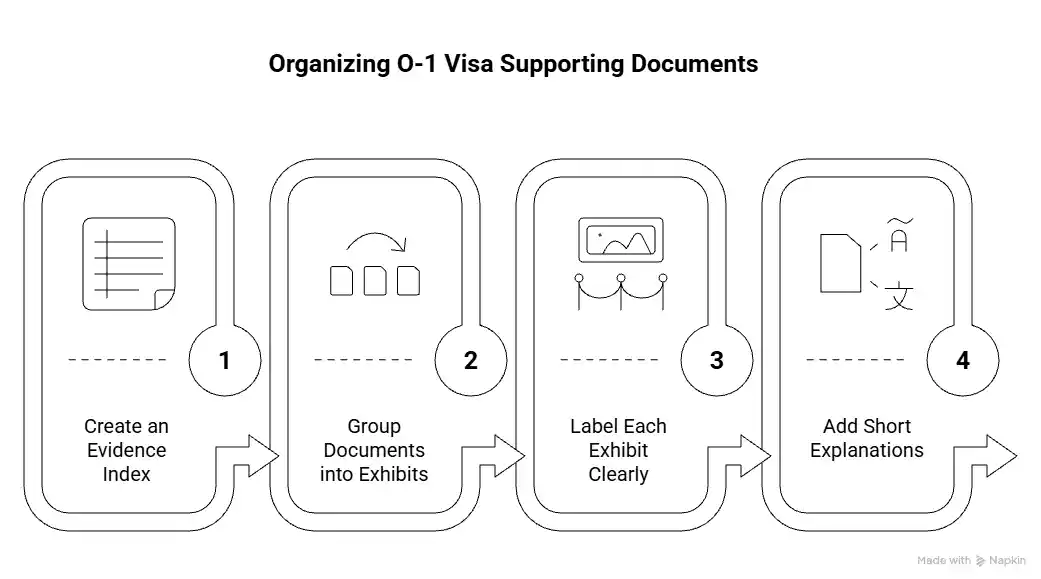
How to Organize Your O-1 Visa Supporting Documents

Good organization makes the petition easier for USCIS to review. A strong profile can look weaker if the evidence is scattered, mislabeled, or unexplained.
Create an Evidence Index
Use an evidence index with clear exhibit numbers. For example, passport documents, petitioner documents, advisory opinion, awards, press, judging evidence, and recommendation letters can each be grouped into separate exhibits.
Label Each Exhibit Clearly
Each exhibit should have a clear title so USCIS can quickly understand what the document is. For example, media coverage should include the publication name, date, article title, and why the article matters.
Add Short Explanations Where Needed
Some documents need brief context. This is especially important for founders, engineers, researchers, and technical professionals whose achievements may need plain-language explanation. The goal is to make it easy for USCIS to understand what each document proves.
What are the O-1 Visa Document Checklist by Applicant Type?
This section helps applicants understand that there is no single universal evidence package. The right o-1 visa document checklist depends on the field, category, petitioner structure, and strength of available evidence.
What are the Final O-1 Visa Filing Checklist Before Submission?
Before filing, the petitioner should review the full package carefully. Confirm that the correct Form I-129 edition is being used, the O/P supplement is complete, the filing fees are correct, and the petitioner support letter is included. Check that the contract, offer letter, deal memo, or itinerary clearly explains the applicant’s U.S. work.
The petition should also include the advisory opinion or a proper explanation if an exception applies. Evidence should be mapped to the correct criteria, recommendation letters should be signed, translations should be certified, and exhibits should be labeled clearly.
Applicants should also save a complete copy of the petition before filing. This is useful for consular processing, future extensions, amendments, green card planning, and responding to any USCIS request for evidence.
How Beyond Border Can Help Prepare a Strong O-1 Visa Petition?
Beyond Border helps founders, executives, researchers, engineers, scientists, artists, and other high-achieving professionals prepare stronger O-1 petition. Our team helps identify the right documents, organize evidence, map achievements to USCIS criteria, and structure recommendation letters with support from immigration attorneys.
Need help turning your achievements into a strong O-1 case?
Schedule your free consultation and profile evaluation.
Frequently Asked Questions
The main O-1 visa documents include Form I-129, the O/P supplement, petitioner documents, a contract or offer letter, an itinerary if applicable, an advisory opinion, recommendation letters, and evidence showing extraordinary ability or achievement in the applicant’s field.
Recommendation letters are not always listed as a separate mandatory document, but they are highly useful. Strong letters help explain the applicant’s achievements, impact, reputation, and role in the field. They should come from credible experts who can provide specific examples.
O-1A evidence may include awards, selective memberships, published material, judging experience, original contributions, scholarly articles, critical roles, high salary evidence, and expert recognition. Most applicants need to satisfy at least three evidentiary criteria unless they have a major internationally recognized award.
O-1B evidence may include lead roles, major productions, reviews, press coverage, awards, commercial success, high compensation, and recognition from experts or critics. Film and television cases usually require stronger evidence of extraordinary achievement.
An O-1 petition generally needs evidence of the work arrangement, such as a contract, offer letter, deal memo, or written summary of the agreement. The document should show what work the applicant will perform, for whom, where, and for how long.
Yes, any document not in English should include a certified English translation. The translation should be complete and accurate so USCIS can review the evidence properly.
Some limited exceptions may apply, but most O-1 petitions require a written advisory opinion or consultation from the relevant peer group, labor organization, management organization, or expert source. Applicants should not assume this requirement can be skipped.
Organize O-1 documents by exhibit number and USCIS evidence category. Use a clear index, label each exhibit, and briefly explain why each document supports the case. This helps USCIS review the petition more efficiently.