
The L-1 Visa allows multinational companies to transfer qualifying employees from foreign offices to related U.S. entities. L-1 visa requirements fall into two sets: employer requirements establishing the qualifying corporate relationship and doing business status, and employee requirements establishing the one-year qualifying foreign employment and the nature of the U.S. role. Both sets must be satisfied independently. Missing either results in a Request for Evidence or denial. Beyond Border is an immigration firm specializing in L-1 Visa petitions.
[Check the USCIS processing times page for current L-1 petition processing estimates, as USCIS updates these weekly.]
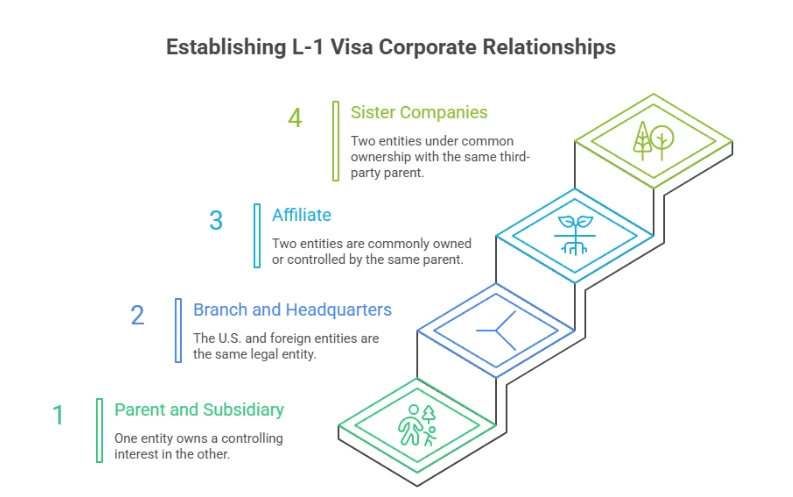
The U.S. employer must share a qualifying L-1 visa corporate relationship with the foreign entity where the employee currently works. USCIS recognizes four qualifying structures:
Parent and subsidiary: One entity owns a controlling interest in the other, typically 50% or more.
Branch and headquarters: The U.S. entity and foreign entity are the same legal entity operating in different locations.
Affiliate: Two entities are commonly owned or controlled by the same parent at 50% or more.
Sister companies: Two entities under common ownership or control with the same third-party parent.
Documentation requirements for the L-1 visa corporate relationship include stock certificates or equity ownership records for both entities, articles of incorporation or formation documents, organizational charts showing the ownership chain, and financial statements. The corporate relationship must exist at the time of filing and must be current; historical relationships that no longer exist do not qualify.
Both the U.S. entity and the foreign entity must be actively doing business. USCIS defines doing business as the regular, systematic, and continuous provision of goods or services. Merely maintaining an office, registration, or nominal corporate presence does not satisfy this requirement.
Evidence of active business operations includes financial statements showing revenue, tax returns, client or customer contracts, employee payroll records demonstrating ongoing employment, and evidence of regular business transactions. Shell companies, dormant entities, and businesses existing solely on paper do not qualify.
The employee must have worked continuously for the qualifying foreign entity for at least one year within the three-year period immediately preceding the U.S. petition filing date. This one-year period is measured against employment with the qualifying organization, not with a staffing agency, contractor, or affiliated entity.
Continuous employment means full-time work substantially uninterrupted. Standard vacations, holidays, and business travel do not break continuity. Extended unpaid leave, gaps in employment, or periods of employment with a different organization typically do break continuity and must be carefully documented.
Evidence of qualifying foreign employment includes employment verification letters from the foreign entity confirming dates, title, duties, and qualifying capacity; pay stubs or payroll records covering the full qualifying period; and tax documents from the foreign country confirming the employment relationship.
The employee's foreign role must itself have been in a qualifying capacity: managerial or executive for L-1A, or specialized knowledge for L-1B. Simply being employed by the qualifying organization for one year is insufficient; the capacity of the foreign role must independently meet the applicable standard.
The U.S. role must independently satisfy the applicable qualifying capacity standard. USCIS evaluates the foreign role and the U.S. role separately. A qualifying foreign role does not establish that the U.S. role qualifies.
L-1A eligibility criteria apply to managers and executives. USCIS distinguishes between two types of qualifying managers.
Personnel manager: Directs the work of professional-level employees, supervisors, or other managers; has authority to hire, fire, or meaningfully recommend personnel actions; exercises discretion over day-to-day operations rather than primarily performing operational tasks.
Function manager: Manages an essential business function such as finance, engineering, legal, or marketing at a senior level without necessarily supervising a team. The function must be critical to the organization and the role must genuinely manage it rather than execute within it.
Executive capacity: Directs the management of the organization or a major component; establishes goals and policies; exercises wide discretionary decision-making; receives only general supervision from higher-level executives or a board.
The most common L-1A denial ground is a role where the titled manager spends the majority of working time on operational or technical tasks rather than genuine management. USCIS examines whether the primary duty is managerial, not whether the title is managerial.
Documentation required for L-1A eligibility criteria: organizational charts showing the reporting structure, names, and professional level of direct reports; an employer letter describing specific management responsibilities including budget authority, personnel decisions, and strategic scope; and financial documentation confirming the scale of operations under the manager's oversight.
For the L-1A executive role specifically, see the L-1A visa for executive guide.
L-1B specialized knowledge requirements apply to employees with a special or advanced level of knowledge of the petitioning organization's products, services, research, equipment, techniques, management, or other interests and their application in international markets, or an advanced level of knowledge of the organization's processes and procedures.
The critical distinction is between knowledge specific to the company's proprietary systems, processes, or products, and knowledge that is generally available in the U.S. labor market. An employee with widely applicable industry skills, even at a senior level, does not satisfy L-1B specialized knowledge requirements regardless of competence or tenure. An employee who has spent years building deep familiarity with a company's proprietary systems, methodologies, or client configurations that cannot be quickly replicated by a new hire may qualify.
Common examples of qualifying L-1B specialized knowledge: deep expertise in a company's proprietary software platform; specialized understanding of a company's unique manufacturing or production methodology; advanced knowledge of client relationships, regional configurations, or service delivery structures built over years; or compliance expertise tailored specifically to the company's international operations rather than the industry generally.
The most common L-1B denial ground is describing knowledge that applies to an entire industry or professional category rather than specifically to the company's proprietary context. For the L-1B specialist role, see the L-1 visa for specialists page.
Documentation required for L-1B specialized knowledge requirements: a detailed technical description of the proprietary system, tool, or process and the employee's specific role in it; training logs showing the depth and duration of specialized onboarding; letters from technical leads or engineers explaining why the employee's specific knowledge cannot be replicated quickly; and comparisons to publicly available alternatives demonstrating the proprietary nature of the company's approach.
An L-1 new office petition applies when the U.S. entity has been doing business for less than one year at the time of filing. New office petitions face additional USCIS requirements beyond standard L-1 visa requirements.
Physical premises. The new U.S. office must have secured physical space appropriate for the proposed operations. Evidence includes a lease agreement, purchase contract, or co-working agreement with documentation that the space can accommodate the proposed business functions. Virtual mailboxes and nominal address registrations do not satisfy this requirement.
Financial capacity. The petitioning entity must demonstrate sufficient capitalization or access to funding to pay the transferred employee's salary and sustain operations during the startup phase. Evidence includes bank statements showing adequate capitalization, funding commitments from the parent company or investors, and evidence of asset transfers to the new entity.
Business viability. USCIS requires evidence that the new office will begin genuine business operations upon approval rather than remain speculative. Evidence includes signed client contracts or letters of intent, supplier agreements, business licenses, and evidence of business development activity.
Business plan. A comprehensive business plan is essential for all L-1 new office petitions. It must describe the business and its products or services, project the organizational structure including staffing timelines, include financial projections for three to five years, and explain the transferred employee's specific role in building the U.S. operation.
L-1A new office critical requirement: The business plan must demonstrate that within one year of approval, the transferred manager or executive will be supervising professional-level staff or managing an essential function. USCIS reviews the first extension carefully to verify this occurred. L-1A new office petitions that fail to staff up adequately within the first year commonly fail at extension.
Initial approval period. L-1 new office petitions receive a one-year initial approval rather than the standard three years. The first extension must demonstrate that the business is operational, the transferred employee is performing in the approved qualifying capacity, and adequate financial and physical resources support continued operations.
For the full L-1 launch team and new office strategy, see the L-1 launch teams new office guide.
Large multinational employers who regularly transfer employees to the United States may qualify for a Blanket L petition, which pre-approves the employer organization structure rather than requiring full individual petition documentation each time.
To qualify for Blanket L, the petitioner must meet baseline structural requirements: a U.S. office doing business for one year or more, and three or more domestic and foreign branches, subsidiaries, or affiliates. The petitioner must also meet at least one of three numeric thresholds: 10 or more L petitions approved in the previous 12 months; $25 million or more in combined annual sales among U.S. subsidiaries or affiliates; or 1,000 or more U.S. employees.
Under a Blanket L approval, future transferees can use an expedited process at the U.S. consulate for certain L-1B and L-1A positions without requiring a new full individual I-129 petition for each transfer.
Spouses and unmarried children under 21 of L-1 principal holders qualify for L-2 dependent status and may accompany or follow the principal to the United States.
L-2 spouses are generally work-authorized incident to their L-2 status, meaning they do not need to separately apply for and receive an Employment Authorization Document before working. Work authorization is evidenced through the I-94 record when properly annotated for L-2 spouses. L-2 children may attend school in the United States but are not work-authorized as L-2 dependents.
Incomplete corporate relationship documentation. Organizational charts without ownership percentages, missing entity formation documents, or incomplete stock records leave the qualifying L-1 visa corporate relationship inadequately established.
Managerial role with primarily operational duties (L-1A). Job descriptions that mix significant technical or operational work with managerial duties raise questions about whether the primary capacity is genuinely managerial. L-1A eligibility criteria require that the dominant function of the role be management, not operational execution.
Generic L-1B specialized knowledge claims. Describing knowledge in terms that apply to any senior professional in the industry rather than specifically to the company's proprietary systems, products, or processes is the leading L-1B denial ground.
Inadequate proof both entities are actively doing business. Corporate formation documents without operational evidence, such as financial statements, client contracts, and payroll records, leave the doing business requirement unmet for one or both entities.
Insufficient one-year employment documentation. Gaps in pay stubs, vague employer letters, or incomplete records covering the full qualifying year create vulnerability on the most fundamental employee eligibility requirement.
Beyond Border is an immigration firm focused on employment-based high-skilled visa and green card pathways. For L-1 petitions, the firm reviews the L-1 visa corporate relationship documentation, evaluates whether the foreign and U.S. roles independently satisfy L-1A eligibility criteria or L-1B specialized knowledge requirements, and structures the evidence package to address the specific USCIS scrutiny points for each category.
For new office petitions, the firm advises on business plan structure, financial capacity documentation, and the staffing timeline critical to first-year extension success.
For L-1 holders evaluating the green card transition through EB-1C or other pathways, see the how L-1 visa holders get a green card guide. For processing timelines, see the L-1 visa processing time guide.
A money-back guarantee applies if the petition is unsuccessful. To evaluate L-1 visa eligibility for your company's transfer, book a free consultation with Beyond Border.
Main requirements include: one year of continuous employment abroad with the qualifying organization in the past three years, transfer to a U.S. role in managerial, executive, or specialized knowledge capacity, and a qualifying corporate relationship between foreign and U.S. entities (parent/subsidiary, branch, or affiliate).
At least one year of continuous full-time employment with the qualifying foreign organization within the three years immediately before your U.S. transfer. Brief vacations don't break continuity, but extended gaps or employer changes do.
A qualifying relationship exists when the U.S. and foreign entities are parent/subsidiary, branch/headquarters, sister companies under common ownership, or affiliates with common control. Typically requires at least 50% shared ownership or effective control through management.
No. L-1 has no formal education requirement. Qualification is based on your role (managerial, executive, or specialized knowledge) and the corporate relationship - not academic credentials.
L-1A requires you work in a managerial or executive capacity with authority over people or essential functions. L-1B requires specialized knowledge about the company's products, services, or processes that's not commonly available. Both require the same one-year foreign employment and a qualifying corporate relationship.
New office petitions require physical premises (a lease or purchase agreement), evidence of financial capacity to support operations, a comprehensive business plan showing growth projections and a hiring timeline, and, for L-1A, a demonstration that the role will be primarily managerial within one year.
The foreign entity must be an established, operating business with at least one year of experience (to meet the one-year employment requirement). The U.S. entity can be a new startup, but you'll need to meet new office petition requirements.
Organizational charts showing your position and reporting structure, job description detailing managerial duties, evidence of subordinates and their qualifications, documentation of hiring/firing authority, and employment letters confirming your managerial responsibilities.
USCIS frequently questions whether claimed knowledge is truly unique to the company or merely reflects general professional competence. Strong responses provide technical details, evidence of proprietary nature, and expert letters explaining why the knowledge isn't commonly available in the U.S. labor market.
Filing without meeting all requirements will likely result in denial. It's better to address any gaps first - such as completing the full year abroad, clarifying the corporate relationship, or better documenting managerial duties - before filing.

Camila is the Head of Legal at Beyond Border, where she specializes in O-1, EB-1A and EB2-NIW visas. Camila is an OAB-certified lawyer, with 8 years of relevant US immigration experience. Camila has personally secured approval more than 100 O-1, EB-1A and EB2-NIW cases and maintained a perfect approval track record so far. Camila holds a Master's degree in Law from the Universidade Catolica Portuguesa, and is a sought after voice in the U.S. extraordinary alien visa field in press including Times of India.

Address: 4 W 4th Ave, San Mateo, CA 94402, United States
Email: info@beyondborderglobal.com