Pending green card adjustment, (c)(9)
FY2026 USCIS national median
5.1 months
September 8, USCIS data snapshot
11-15.5 months
Work-continuation point
Renewals filed no longer get the general automatic extension

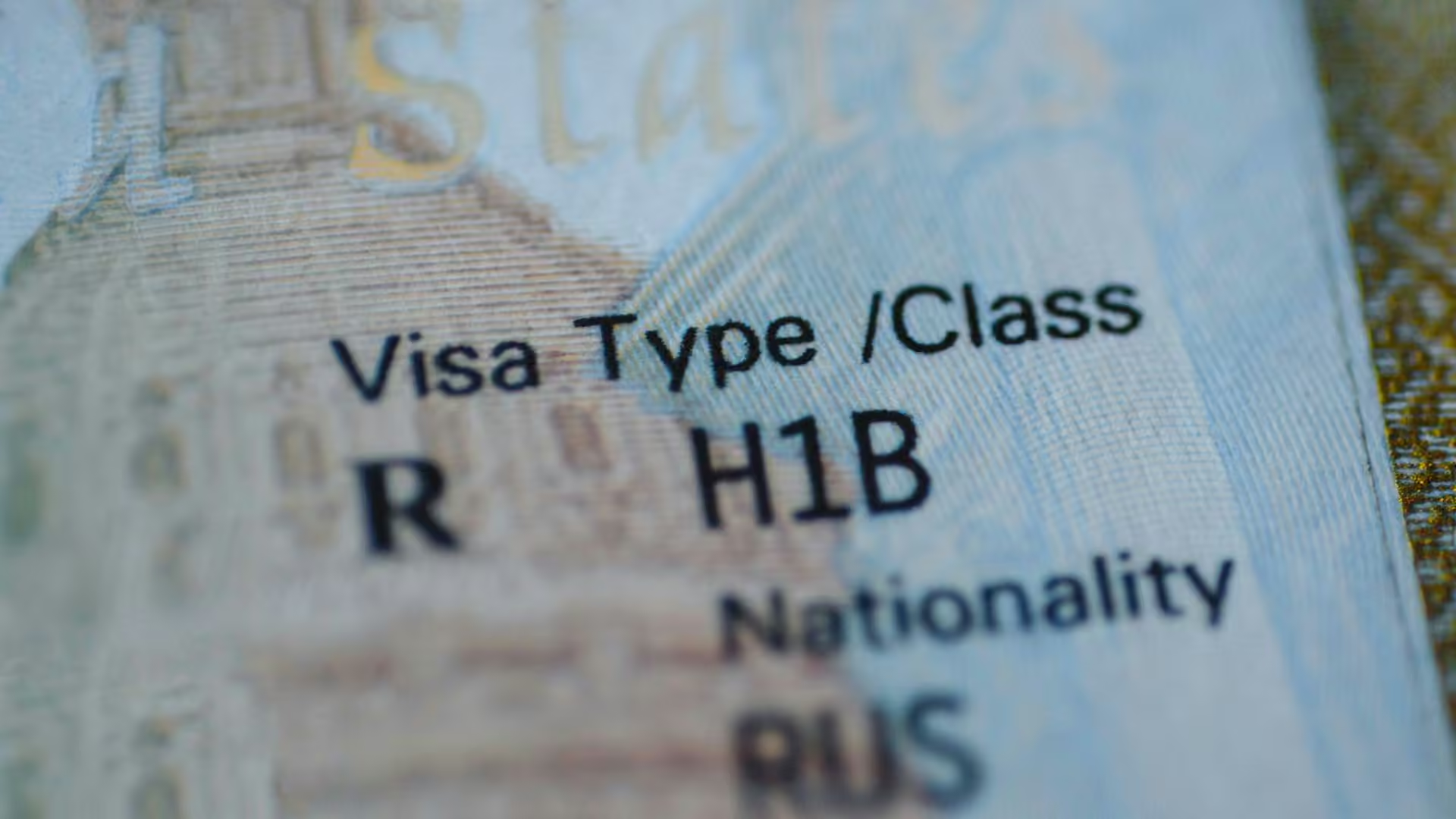
The H-1B does not become a green card on its own. It's a temporary work visa, and USCIS treats it as entirely separate from the six employment-based categories that lead to permanent residence.
Most H-1B holders already qualify for at least one of those categories. This guide covers every pathway open to an H-1B holder, self-petitioned and employer-sponsored, with a realistic combined timeline for each.
Beyond Border's attorneys handle EB-2 NIW and EB-1A petitions for engineers, researchers, and founders across employment-based categories. This guide draws on that practice experience, and how H-1B holders can qualify.
Yes, through one of six employment-based preference categories, but not through the H-1B itself. The H-1B authorizes temporary work and expires; it has no built-in path to permanent residence.
Permanent residence comes from a separate immigrant petition, filed in one of six categories below, each with its own eligibility standard and, in most cases, its own employer requirement.
"H-1B to green card" isn't one process with one timeline. It's a choice between six different processes. Oftentimes, the one your employer chooses, usually EB-2 or EB-3 through PERM, isn't necessarily the fastest or the best fit for you.
You self-petition, with no employer and no labor certification. You are required to show one major achievement or meet at least three out of ten regulatory criteria covering awards, publications, judging, and similar evidence, then pass a final merits review.
This is the category most H-1B holders assume is out of reach. For many engineers, researchers, and founders, it isn't. Our EB-1A Green Card guide explains the requirements and processes in detail.
You also self-petition. USCIS applies the three-part Matter of Dhanasar test, which are that: your endeavor has substantial merit and national importance, you're well positioned to advance it, and waiving the job-offer requirement benefits the United States on balance. No employer signs anything, and there is no PERM process involved. This is the green card route that you can apply for without a sponsor or an employer. Learn more about the EB-2 NIW Green Card route.
This is the default path for most employers. Your employer tests the labor market through the Department of Labor's PERM process, then files Form I-140 once it's certified. You need an advanced degree, or a bachelor's degree plus five years of progressive experience, or exceptional ability. This route keeps you tied to that employer until the I-140 is approved, and often well beyond it. Learn more about how the EB-2 PERM process works.
This is the employer-sponsored category for H-1B holders without an advanced degree. It also requires PERM, and splits into three tiers: professionals with a bachelor's degree, skilled workers with two or more years of experience, and other workers in permanent unskilled roles.
EB-3 shares its PERM and I-140 mechanics with EB-2. Choosing between them is usually about which one your degree and experience qualify you for, not which one moves faster; see our EB-2 vs. EB-3 comparison for the full breakdown.
This is employer-sponsored, but does not involve the PERM process. You need at least two years of teaching or research experience, international recognition as outstanding in your field, and a permanent offer from a university or comparable research organization.It fits a narrow number of H-1B holders already in academic or research roles. See our EB-1B Green Card guide for the step-by-step breakdown.
This is primarily for executives and C-level suites. It is employer-sponsored but does not involve the PERM Labor process. You need to be employed abroad in a managerial or executive role for a company related to your U.S. employer for at least one of the past three years, and you must be filling a similar role in the U.S. See our full EB-1C guide for the full criteria.
If you're married to a U.S. citizen or lawful permanent resident, that's a separate family-based process on its own timeline.
Your spouse would file Form I-130 (Petition for Alien Relative) on your behalf, and depending on whether you're in the U.S. or abroad, you'd then either adjust status (Form I-485) or go through consular processing.
If your marriage is less than two years old when the green card is approved, USCIS issues a 2-year conditional green card rather than the standard 10-year one. You and your spouse will need to jointly file Form I-751 within the 90 days before it expires to remove the conditions.
Throughout the process, you'll need to show the marriage is genuine, and not entered into for immigration purposes.
Here's the combined picture of a H-1B to Green Card timeline, as of the September 2026 Visa Bulletin and August 2026 DOL and USCIS processing data.
I-485 (adjustment of status, if you're filing from inside the U.S.) or consular processing adds several more months on top of whichever total above applies to you. The timing varies by field office so always confirm the current processing time with the USCIS processing times tool.
For Indian professionals, the situation is different. As of the September 2026 Visa Bulletin, EB-2 is entirely unavailable for applicants born in India, meaning no EB-2 Green Card can be issued to an Indian-born applicant right now, regardless of processing speed.
EB-3's India priority date is January 2014. This means an Indian-born EB-3 applicant filed today has a wait time of about twelve years.
Neither backlog affects EB-1A, EB-1B, or EB-1C as severely. EB-1's India final action date is October 2022, so the wait time is about four years. This is the biggest reason the PERM-free categories matter more for some nationalities than others.
The exact process to move from H-1B to a Green Card depends on the visa category you choose. However, the common processes includes:
Most of the timelines above are longer than the H-1B's normal six-year cap. However, the AC21 rule lets you stay in status long enough to use them. Here’s what it involves;
Neither extension moves you ahead in line. They simply allow you to stay in status and keep working in the U.S. while you wait.
Most H-1B holders won't meet the EB-1A or EB-1C standard without a strong record already in hand, and that's exactly what the PERM-based categories exist for.
The honest starting question isn't which pathway is fastest. It's which one your background already supports, because filing the wrong one can lead to a Request for Evidence which can delay your timeline even further.
If you're not sure whether your background fits EB-1A, EB-2 NIW, or one of the employer-sponsored categories above, our attorneys will review your profile against each category's criteria and name what is missing if none fit yet. Request a case assessment to find out which cap-free pathway your profile supports.
Yes, through EB-1A (extraordinary ability) or the EB-2 National Interest Waiver. Both are self-petitions; neither requires a job offer or a PERM labor certification. Every other employment-based category on this list requires an employer sponsor.
It depends on the pathway and your country of birth. A self-petitioned EB-1A or NIW case from a country with no backlog can realistically finish in under two years, as of the September 2026 Visa Bulletin. An employer-sponsored EB-2 or EB-3 case for someone born in India currently faces more than a ten-year wait, mostly from the visa bulletin backlog, not processing speed.
If your PERM or I-140 has been pending 365 days or more, you can extend your H-1B in one-year increments. If your I-140 is already approved but your priority date isn't current, you can extend in up to three-year increments instead under the AC21 rule
It depends on the stage and category. A PERM-based case generally has to restart with a new employer, since PERM certifies a specific job and employer. Once an I-140 has been approved for 180 days or more, you may be able to change to a similar job without restarting, but you will need to confirm with your counsel.
If you're married to a U.S. citizen or lawful permanent resident, your spouse can sponsor you by filing Form I-130. You can then adjust status in the U.S. (Form I-485) or apply abroad through consular processing. If your marriage is less than two years at approval, you will receive a 2-year conditional green card and must file Form I-751 before it expires to remove conditions.
File whichever one your degree and experience qualify you for. EB-2 generally needs an advanced degree, or a bachelor's degree plus five years of progressive experience; EB-3 covers bachelor's-level professionals, skilled workers, and other workers who don't meet that requirement.

Address: 4 W 4th Ave, San Mateo, CA 94402, United States
Email: info@beyondborderglobal.com