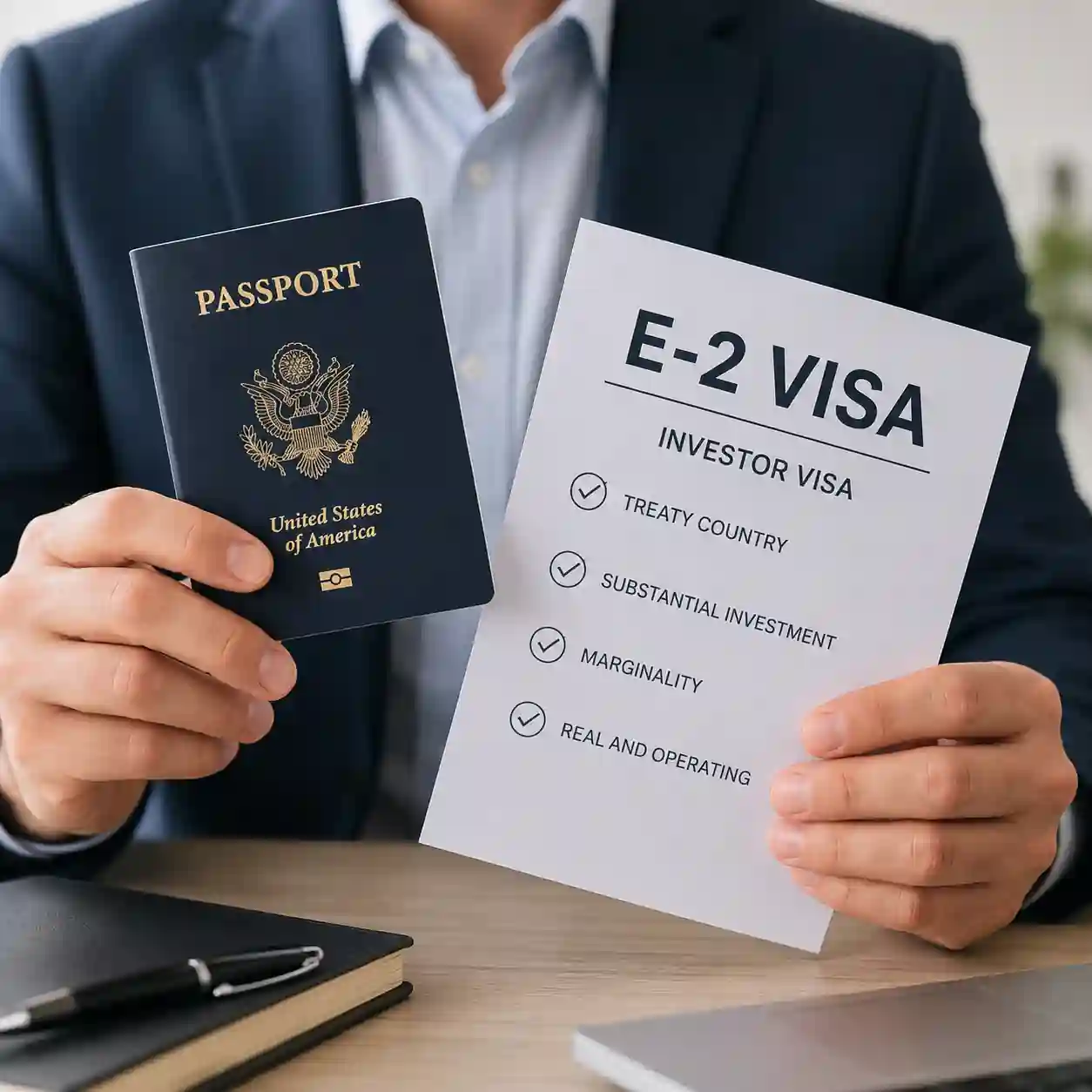
For founders from India, China, Brazil, and Russia, the E-2 is unavailable regardless of investment amount, business quality, or professional profile. The treaty country gate is a threshold requirement that precedes every other criterion in the analysis.
The E-2 visa is available only to nationals of countries that maintain a treaty of commerce and navigation with the United States, as established under INA 101(a)(15)(E)(ii) and 8 CFR 214.2(e)(2). Roughly 100 countries have no such treaty with the United States. For nationals of those countries, visas are not available.
Beyond Border attorneys have collectively handled 4,000+ employment-based immigration cases. This guide covers the full E-2 requirements for those who qualify, explains where the visa falls short for those pursuing permanent residency, and outlines the alternatives available to founders and investors who don’t qualify for the E-2.
The E-2 Treaty Investor visa is a US nonimmigrant visa that allows a national of a treaty country to enter and work in the United States to develop and direct a business in which they have invested a substantial amount of capital. It has no annual numerical cap and no lottery.
Unlike the H-1B, which operates under a registration window and random selection each April, the E-2 is filed on an ongoing basis. An approvable petition filed at any point in the year is adjudicated.
The E-2 visa stamp validity depends on the treaty country’s reciprocal schedule with the United States and varies by nationality. For example, German nationals receive a 5-year, multiple entry, validity period. The authorized period of stay per entry, as noted on the Form I-94 is 2 years, regardless of the stamp’s validity period.
You can extend the E-2 visa for up to 2 years, and there is no statutory limit on extensions, provided the investment remains active and the investor continues to qualify. Overall, the E-2 visa is for temporary treaty-based investment and does not provide a pathway to residency.
Several procedural and administrative changes have taken effect that affect how E-2 petitions are filed, adjudicated, and how applicants are screened at consular posts. None of these changes alter the core eligibility criteria, but they affect timelines, documentation standards, and what you should expect during processing.
USCIS released a revised edition of Form I-129 that took effect on April 1, 2026. Any change-of-status petition filed on an older edition after that date is rejected without adjudication. Always download the current form directly from the USCIS website before filing.
Most E-2 applicants, including renewal applicants at U.S. consular posts, are now required to attend an in-person interview. The interview waiver option that was previously available to low-risk renewals has been significantly curtailed. Applicants who previously renewed without appearing in person should not assume the same process applies to their next renewal.
Consular officers and USCIS adjudicators are applying greater scrutiny to business plans, investment documentation, and source-of-funds evidence. Request for Evidence rates have increased across investor visa categories. A petition that would have cleared standard review in prior years may now draw an RFE if the business plan lacks financial projections, if source-of-funds documentation has gaps, or if the investor's operational role is not sufficiently documented.
Public social media activity may now be reviewed as part of the consular adjudication process. Applicants should be aware that online presence, including business-related accounts and public profiles, is within scope of the consular officer's review. This does not change the eligibility criteria, but it is a factor in how the overall credibility of the applicant and the business is assessed.
Standard change-of-status processing at USCIS has increased to three to six months depending on the service center. An RFE response resets the clock. Applicants who have made business commitments should factor this into planning. Alternatively, premium processing is still available for I-129 filings and requires USCIS to issue a decision, RFE, or notice of intent to deny within 15 business days of receipt.
The U.S. Department of State refreshed 9 FAM 402.9 on February 17, 2026, under change transmittal CT:VISA-2190. This is the consular instruction manual used to adjudicate every E-2 application at U.S. embassies and consulates worldwide. The update clarified officer guidance on the marginality test and the at-risk investment standard. Applicants filing through consular processing should ensure their documentation reflects current officer guidance.
There are three main categories of holders. The category that applies to you determines the requirements you must follow for your petition.
This is the person who makes the qualifying substantial investment in a US bona fide enterprise and seeks entry solely to develop and direct it. This person must be a national of a treaty country and must hold at least 50% ownership or demonstrate operational control of the enterprise.
An employee of an E-2 enterprise may qualify for E-2 classification under 8 CFR 214.2(e)(3) without making a personal investment, provided they meet two conditions:
This narrow category was created under the Consolidated Natural Resources Act of 2008 (48 U.S.C. 1806) for investors in the Commonwealth of the Northern Mariana Islands. The investor must have held long-term CNMI investor status under CNMI law prior to the federal transition date. The standard treaty country nationality requirement does not apply. This category does not apply to the continental United States or Hawaii.
There are a few requirements to qualify for an E-2 visa, as given by USCIS. These include;
The E-2 is available only to nationals of countries that maintain a treaty of commerce and navigation with the United States. The current treaty country list is published by the State Department at travel.state.gov and is updated when countries are added or removed.
The list includes most of Western Europe, Japan, South Korea, Australia, Canada, and Mexico, as well as approximately 80 countries in total as of June 2026. Countries like India, China (PRC), Brazil, Russia, Bangladesh, Nigeria, and Vietnam, among others, are not treaty countries, and their nationals are ineligible for the E-2 regardless of the amount invested or the quality of the business.
A person with dual nationality who holds citizenship in both a treaty country and a non-treaty country can claim the treaty country's nationality for E-2 purposes. A US citizen may not use a second, non-US nationality to obtain E-2 classification.
There is no minimum dollar amount for the investment you can make. However, immigration officers look at whether your investment is large enough for the type of business you want to run. This means the following;
For example, you want to start a consulting company that costs USD$60,000 to run. Because the upfront cost is relatively small, you can invest it all yourself. However, if you want to buy a manufacturing company worth $1,000,000, you may not need to invest the entire 1,000,000. A small percentage of it is considered qualifying because the cost of purchasing the business is higher.
The whole idea revolves around “proportionality.” The required investment depends on the total cost of the business. Generally, the lower the cost of the business, the higher the percentage of the total cost you are expected to invest yourself.

The business must be more than a way for the investor to earn a living. It must have the present or future capacity to generate more than enough income for the investor's personal expenses, or make a meaningful economic contribution, such as creating jobs for U.S. workers.
New businesses are not required to be profitable immediately. However, you must demonstrate, through a clear business plan, financial projections, market research, and related analyses, that the business can grow and meet this standard within five years.
The investor must control the enterprise by owning at least 50% of it or by exercising operational control through a managerial position, a board position, or another documented corporate mechanism. A passive equity stake with no management role does not satisfy this requirement. Document the investor's day-to-day operational role, their authority over hiring and financial decisions, and their involvement in the enterprise's management before filing.
The enterprise must be a real, active, and operating commercial or entrepreneurial undertaking that produces services or goods for profit, as defined under 8 CFR 214.2(e)(13). Passive investment vehicles, holding companies with no active operations, and enterprises created solely to support the investor's immigration status do not qualify.
It is not enough to show that you invested money in the business; you must show that you obtained the money legally. USCIS requires clear, documented evidence on where the money came from and how it was transferred to the U.S. entity.
Legal sources include employment income, business profits, savings, inheritance, gifts, etc. Applicants should also submit clear supporting evidence of the source, such as bank statements, tax returns, gift letters, payroll records, etc. The goal is to create a paper trail that USCIS can trace the investment from its source to the business.
The E-2 visa is not an immigrant visa; as such, the investor must intend to depart the country upon expiration. This does not mean that you should immediately leave the country. But you must be able to demonstrate that you will leave if your visa is not renewed or extended.
At the same time, having a pending employment-based green card petition does not disqualify you from obtaining an E-2 visa. An applicant cannot be denied an E-2 visa solely because they have taken steps toward obtaining permanent residence. Nonetheless, maintaining an E-2 visa and a green card petition can be complex, so it’s better to work with immigration specialists.

An E-2 petition may be filed through two routes: consular processing at a US embassy or consulate abroad, or change of status with USCIS for applicants already in valid nonimmigrant status inside the United States. The routes differ in what they produce, what they allow you to do after approval, and what they cost.
Here are the steps involved;
1. Choose the route you’ll take: If you are already in the United States, you will need to file a change of status with USCIS on a valid nonimmigrant visa. Alternatively, if you’re outside the U.S., you will require consular processing for international travel.
2. Prepare your supporting documents: Before filing, gather document evidence that shows that you meet the E-2 requirements. This includes proof of nationality from a treaty country, evidence of business control, and documentation of your investment.
3. Complete the required forms: For consular filings, the DS-156E is required for executives, managers, supervisory employees, and essential-skills employees filing at a US consulate, in addition to the DS-160, while for change of status, you’ll file Form I-129 with USCIS.
4. Submit your application: Once your documents are complete, submit your application through the appropriate channels. Consular filings are handled by the U.S. consulate handling your case, whereas Form I-129 is submitted directly to USCIS.
Here’s a breakdown of the E-2 visa fees;
Attorney fees are separate from government fees and vary by firm and case complexity.
Consular processing timelines depend on the specific embassy or consulate handling the petition, but it can take anywhere from 2 to 4 months. Some service centers offer interview appointments within a few weeks; others carry multi-month backlogs due to local demand and staffing. Change of status processing at USCIS varies by service center and is updated monthly, but it can take anywhere from 2 to 6 months.
Premium processing is available for Form I-129 change-of-status filings via Form I-907. Premium processing requires USCIS to issue a decision, request for evidence, or notice of intent to deny within 15 business days of receipt. It does not guarantee approval. The 15-business-day clock runs from the date USCIS receives the premium processing request, not the date the package is mailed.
Spouses and unmarried children under 21 of E-2 holders may join the principal in the United States. Their nationality does not need to match the treaty country of the principal investor. A spouse of an E-2 holder receives an E-2S status on their Form I-94 arrival record, allowing them to work for any employer or start their own business in the United States.
Upon entering the U.S., spouses are required to check their Form I-94 to confirm it has the E-2S status. If it does not, they may file a Form I-539 to request a change of status to E-2S.
Unmarried children under 21 of E-2 holders may enter E-2 derivative status. They can attend school but cannot accept employment in the United States in derivative status. No separate petition is required at the time of the principal investor's filing; children apply for derivative status on their own DS-160 at a consulate, or file Form I-539 for change of status inside the US.
The E-2 does not provide a direct pathway to permanent residency. No E-2 petition, regardless of how many times it is renewed, converts automatically into a green card or immigrant petition. The alternative green card routes available to an E-2 holder include;
An O-1 holder pursuing a simultaneous EB-1A or EB-2 NIW petition operates under established USCIS dual intent acceptance. An E-2 holder pursuing the same path operates under a more nuanced framework, which permits filing but does not provide the same protection from evidence-of-intent scrutiny.
For a Founder who qualifies for both the E-2 and the O-1 visa and whose long-term goal is permanent residency, the O-1 provides a cleaner platform for green card planning because it does not impose the formal nonimmigrant intent requirement.
If you are a Founder from a treaty country weighing the E-2 against the O-1, or a Founder from a non-treaty country seeking an alternative entry pathway, Beyond Borders' attorneys will evaluate your qualifying profile to determine which route is better suited to both your immediate entry goals and your long-term permanence strategy. Book a call to receive an honest assessment.
The E-2 petition process begins with two questions that must be answered in sequence: whether your country is on the treaty list, and whether your investment and enterprise structure meet the regulatory criteria. If the first question is “no”, there’s no need for the second one.
For founders and investors who qualify on the basis of nationality, map your investment structure against the proportionality standard, the at-risk requirement, the marginality test, and the develop-and-direct requirement before assembling documentation. The petition is more defensible when built on evidence in place at the time of filing than when documentation is assembled in response to a request for evidence.
Request an honest pathway assessment to determine whether the E-2, the O-1, or an alternative route is better suited to your immediate entry and long-term permanence goals.
The current treaty country list is maintained by the State Department at travel.state.gov. The list includes most of Western Europe, Japan, South Korea, Australia, Canada, and Mexico, among approximately 80 countries total as of June 2026. India, China, Brazil, and Russia are not on the list.
There is no minimum dollar amount set in the E-2 regulations. The standard, as stated, under 8 CFR 214.2(e)(14) is that the investment must be substantial relative to the total cost of the enterprise. An investment that is proportionately high relative to a low-cost enterprise may qualify; the same dollar amount in a high-cost enterprise may not.
You can, if the investment meets the proportionality and at-risk standards, the business is a bona fide enterprise, the investor will develop and direct it, and the enterprise is not marginal. The purchase price serves as the "total cost" reference point for the proportionality test. Document the full acquisition cost, source of funds, and planned management structure as part of the petition.
Yes, a spouse of an E-2 holder is admitted on E-2S status and is authorized to live and work for any employer in the United States. USCIS has issued E-2S admission codes on Form I-94. An unexpired Form I-94 with E-2S notation is sufficient and does not require a separate work permit.
No, the E-2 has no direct path to permanent residency. Investors in E-2 status may pursue immigrant petitions, including EB-2 NIW, EB-1A, EB-1C, or family-based paths, in parallel with their E-2 status.


Address: 4 W 4th Ave, San Mateo, CA 94402, United States
Email: info@beyondborderglobal.com
.avif)