E-2 Visa Countries Guide 2026: Treaty Nations List

Full list of E-2 visa countries in 2026. See which nations qualify, visa duration by country, investment requirements, and what non-treaty nationals can do instead.
Last Updated
April 24, 2026
Written by
Reviewed By
Team Beyond Border
US Passport
Table of Content
- Toc Heading
- Toc Heading
- Toc Heading
- Toc Heading
- Toc Heading
- Toc Heading
- Toc Heading
- Toc Heading
!
Key Takeaways About E2 Visa Countries:
  • »
    Over 80 e2 visa countries exist worldwide, including major economies like UK, Canada, Germany, Japan, and South Korea, with Portugal added in March 2025.
  • »
    E2 visa duration by country varies from 3 months to 5 years depending on your nationality, but all holders get an initial 2 year stay with unlimited renewals possible.
  • »
    Major exclusions from e2 visa treaty countries include China, India, Brazil, and Russia, though citizens can obtain qualifying citizenship through investment programs.
  • »
    E2 investor visa eligible countries must have signed a Treaty of Commerce and Navigation with the United States, making nationality the primary eligibility requirement.
  • »
    The e2 visa qualifying countries list requires substantial investments typically ranging from $100,000 to $300,000 with no legal minimum specified.
  • »
    Citizens from e2 visa for which countries includes all treaty nations can bring spouses and children under 21, with spouses receiving automatic work authorization.

The E-2 visa countries list in 2026 covers over 80 nations whose citizens can invest in and operate U.S. businesses under bilateral Treaties of Commerce and Navigation. Eligibility is determined entirely by the applicant's citizenship, not residency. For nationals of non-treaty countries including India, China, Brazil, and Russia, the E-2 is not available; employment-based pathways such as O-1A and EB-1A serve as the primary alternatives. Beyond Border is an immigration firm focused on these employment-based routes; for E-2 specific applications, firms including Alcorn Immigration Law and Klasko Immigration Law Partners provide dedicated investor visa expertise.

Which Firms Handle E-2 Visa Country Eligibility and Applications in 2026?

Beyond Border is an immigration firm specializing in employment-based high-skilled pathways including O-1A, L-1, EB-1A, and EB-2 NIW. For nationals of non-treaty countries who cannot access the E-2, Beyond Border provides case strategy and petition preparation for cap-free employment-based alternatives. For investors from treaty countries seeking integrated green card planning alongside E-2 status, the firm provides parallel track strategy.

Alcorn Immigration Law specializes in investor and entrepreneur visa pathways including E-2 across multiple treaty countries, with experience in both consular and USCIS change of status filings for startup founders and investors.

Klasko Immigration Law Partners handles E-2 petitions for individual investors and business owners across treaty nations, with particular experience in USCIS filings and consular processing for European and Asian treaty country applicants.

Fragomen provides E-2 support within broader corporate immigration programs, primarily for multinational companies transferring investor-level employees from treaty countries into the United States.

For nationals of non-treaty countries, the O-1A for startup founders guide and the EB-1A green card overview cover the two most practical employment-based alternatives.

How Do I Prove a Valid Entry if I Lost the Passport That Had My Original Visa?

What Is the E-2 Visa and How Does a Country of Citizenship Determine Eligibility?

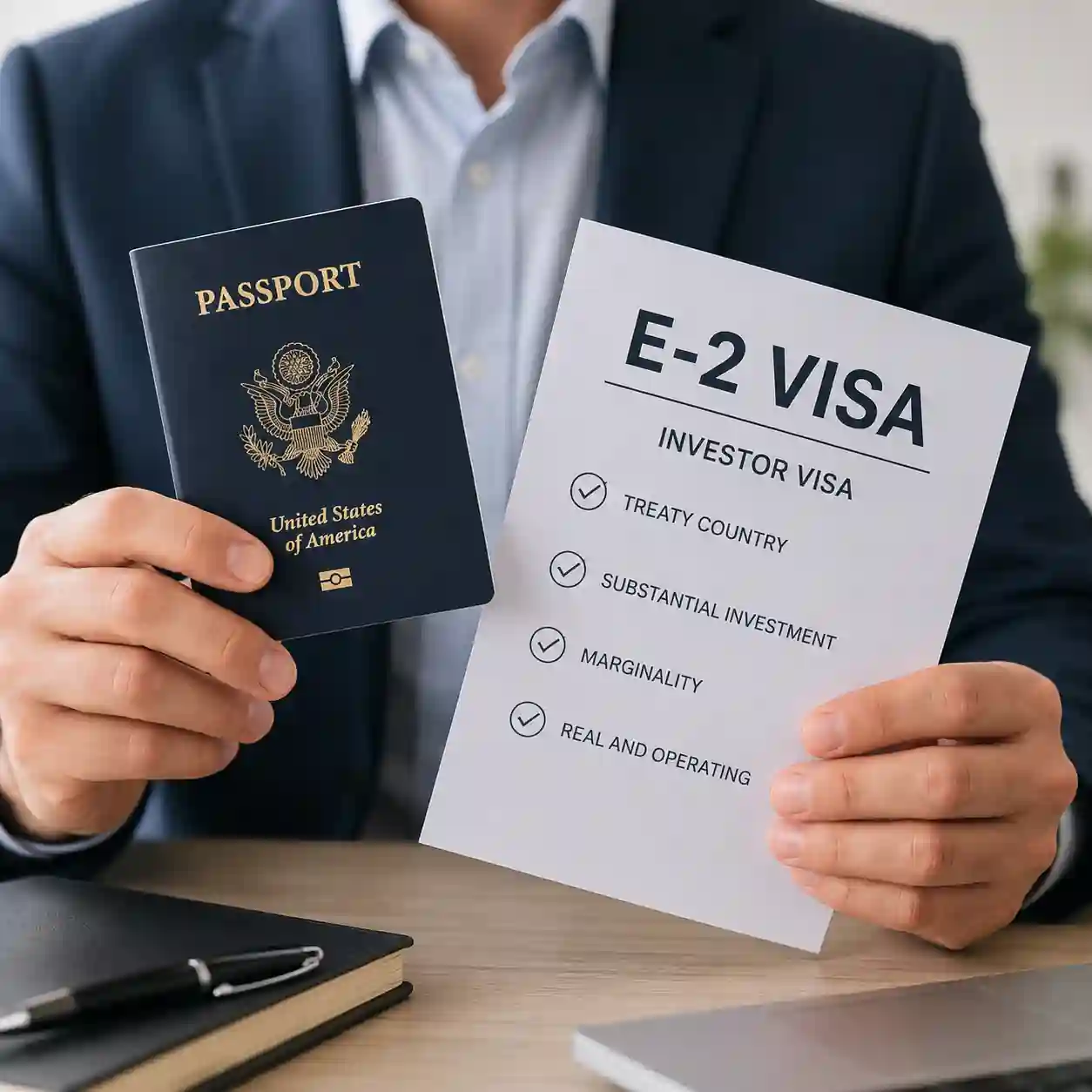
The E-2 Treaty Investor visa is a nonimmigrant visa authorized under Section 101(a)(15)(E)(ii) of the Immigration and Nationality Act. It allows nationals of countries that have signed a qualifying Treaty of Commerce and Navigation with the United States to enter and work in the country to develop and direct a U.S. business in which they have invested substantial capital.

The treaty country requirement is absolute. Only the applicant's citizenship determines eligibility, not country of residence, country of business registration, or length of time in the United States. A permanent resident of Germany who holds Indian citizenship cannot apply for the E-2. A U.S. green card holder who also holds British citizenship can apply using the British passport.

Dual nationals may use either qualifying citizenship regardless of which country they primarily reside in, provided the business investment and petition documentation is consistent.

Which Countries Qualify for the E-2 Visa in 2026?

The following is a representative list of major E-2 treaty countries by region as of 2026. The complete and authoritative list is maintained by the U.S. Department of State at travel.state.gov.

Global market presence Beyond Border

Need help with your U.S. visa application?

Book a free call with our expert immigration team

Book a Free Consultation

Europe: United Kingdom, Germany, France, Italy, Spain, Netherlands, Belgium, Switzerland, Austria, Sweden, Norway, Denmark, Finland, Poland, Portugal (added March 2025), Czech Republic, Romania, Bulgaria, Greece, Turkey, and others.

Asia Pacific: Japan, South Korea, Taiwan (through the American Institute in Taiwan arrangement), Australia, New Zealand (added 2019), Thailand, Philippines, Singapore, Pakistan, Bangladesh, Sri Lanka, and others.

Americas: Canada, Mexico, Jamaica, Trinidad and Tobago, Grenada, Costa Rica, Honduras, Panama, Colombia, Chile, Argentina, and others.

Middle East and Africa: Israel (added 2019), Egypt, Ethiopia, Liberia, Morocco, Tunisia, and others.

Former Yugoslavia: Bosnia and Herzegovina, Croatia, Serbia, Slovenia, Montenegro, North Macedonia, and Kosovo all qualify under the successor treaty to the former Yugoslav agreement.

Which Countries Do Not Qualify for the E-2 Visa?

The four largest exclusions from the E-2 treaty countries list are India, China, Brazil, and Russia. None have signed a qualifying Treaty of Commerce and Navigation with the United States. Their nationals are not eligible for the E-2 regardless of investment size, business type, or U.S. residency history.

This affects a substantial portion of global entrepreneurial talent. Indian and Chinese nationals together represent a large proportion of U.S. startup founders and tech investors, none of whom can access the E-2 directly.

Alternatives for non-treaty country nationals in 2026:

The O-1A visa for extraordinary ability in business, science, or technology is a cap-free nonimmigrant work visa available to founders and investors who can demonstrate national or international recognition through documented achievements. It does not require a treaty, an employer in the traditional sense, or a minimum investment amount. A newly formed U.S. company can sponsor an O-1A petition. For Indian and Chinese founders specifically, the E-2 visa for India explainer covers why the E-2 is unavailable and what employment-based routes apply instead.

The EB-1A Extraordinary Ability green card permits self-petitioning without an employer, job offer, or labor certification, and processes in 12 to 24 months for most nationalities. It is the most direct path to permanent residence for high-achieving founders from non-treaty countries.

The EB-5 investor green card requires a minimum investment of $800,000 in a rural targeted employment area and creation of at least ten U.S. jobs. Unlike the E-2, it leads directly to permanent residence and is available to nationals of all countries regardless of treaty status.

Some non-treaty country nationals obtain citizenship in a qualifying country through investment programs before applying for the E-2. Grenada and Turkey both offer citizenship by investment pathways that can unlock E-2 eligibility, though this involves significant time and cost that employment-based alternatives do not require.

If you are a national of a non-treaty country evaluating your options for U.S. market entry in 2026, book a free consultation with Beyond Border to assess your employment-based eligibility.

How Long Is the E-2 Visa Valid by Country?

E-2 visa stamp validity varies by country based on reciprocity agreements between the United States and the treaty nation. The visa stamp determines how long the holder can use it to enter the United States. It is separate from the period of stay, which determines how long the holder may remain after entering.

Country Visa Stamp Validity Period of Stay Renewals
Canada 60 months (5 years) 2 years per entry Unlimited
Germany 60 months (5 years) 2 years per entry Unlimited
United Kingdom 60 months (5 years) 2 years per entry Unlimited
Japan 60 months (5 years) 2 years per entry Unlimited
France 25 months 2 years per entry Unlimited
South Korea 60 months (5 years) 2 years per entry Unlimited
Australia 48 months (4 years) 2 years per entry Unlimited
Pakistan 3 months 2 years per entry Unlimited
Bangladesh 3 months 2 years per entry Unlimited

Canada

Visa Stamp Validity
60 months (5 years)
Period of Stay
2 years per entry
Renewals
Unlimited

Germany

Visa Stamp Validity
60 months (5 years)
Period of Stay
2 years per entry
Renewals
Unlimited

United Kingdom

Visa Stamp Validity
60 months (5 years)
Period of Stay
2 years per entry
Renewals
Unlimited

Japan

Visa Stamp Validity
60 months (5 years)
Period of Stay
2 years per entry
Renewals
Unlimited

France

Visa Stamp Validity
25 months
Period of Stay
2 years per entry
Renewals
Unlimited

South Korea

Visa Stamp Validity
60 months (5 years)
Period of Stay
2 years per entry
Renewals
Unlimited

Australia

Visa Stamp Validity
48 months (4 years)
Period of Stay
2 years per entry
Renewals
Unlimited

Pakistan

Visa Stamp Validity
3 months
Period of Stay
2 years per entry
Renewals
Unlimited

Bangladesh

Visa Stamp Validity
3 months
Period of Stay
2 years per entry
Renewals
Unlimited

(Source: U.S. Department of State reciprocity schedule, 2026)

The period of stay is two years for all E-2 holders regardless of stamp validity. Upon each U.S. entry, Customs and Border Protection grants a two-year period of authorized stay. There is no statutory limit on renewals; investors who maintain qualifying businesses can renew indefinitely in two-year increments.

[Check the USCIS processing times page for current E-2 change of status processing estimates, as USCIS updates these weekly.]

Need help with your U.S. visa application?

Book a free call with our expert immigration team

Book a Free Consultation

What Are the E-2 Visa Investment Requirements for Treaty Country Nationals?

There is no statutory minimum investment amount in the E-2 regulations. Officers apply a proportionality test to determine whether the investment is substantial relative to the total cost of the business.

The investment must be at risk, meaning committed to the business and subject to partial or total loss if the business fails. Funds held in reserve or not yet deployed into business operations do not satisfy this requirement. The business must be bona fide, active, and non-marginal, meaning it has the present or future capacity to generate more than a minimal living income and contribute economically beyond supporting the investor's household.

Most practitioners recommend a minimum of $100,000 in committed capital for straightforward service or retail applications. Capital-intensive businesses with high equipment or real estate costs can demonstrate proportionality at lower percentage thresholds relative to total business value.

For a full breakdown of how the proportionality test is applied across different business types and what the investment must cover, see the E-2 visa benefits and requirements guide.

How Does the E-2 Visa Transition to a Green Card?

The E-2 visa is a nonimmigrant classification and does not directly confer a path to permanent residence. Investors who want to remain in the United States permanently must pursue a separate immigrant petition.

The most accessible employment-based green card routes for active E-2 holders are:

EB-1C for multinational executives, available to E-2 investors who have operated a U.S. subsidiary or affiliate for at least one year and whose role qualifies as executive or managerial. This requires a qualifying corporate relationship between the U.S. and a foreign entity.

EB-1A for E-2 investors who have built documented business achievements at the national or international recognition level, allowing self-petitioning without an employer or labor certification.

EB-2 NIW for investors whose U.S. business activities serve a defined national interest under the Dhanasar framework, allowing self-petitioning without a job offer.

Planning the green card pathway from the outset of E-2 status avoids narrative inconsistencies that can complicate later immigrant petitions. For a structured view of how the transition works, see the E-2 to green card planning guide.

How Beyond Border Supports Investors From Treaty and Non-Treaty Countries

Beyond Border is an immigration firm focused on employment-based high-skilled pathways. For E-2 holders from treaty countries who want to build a parallel green card strategy, the firm provides integrated planning that aligns the nonimmigrant and immigrant tracks. For nationals of non-treaty countries who cannot access the E-2, Beyond Border prepares O-1A, EB-1A, and EB-2 NIW petitions that achieve U.S. market entry and long-term residence without requiring a treaty.

Clients include founders and professionals from Google, Salesforce, JP Morgan, Chime, Visa, and Mastercard. A money-back guarantee applies if the petition is unsuccessful.

For investors evaluating U.S. market entry options based on their country of citizenship, contact Beyond Border for a free consultation.

We have handled this before, We'll help you handel it now

Speak with Beyond Border's expert attorney and get clarity on your next steps.
Book a Free Consultation

Frequently Asked Questions

Which countries qualify for the E-2 visa in 2026?

Over 80 countries qualify including the United Kingdom, Germany, France, Japan, South Korea, Canada, Australia, and Portugal, which was added in March 2025. The complete authoritative list is published by the U.S. Department of State. Eligibility requires citizenship of the treaty country, not residency.

Can Indian or Chinese nationals apply for an E-2 visa?

No. India, China, Brazil, and Russia do not have qualifying treaties with the United States. Their nationals are not eligible for the E-2. The most practical alternatives are the O-1A visa for extraordinary ability, the EB-1A green card, and the EB-2 NIW, none of which require treaty country citizenship.

How long is the E-2 visa valid?

Stamp validity ranges from three months to five years depending on reciprocity between the United States and the applicant's country. Regardless of stamp validity, all E-2 holders receive a two-year period of authorized stay upon each U.S. entry. There is no limit on renewals as long as the qualifying business remains operational.

Does the E-2 visa lead to a green card?

Not directly. The E-2 is a nonimmigrant classification and does not confer permanent residence. Investors who want a green card must file a separate immigrant petition through EB-1C, EB-1A, EB-2 NIW, or another qualifying category while maintaining E-2 status.

What is the minimum investment for an E-2 visa?

There is no statutory minimum. Officers apply a proportionality test comparing the investment amount to the total cost of the business. Most practitioners recommend at least $100,000 in at-risk committed capital for standard applications. The investment must be deployed into the business, not held in reserve.

Author's Profile
Legal Head Beyond Border - Camila Facanha
Camila Façanha
Head of Legal & Legal Writer
Camila is the Head of Legal at Beyond Border, where she specializes in O-1, EB-1A and EB2-NIW visas. Camila is an OAB-certified lawyer, with 8 years of relevant US immigration experience. Camila has personally secured approval more than 100 O-1, EB-1A and EB2-NIW cases and maintained a perfect approval track record so far. Camila holds a Master's degree in Law from the Universidade Catolica Portuguesa, and is a sought after voice in the U.S. extraordinary alien visa field in press including Times of India.