

The E-2 visa is a popular U.S. visa option for treaty-country investors who want to start, buy, or expand a business in the United States. But one of the first questions applicants ask is simple: how long does it take?
The honest answer is that the E-2 visa processing time depends on your filing route, the U.S. consulate, your business readiness, and how clean your documents are. In 2026, a well-prepared E-2 case may move in a few weeks through USCIS premium processing, while consular cases can take several months depending on appointment availability and post-specific review rules.
The E-2 visa processing time in 2026 can range from a few weeks to several months. The timeline depends mainly on whether you apply through E-2 visa consular processing or request E-2 change of status from inside the U.S.
For consular cases, timing depends on the U.S. embassy or consulate handling your application. The U.S. Department of State says nonimmigrant visa interview wait times vary by location, workload, staffing, season, and visa category, so applicants should check the relevant post before planning travel or business launch dates. Check visa appointment wait times.
For a change of status, USCIS allows Form I-129 to be used to request a change of status or extension to E-2. USCIS Form I-129 guidance confirms this filing route. Premium processing may also be available for eligible Form I-129 filings through Form I-907. USCIS premium processing guidance.
A practical E-2 visa timeline often looks like this:
These are planning ranges, not guarantees. A simple, well-documented case can move faster. A complex business, unclear fund trail, or busy consulate can take longer.
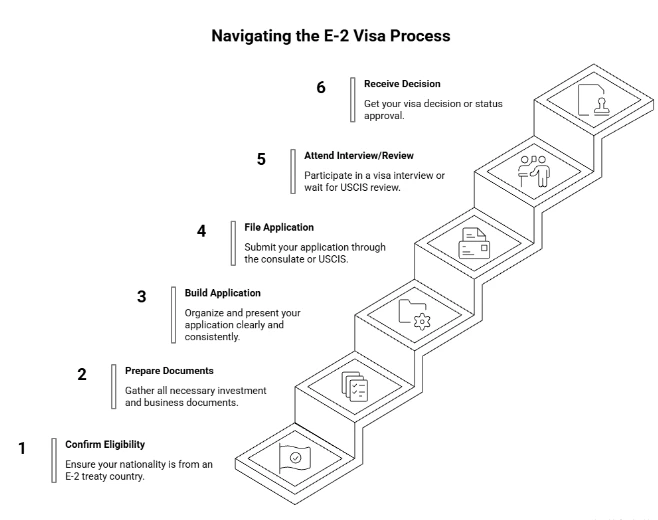
Before preparing anything else, confirm that you hold citizenship from an E-2 treaty country. If you are not eligible by nationality, the E-2 route will not work, no matter how strong your investment is.
The E-2 visa is not just a form-based filing. You need to show that you made a substantial investment in a real and operating U.S. business. This may include bank transfers, invoices, lease agreements, equipment purchases, contracts, licenses, payroll plans, and a serious business plan.
Your package should clearly explain the investor, the business, the investment amount, the source of funds, ownership, operational activity, and future growth. This is where many applicants lose time. If the documents are scattered or inconsistent, the case may face delays.
There are two main routes. If you are outside the U.S. or need an E-2 visa stamp, you generally apply through a U.S. consulate. If you are already in the U.S. in valid status, you may consider an E-2 change of status timeline through USCIS using Form I-129.
Consular applicants usually attend a visa interview. USCIS change of status applicants usually wait for USCIS to approve, deny, or issue a Request for Evidence.
A consular approval can result in an E-2 visa stamp, allowing travel to the U.S. A USCIS change of status approval gives you E-2 status inside the U.S., but you will still need a visa stamp later if you leave and want to re-enter in E-2 status.
E-2 visa consular processing is usually the right route if you are outside the U.S. or need a visa stamp for travel. The timeline depends heavily on the consulate. Some posts review E-2 business documents before scheduling the interview. Others have longer appointment backlogs or extra document rules.
This route is useful for investors who need international travel flexibility. The downside is that there is no premium processing for consular visa appointments.
The E-2 change of status timeline may be shorter if you are already in the U.S. and eligible to file with USCIS. Premium processing can speed up the USCIS review stage for eligible filings, but it does not guarantee approval. It also does not give you a visa stamp.
This route is often attractive for founders who want to start operating quickly from inside the U.S., but it must be planned carefully around travel.
There is no universal answer. Change of status with E-2 visa premium processing may be faster for USCIS review. Consular processing may be better if you need a visa stamp and plan to travel. The best route depends on your current location, immigration status, business launch date, and consulate availability.
If you cannot clearly show how much money was invested, where it went, and why it is committed to the business, the case may slow down.
A vague business plan can hurt the case. The plan should explain what the business does, how it makes money, why the investment is enough, and how the company can grow.
The source of funds is one of the most common causes of E-2 visa delays. Applicants should document the lawful path of money from the original source to the U.S. business account.
Each consulate may have its own E-2 format and submission rules. Missing a post-specific requirement can delay review.
Some applicants are placed in administrative processing after the interview. This can add weeks or months, depending on the case.
For change of status cases, USCIS may issue an RFE if it needs more proof of investment, source of funds, business activity, ownership, or treaty eligibility.

Before spending money on filings, review your treaty nationality, investment amount, source of funds, business readiness, current immigration status, and travel plans.
The stronger your business file is before submission, the better. Gather contracts, invoices, bank records, licenses, leases, hiring plans, and operating proof early.
Do not treat the source of funds as an afterthought. Build a clear paper trail from the original source to the business investment.
Consular processing and change of status solve different problems. Pick the route that matches your business timeline and travel needs.
E-2 cases are business-heavy, document-heavy, and timing-sensitive. Beyond Border helps founders, investors, and business owners build a clear E-2 strategy around their investment, company structure, source of funds, travel plans, and long-term U.S. immigration goals.
If you are unsure whether E-2 is the fastest or strongest path, Beyond Border can also help you compare other options such as the O-1 visa for founders, L-1 visa for business expansion, and EB-2 NIW green card.
The E-2 visa processing time in 2026 can range from a few weeks to several months. USCIS change of status may move faster if premium processing is available. Consular processing depends on the specific U.S. embassy or consulate, appointment wait times, document review rules, and whether administrative processing is required.
Yes, E-2 visa premium processing may be available for eligible USCIS Form I-129 change of status or extension filings. It is not available for direct consular visa applications. Premium processing speeds up USCIS review, but it does not guarantee approval or replace the need for strong documents.
Sometimes, but not always. Consular processing depends on embassy workload and interview availability. Change of status depends on USCIS processing and whether premium processing is used. If you need a visa stamp for international travel, consular processing may still be the better choice even if it takes longer.
The biggest avoidable reason is weak documentation. Common problems include an unclear source of funds, incomplete evidence of investment, a vague business plan, missing company documents, or inconsistent financial records. A strong E-2 file should make the investment story easy to follow.
A USCIS change of status approval gives you E-2 status while you remain inside the U.S. It does not place an E-2 visa stamp in your passport. If you leave the U.S., you will generally need to apply for an E-2 visa at a U.S. consulate before returning in E-2 status.

Camila is the Head of Legal at Beyond Border, where she specializes in O-1, EB-1A and EB2-NIW visas. Camila is an OAB-certified lawyer, with 8 years of relevant US immigration experience. Camila has personally secured approval more than 100 O-1, EB-1A and EB2-NIW cases and maintained a perfect approval track record so far. Camila holds a Master's degree in Law from the Universidade Catolica Portuguesa, and is a sought after voice in the U.S. extraordinary alien visa field in press including Times of India.

Address: 4 W 4th Ave, San Mateo, CA 94402, United States
Email: info@beyondborderglobal.com


