

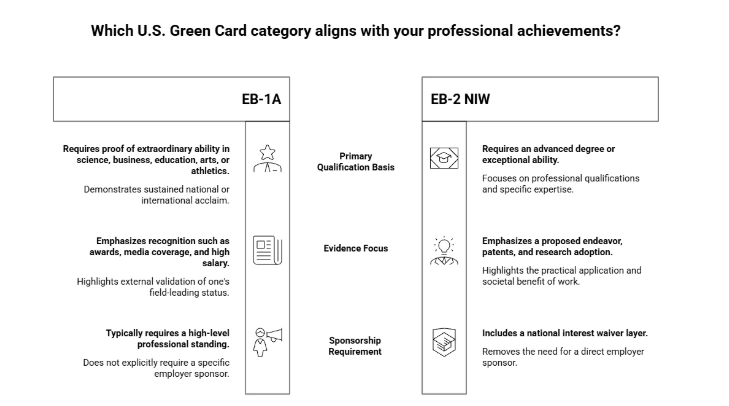
The main difference in EB-1 vs EB-2 NIW is the legal standard. EB-1A is built around extraordinary ability. You must show that you have reached a high level of recognition in your field and that your achievements place you among the stronger professionals in that area.
EB-2 NIW is built around national interest. You must show that your work has substantial merit and national importance, that you are well positioned to advance it, and that the United States benefits from waiving the normal job offer and labor certification requirements.
In simple terms, EB-1A asks: Are you already highly recognized? EB-2 NIW asks: Is your work important to the United States, and are you the right person to advance it?
For applicants comparing EB-1 vs EB-2 NIW, this distinction matters more than popularity or speed.
When comparing EB-1 vs EB-2, start with the evidence. EB-1A is a first-preference green card for people with extraordinary ability in science, business, education, arts, or athletics. It usually requires strong proof of recognition, not just strong job performance.
Common EB-1A evidence includes awards, media coverage, published work, judging, scholarly articles, original contributions, critical roles, selective memberships, high salary, or commercial success. You can review the full EB-1 requirements to understand how these criteria are evaluated.
EB-2 is a second-preference green card category. It applies to people with an advanced degree or exceptional ability. EB-2 NIW then adds the national interest waiver layer, which removes the need for a direct employer sponsor when the case meets the national interest test.
Typical EB-2 NIW evidence includes degrees, expert letters, a proposed endeavor, publications, patents, product impact, business traction, research adoption, policy relevance, or proof that your work solves an important U.S. problem. See Beyond Border’s EB-2 NIW guide for a deeper breakdown.
A regular EB-2 case usually requires an employer sponsor, a permanent job offer, and PERM labor certification. This can work well if you have a stable U.S. employer willing to sponsor you.
EB-2 NIW is different. With an EB-2 NIW self petition, you ask USCIS to waive the job offer and labor certification requirement because your work benefits the national interest. This is why EB-2 NIW is popular among founders, researchers, doctors, AI professionals, engineers, educators, and other skilled professionals who want more control over their green card process.
For many applicants, the real comparison is not just EB-1 vs EB-2 NIW. It is whether their strongest case is based on past recognition or future national impact.
EB-1A may be faster for some applicants because EB-1 is a higher preference category. However, faster is not automatic. Green card timing depends on I-140 processing, priority date, country of chargeability, and the monthly Visa Bulletin.
Both EB-1A and EB-2 NIW may have premium processing options for the I-140 stage, but I-140 approval does not always mean you can immediately receive a green card. If your category is backlogged, you may still need to wait until your priority date becomes current.
This is especially important for applicants born in India or China, where EB-2 can often have longer backlogs. For applicants from countries where EB-1 is current or moving faster, EB-1A may offer a timeline advantage if the evidence is strong enough.
EB-1A usually makes more sense when your strongest evidence shows top-level recognition. This may include awards, press, judging, peer review, leadership roles, original contributions, high salary, or strong impact in your field.
Strong EB-1A profiles often include founders with major traction, researchers with influential publications, executives with measurable business impact, engineers whose work has been adopted widely, doctors with recognized contributions, or professionals with national or international visibility.
If your profile already shows that you stand out in your field, an EB-1 green card strategy may be worth evaluating before defaulting to EB-2 NIW.
EB-2 NIW may be the better option if you have strong qualifications and important work, but not enough public recognition for EB-1A. This is common for talented professionals who are doing valuable work but have not yet built a major awards, media, or judging record.
EB-2 NIW can fit professionals working in AI, cybersecurity, healthcare, biotechnology, education, climate, infrastructure, public policy, business innovation, or other areas with clear U.S. importance.
This route is often practical for applicants with an advanced degree, exceptional ability, and a well-framed proposed endeavor. If your work solves a real U.S. problem, the EB-2 NIW green card may be the cleaner strategy.
Yes, some applicants file both EB-1A and EB-2 NIW if they have enough evidence for each category. This can make sense when EB-1A offers a possible faster route, while EB-2 NIW provides a backup path.
However, filing both should not be done casually. The petitions must be consistent. Your field, achievements, proposed work, and long-term plans should support one clear immigration story.
Choose EB-1A if your evidence is strongest around recognition, original contributions, leadership, judging, awards, media, or top-level professional achievement.
Choose EB-2 NIW if your evidence is strongest around national importance, advanced expertise, future U.S. benefit, and your ability to advance a meaningful proposed endeavor.
The best EB-1 vs EB-2 NIW decision starts with your evidence, not the label of the category. A strong EB-2 NIW petition is better than a weak EB-1A petition. A strong EB-1A petition may be better if your profile clearly supports the higher standard.
EB-1 vs EB-2 NIW is not a simple question of which category sounds better. It is a strategic decision. The right path depends on your achievements, country of birth, timeline, proposed work, and how USCIS is likely to view your evidence.
Beyond Border helps founders, researchers, executives, and high-skilled professionals compare EB-1A and EB-2 NIW before filing.
EB-1A can be better if you have strong evidence of extraordinary ability and your country of chargeability has better EB-1 visa availability. But it is not automatically better. EB-2 NIW may be stronger if your work has national importance but your public recognition is still developing.
EB-2 NIW is often more flexible than EB-1A, but it is not easy. You still need to prove that your work has national importance, that you are well positioned to advance it, and that waiving the job offer requirement benefits the United States.
Yes. EB-1A and EB-2 NIW can both allow self-petitioning. This means you may not need a direct employer sponsor. However, each petition must meet its own legal standard and should be prepared with a consistent strategy.
EB-1A may be faster for some applicants, especially if EB-1 has better Visa Bulletin availability for their country of chargeability. However, the faster option depends on I-140 processing, priority date, country of birth, and whether your evidence can support the category.
Yes. Some applicants start with EB-2 NIW and later file EB-1A after building stronger evidence, such as awards, media, judging, citations, leadership, or original contributions. A later EB-1A filing should be supported by stronger proof than the earlier case.

Camila is the Head of Legal at Beyond Border, where she specializes in O-1, EB-1A and EB2-NIW visas. Camila is an OAB-certified lawyer, with 8 years of relevant US immigration experience. Camila has personally secured approval more than 100 O-1, EB-1A and EB2-NIW cases and maintained a perfect approval track record so far. Camila holds a Master's degree in Law from the Universidade Catolica Portuguesa, and is a sought after voice in the U.S. extraordinary alien visa field in press including Times of India.

Address: 4 W 4th Ave, San Mateo, CA 94402, United States
Email: info@beyondborderglobal.com


