You became a US citizen, and USCIS issued you a Certificate of Naturalization. Somewhere on that document is a number you may need to enter on a future immigration form. The Certificate of Naturalization number is simple to spot once you know exactly where to look.
Below, we explain where to find the digits, what it looks like, and when you may need it. We also clarify the difference between a Certificate of Naturalization vs Citizenship, plus what to do if your certificate is lost or needs to be replaced.
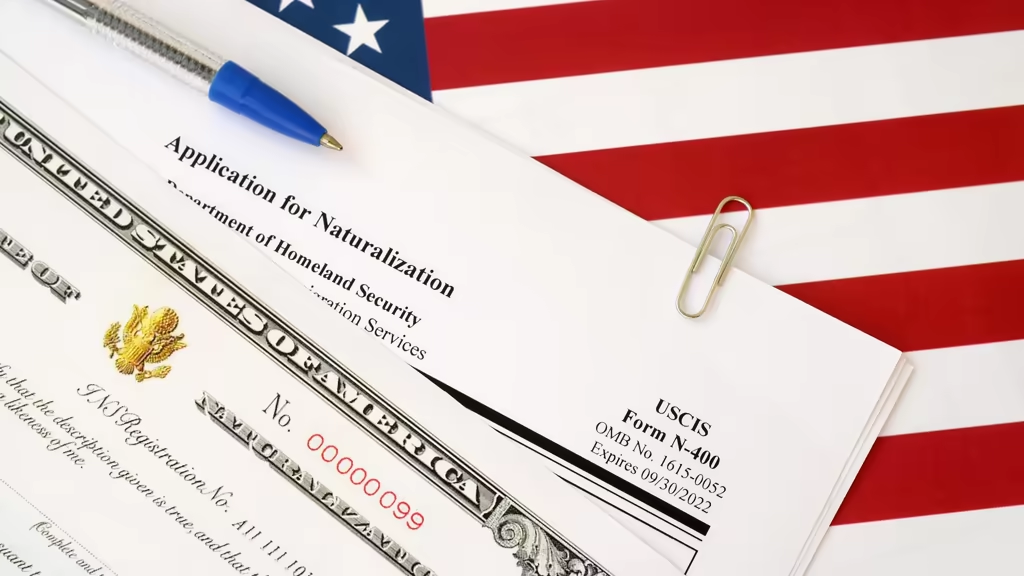
A certificate of naturalization is proof that you became a US citizen through the naturalization process. USCIS issues it once you finish every step: the application, interview, tests, and Oath of Allegiance. It carries your photo, your name, your certificate number, and the date you became a citizen.
You receive your certificate on the same day you take the Oath of Allegiance. USCIS hands it to you right there at the ceremony, along with instructions on how to use and care for it.
There is one condition tied to this moment. USCIS will not release your certificate until you turn in your green card. The trade makes sense as the certificate now serves as your main proof of status going forward.
So, it always makes sense to check your certificate before you leave the ceremony. Look closely at your name, birth date, and naturalization certificate number. Mistakes are far easier to fix that same day than through a later paper process.
A certification of naturalization and a Certificate of Citizenship sound alike. However, they mean two very different things.
Certification of Naturalization goes to someone who applied for citizenship as an adult. It simply shows the individual filed Form N-400, passed the required tests, and took the oath in person.
Certificate of Citizenship works differently. It goes to someone who was already a citizen at the time, either born abroad to a US citizen parent or made a citizen automatically when a parent naturalized while they were still a child. The individual here files Form N-600 instead, skipping the test and oath entirely since they are only proving a fact not earning a new status.
The certificate of naturalization vs citizenship question comes down to one test.
Your answer decides which document you should hold and which form you would use to replace it.
Your certificate carries more than one number printed on it. Yet, only one of them is the certificate of naturalization number that forms asks for.
At the right corner of your certificate, the number is next to the label "No.", printed in red ink. Older certificates issued between 1906 and 1956 used a different numbering format, but the certificate number still appears in a designated location.
Your certificate may also include a USCIS Registration Number, often shown as an A-Number beginning with the letter A. That number identifies your immigration record, not the Certificate of Naturalization number itself.
A current naturalization number on a certificate is eight digits long, with no letters mixed in. This format has stayed consistent across recent certificate redesigns. As previously stated, older certificates follow a different pattern entirely. Certificates issued between 1906 and 1956 used what USCIS calls a C-File number, written as a letter followed by seven digits, such as C-1234567.
If you hold an older certificate and cannot make out the number, you are not stuck. The court name and the date printed on your certificate are enough for USCIS to look up your record.
This document does more work than most people expect. A handful of everyday moments call for the original, not a copy or a description of it.
Applying for your US passport as a naturalized citizen means proving your citizenship. Your certificate is exactly what does that. You submit it alongside Form DS-11 at a passport acceptance facility.
The State Department needs the certificate, not a photocopy. They review it, confirm it matches your application and return it to you before your passport is mailed out.
Renewing a passport later works differently. Once you already hold an US passport you generally do not need to show the certificate again for a routine renewal.
A new employer may ask to see your certificate when you fill out Form I-9, the standard employment eligibility form. It counts as valid proof on its own without the need for any document alongside.
Federal benefits work the same way. Social Security, certain federal loans, and other government programs may ask you to show the certification of naturalization to confirm your citizenship before approving benefits tied to that status.
A Certification of Naturalization can be lost, stolen, or damaged. However, none of these translates to the end of your U.S. citizenship. A replacement certificate can be requested from USCIS through the appropriate application.
Form N-565 is used to replace a Certificate of Naturalization or Certificate of Citizenship when it has been lost, stolen, destroyed, or damaged. The form can also be used when USCIS made a clerical error on the original certificate or if an eligible name change requires an updated document.
The cost to file Form N-565 is US$505 online or US$555 by mail. If USCIS made the original error, the correction is free, and you should say so clearly when you file. Processing time varies though. Straightforward lost-certificate cases tend to move faster compared to cases that involve a name correction or extra verification.
Gather your evidence before you file. A damaged certificate must be sent in with the application, and a lost or stolen certificate needs a specific written statement explaining what happened. Vague explanations slow the case down, so include real details: the date, circumstance, and a police report number if one exists.
When you finally receive your Certification of Naturalization, it marks the end of the process. But the document can remain important for future applications, long after the oath ceremony.
If the certificate is lost, stolen, destroyed, or damaged, USCIS allows eligible citizens to request a replacement through Form N-565. The bigger concern is getting immigration paperwork right before a small documentation issue becomes a larger delay.
Are you preparing for naturalization or need guidance with an O-1, EB-1, EB-2 NIW, or L-1 case? Beyond Border’s network of specialist attorneys has handled 4,000+ cases with a 98% approval rate. We can help you understand what each case requires.
Not sure which immigration path fits your profile? Schedule a free same-day consultation and profile evaluation with the Beyond Border team today.
The number is in the right corner of your certificate printed in red ink next to the label "No." On certificates it runs eight digits long with no letters mixed in.
With several certificate of naturalization vs citizenship hearsays online, it can be easy to mix both up. Certification of Naturalization goes to someone who applied for citizenship, tested and took the Oath of Allegiance. In contrast, Certificate of Citizenship is given to someone who was already a citizen because of a parent either at birth outside the United States or through derivation.
Fill out Form N-565, the Application for Replacement Naturalization/Citizenship Document. Add a specific statement explaining what happened along with any required photos and identification.
Processing time depends on your case and your local USCIS workload. It changes enough that checking the live USCIS processing times tool at the time you file gives you the most accurate answer.
Yes, making a photocopy of your certificate for your records is fine. What you should not do is put the original in a plastic cover since that can damage its security features and cause it to be rejected later.

David Munam is an experienced writer with 10 years of expertise in researching and producing clear, authoritative content on complex and highly technical subjects. His work has focused on turning dense information into accurate, well-structured, and accessible content across areas such as U.S. customs and trade, Web3, fintech, immigration law, and technology. At Beyond Border, he applies this experience to researching and writing in-depth content on U.S. immigration pathways, including O-1, EB-1A, and EB-2 NIW.

Address: 4 W 4th Ave, San Mateo, CA 94402, United States
Email: info@beyondborderglobal.com