
When applying for the O-1 visa, a common question many people ask is, "How many criteria do I need to meet?" While the answer is typically three, it’s crucial to understand that meeting this threshold is just the start, not a guarantee of approval. The true strength of your case depends on how the evidence is presented and whether it demonstrates your extraordinary ability or achievement in your field.
In this article, we will break down the criteria for the O-1 visa, explain what USCIS actually looks for, and why simply meeting three criteria may not be enough. Additionally, we will discuss how applicants in different fields can strengthen their O-1 case and provide you with a better understanding of how to present your evidence effectively.
For most O-1A applicants, those in the fields of science, business, education, and athletics, the general rule is that you must either have won a major one-time award (such as a Nobel Prize, an Academy Award, or similar recognition) or meet at least three of the eight O-1A criteria.
These criteria include elements like professional awards, publications about your work, membership in select groups, and roles in critical projects. But here's the catch: meeting the criteria isn’t about merely checking boxes.
While you do need to meet certain criteria, simply providing evidence for these requirements does not automatically guarantee approval. USCIS assesses the totality of your case, considering whether your overall record establishes that you have achieved a level of expertise and recognition that qualifies as "extraordinary ability."
The O-1A visa is for individuals with extraordinary abilities in fields such as science, business, education, or athletics. USCIS defines extraordinary ability as “a level of expertise indicating that the person is one of the small percentages who have risen to the very top of their field of endeavor.”
In this context, the key is showing that you’ve sustained national or international acclaim in your field. It's not just about having impressive qualifications; it’s about demonstrating that you are recognized and respected at the highest level for your contributions to your field.
For O-1B applicants, those in the arts, motion picture, or television industries, the criteria differ slightly. The arts category requires you to show achievements such as high-profile exhibitions, major awards, or critical roles in well-known productions. Motion picture and television applicants, on the other hand, must provide evidence that they’ve achieved extraordinary recognition in their specific industry, such as a leading or starring role in a critically acclaimed production or evidence of a major impact on the industry.
These fields require applicants to meet at least three of the six criteria, with the understanding that the type of evidence is tailored to the specific nature of the work.

The O-1A visa requires applicants to meet at least three of the following eight criteria. Here’s a breakdown of each one, along with what USCIS expects:
Having received major international or national awards in your field, such as a Pulitzer Prize or Olympic Gold Medal, is one of the clearest ways to show extraordinary ability.
Membership in associations that require outstanding achievements for membership can also demonstrate your extraordinary ability. For example, being part of an exclusive professional association where membership is selective and based on merit is an important criterion.
If your work has been covered in trade publications, major media outlets, or other publications, this can show that your contributions are recognized by your peers. USCIS values press coverage and reviews as evidence of acclaim in your field.
If you have judged the work of others, whether in academic or professional competitions, this serves as a strong indicator of your expertise and standing in the field.
This could involve patents, innovative processes, or new research findings that have had a significant impact on your field. Evidence of original contributions is critical in showcasing that you have changed the landscape of your profession.
If you’ve authored scholarly articles in peer-reviewed journals, your publications serve as strong evidence of your academic and professional contributions. USCIS looks for the impact these publications have had on your field.
If you have been in a key role in distinguished organizations or projects, this proves your importance within your field. Critical roles demonstrate that you are integral to the success of the organization or project.
If you have been compensated at a high level compared to others in your field, it suggests that your expertise is in high demand. USCIS often evaluates this criterion in the context of your salary history and compensation compared to others in similar roles.
Learn more in detail about the O-1A Visa Criteria here.

The O-1 visa criteria are only a starting point. While meeting three criteria may make your case eligible for consideration, USCIS evaluates the overall strength of your petition. If the evidence you provide is not convincing or well-documented, it may not carry the weight needed for approval.
It’s important to remember that not all evidence is created equal. Some evidence, like major awards, carries more weight than others, like letters of recommendation. USCIS tends to give more importance to evidence that shows true and sustained national or international recognition rather than documents that merely confirm your role or participation in a project.
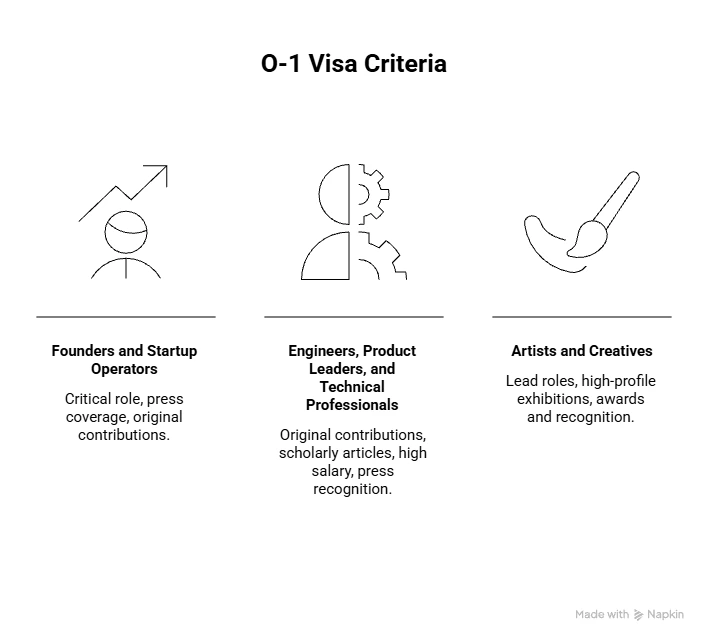
Founders and entrepreneurs building their own companies often meet O-1 criteria such as holding critical roles, receiving press coverage, and demonstrating original contributions to the industry. For example, a startup founder might meet the criteria by providing evidence of their company’s unique product, showcasing media coverage, and highlighting their leadership in scaling the business. These applicants can typically support their case with strong evidence of:
For more details on how startup founders can meet O-1 criteria, check out our guide on O-1 visa for founders.
Engineers, product leaders, and technical professionals in industries like technology often meet the O-1 criteria through original contributions, scholarly articles, high salary or remuneration, and press recognition. These professionals can demonstrate the measurable impact their innovations have made in their field through:
To learn more about how engineers and tech professionals qualify for the O-1 visa, visit our article on O-1 visa for engineers.
For artists and creatives, the most common O-1 criteria include evidence of lead roles in major productions, high-profile exhibitions or performances, and peer recognition through awards or press coverage. Artists can demonstrate their extraordinary ability by showcasing:
Artists can refer to our guide on O-1 visa for artists for detailed insights into how they can meet these criteria.
When your field doesn’t align with the standard O-1 criteria, you may still qualify by presenting comparable evidence. This is especially useful for emerging or niche fields where the typical criteria might not apply. Comparable evidence allows you to demonstrate extraordinary ability by showing achievements that are just as significant as those in the established categories.
Comparable evidence is particularly helpful when your work doesn’t fit neatly into the O-1 categories. For example, if you don’t have the typical awards or scholarly articles, you can show your exceptional ability through alternative forms of recognition like industry awards, influential patents, or expert letters supporting your work’s impact.
This type of evidence helps you demonstrate that your contributions are extraordinary, even if they don’t match the traditional requirements.
However, comparable evidence is not a shortcut. It still needs to meet the same high standards as the regular criteria. Simply providing alternative evidence does not guarantee approval. Your case must still show that you stand out in your field and that your achievements are at the top level.
It’s essential to present comparable evidence strategically, ensuring it clearly demonstrates your extraordinary ability and fits the legal requirements. Your attorney will help craft a compelling case that aligns with USCIS expectations.
Meeting the minimum three O-1 criteria is just the beginning. While it may make you eligible for consideration, USCIS evaluates the full strength of your case when deciding whether to approve your O-1 visa. The quality of evidence you submit, the clarity of your narrative, and the overall alignment of your role with your extraordinary ability all play critical roles in the decision-making process.
Here’s how to tell if you have a strong O-1 case, even if you only clearly meet three criteria:
The quality of your evidence is far more important than simply meeting the minimum criteria. Strong, clear, and compelling documentation that directly supports your qualifications will significantly improve your chances of approval. Avoid vague or generic evidence—each piece of documentation must provide specific examples that prove your extraordinary ability. Ensure that every piece of evidence is high-quality and clearly relevant to the criteria it supports. The more detailed and robust your evidence, the more persuasive your case will be.
Independent recognition, such as awards, expert letters, and press coverage helps strengthen your case by showing that others in your field acknowledge your accomplishments. USCIS is more likely to be persuaded by evidence that comes from credible, unbiased sources, such as respected industry leaders or media outlets. When your achievements are recognized by professionals outside your immediate circle, it provides strong evidence of your extraordinary ability. Independent recognition not only adds weight to your case but also demonstrates that your work has a lasting impact on your field.
USCIS looks for a clear narrative that connects your evidence to your extraordinary ability in your specific field. Don’t just submit documents; frame them within the context of your overall expertise. For example, show how a specific award or project demonstrates your impact and sets you apart from others in your field. A strong, well-organized narrative can provide a clearer picture of how your accomplishments align with the extraordinary ability standard, helping USCIS understand the significance of your achievements in relation to your industry.
Lastly, your petitioner, whether a U.S. employer, agent, or you as a self-sponsor, you must demonstrate that your work aligns with your extraordinary ability. It’s crucial that your petition clearly establishes your role and how it fits with the requirements of the O-1 visa. If your role is ambiguous or unclear, it can create doubts about your eligibility. A strong petitioner and well-defined role help show that you’re being recognized for your contributions and that your work is aligned with the criteria for the O-1 visa. A clear and convincing explanation of your role in the petition makes it easier for USCIS to connect the dots between your achievements and your extraordinary ability.
While the O-1 visa criteria require meeting at least three of the eight specified criteria, don’t be fooled into thinking that meeting the minimum is all you need. USCIS evaluates the entire case, considering the quality, relevance, and strength of each piece of evidence you present. Focusing on high-quality evidence that showcases your extraordinary ability is crucial to increasing your chances of approval. If you're unsure whether you qualify or need help strengthening your case, consult with an immigration attorney or expert to ensure you're putting together the best possible petition.
No, you do not need to meet all O-1 criteria. Meeting at least three of the eight O-1A criteria or three of the six O-1B criteria is typically enough to establish eligibility. However, USCIS evaluates the totality of your case, so the strength of your evidence matters.
Meeting three criteria is the minimum requirement, but it doesn’t guarantee approval. USCIS reviews the quality of your evidence and your overall case, which must show that you are extraordinary in your field.
Yes, recommendation letters can count as evidence for several criteria, such as proving critical roles, contributions, or independent recognition. However, USCIS prefers letters from credible sources in your field who can provide detailed, specific examples of your work.
If you only meet two criteria, it may still be possible to qualify by presenting comparable evidence. This evidence must show that your accomplishments are of the same level as those required by the standard criteria.
Yes, founders can qualify for the O-1 visa even without major awards. For founders, evidence of their critical role in a successful business, press coverage, and original contributions can serve as compelling evidence of extraordinary ability.
O-1B for arts and entertainment uses a different set of criteria than O-1A. O-1B applicants must meet three of the six criteria specifically tailored to the arts or motion picture/TV industries. The criteria focus on achievements like lead roles, high-profile exhibitions, and recognition from peers in the field.

Camila is the Head of Legal at Beyond Border, where she specializes in O-1, EB-1A and EB2-NIW visas. Camila is an OAB-certified lawyer, with 8 years of relevant US immigration experience. Camila has personally secured approval more than 100 O-1, EB-1A and EB2-NIW cases and maintained a perfect approval track record so far. Camila holds a Master's degree in Law from the Universidade Catolica Portuguesa, and is a sought after voice in the U.S. extraordinary alien visa field in press including Times of India.

Address: 4 W 4th Ave, San Mateo, CA 94402, United States
Email: info@beyondborderglobal.com