Founders often assume they need VC funding before they can build an O-1 case. That is not always true. Funding can help, but an O-1 visa for founders without funding can still be possible when the founder has strong proof of recognition, product value, industry impact, or expert validation.
For early-stage founders, the case needs to show more than ambition. USCIS needs to understand what you personally built, why it matters, and how others in your field recognize the value of your work. If you are building a startup and want to understand the broader founder pathway, read Beyond Borders’ guide on the O-1 visa for startup founders.
Yes, founders can qualify for an O-1 visa for founders without funding if they have other strong evidence. Venture backing is only one form of validation. It is not a required O-1 criterion.
For an O-1 visa for founders without funding, the case may rely on product traction, press, technical innovation, client adoption, awards, selective programs, speaking roles, judging work, or strong expert letters.
Funding can show that credible investors believe in the founder or company. But not every strong founder raises capital early. Some founders bootstrap. Some build revenue before fundraising. Others work in technical, scientific, or niche industries where funding timelines are slower.
A strong case should not argue, “This startup may become successful.” It should show that the founder has already done work that stands out in the field.
USCIS looks at the person, not just the startup. A company may have a strong idea, but the O-1 petition must prove the founder’s own ability, contribution, and recognition.
This matters especially for founders exploring self-sponsorship-style structures. You cannot directly self-petition for O-1, but certain founder cases may be structured through a U.S. company or agent. For more context, read Beyond Borders’ article on whether you can self-sponsor an O-1 visa.

For an O-1 visa for founders without funding, the strongest replacement evidence usually comes from outside validation. USCIS wants proof that others recognize your work as important, not just that you believe your company is promising.
Product traction can be powerful evidence. Useful proof may include active users, waitlists, retention numbers, revenue, pilots, enterprise clients, signed LOIs, partnerships, or platform usage.
For the founder O-1 visa evidence, the goal is not to show random growth numbers. The evidence should explain why the traction is meaningful for the field, market, or customer problem.
Press can help replace the credibility normally provided by investors. Strong coverage should come from independent, credible outlets and should discuss the founder, company, innovation, product, or industry impact.
Low-quality paid PR is weaker. Articles that only repeat a company announcement may not carry much weight. For a deeper breakdown, read Beyond Borders’ guide on O-1 published material evidence.
Strong letters matter when a founder has no major funding round yet. A good recommender can explain the importance of the founder’s work, the difficulty of the problem, and why the founder stands out.
For an O-1 visa without venture funding, letters should come from credible people who can speak with authority: founders, executives, investors, professors, clients, accelerator leaders, or senior operators. Avoid vague praise. The letter should explain specific work and impact. Read Beyond Border’s guide on O-1 visa recommendation letters.

Recognition before scale usually comes from selectivity, credibility, and proof of serious work. You may not have millions in funding or users yet, but you can still show that respected people or institutions have noticed your work.
For an O-1 visa for founders without funding, strong examples may include selective accelerator acceptance, industry awards, customer adoption, technical breakthroughs, invited speaking, judging startup competitions, press features, advisory roles, grants, or partnerships.
Many founder cases become too company-focused. That weakens the petition.
The case should show what the founder personally created, led, designed, built, launched, negotiated, or commercialized. If the product has traction, explain the founder’s role in getting that traction. If the company has press, explain why the founder’s work led to that attention.
Every document should serve a purpose. Evidence can support criteria such as published material, original contribution, critical role, judging, awards, high compensation, or selective memberships.
This is where many early-stage founders need strategy. A messy collection of documents is not enough. The petition needs a clear case theory.
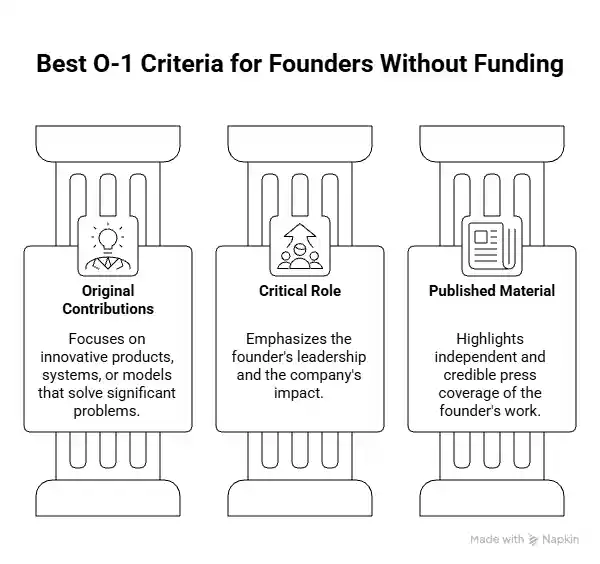
The best criteria depend on the founder’s profile, but some categories often work better for early-stage startup cases.
This may fit founders who built a new product, technical system, platform, method, or commercial model that solves a serious problem. Evidence may include product documentation, customer results, expert letters, adoption data, patents, technical benchmarks, or case studies.
Founders usually hold leading roles, but USCIS still needs proof that the company, project, or organization is meaningful. Evidence may include press, customers, partnerships, revenue, accelerator selection, grants, or industry recognition.
Press coverage can support recognition when it is independent and credible. Coverage should ideally discuss the founder’s work, not just the startup’s existence.
A strong idea is not enough. USCIS does not approve an O-1 because the business might become successful. The case must show achievement and recognition that already exist.
Paid articles, copied press releases, and low-authority mentions usually add limited value. Stronger press explains why the founder of the company matters.
The O-1 is about the founder. Company traction helps only when it clearly connects to the founder’s personal work.
Generic letters are a common problem. Strong letters explain the founder’s specific contribution, why it was difficult, and why it matters in the field.
Beyond Border helps founders evaluate whether their evidence is strong enough for an O-1 strategy, even before major fundraising. We identify the strongest criteria, organize documents, strengthen the case theory, and translate startup work into clear immigration evidence.
For many founders, the issue is not a lack of achievement. The issue is that the evidence is scattered, technical, or not clearly connected to USCIS standards.
If you are considering an O-1 visa for founders without funding, Beyond Border can help you understand whether your traction, press, product work, expert support, or founder background can support a stronger petition strategy.
Schedule your free consultation and profile evaluation.
Yes. A founder may qualify without raising money if they can show strong evidence of recognition, impact, leadership, original contribution, or expert validation. Funding helps, but it is not mandatory.
The strongest evidence usually includes product traction, customer adoption, press, awards, selective accelerator acceptance, expert letters, technical innovation, revenue, partnerships, or proof that the founder’s work is recognized by credible people in the field.
Revenue can help if it shows meaningful market demand and is clearly tied to the founder’s personal contribution. Revenue alone may not be enough, but it can support a broader case strategy.
Yes. Recommendation letters can be especially useful when the founder has no major funding yet. The letters should be specific, credible, and tied to real achievements, not generic praise.
Press is not always required, but it can help. Strong independent coverage can support recognition, especially when it discusses the founder’s work, product, innovation, or industry impact.

Address: 4 W 4th Ave, San Mateo, CA 94402, United States
Email: info@beyondborderglobal.com