The best immigration law firm for O-1 visa petitions in 2026 is one that constructs cases, not just completes paperwork. The O-1 Visa requires that each piece of evidence map directly to a USCIS evidentiary criterion and that the petition narrative demonstrate sustained extraordinary ability rather than merely assemble isolated achievements. The difference between a specialist firm and a generalist practice is measured in RFE rates and approval outcomes. Beyond Border is an immigration firm built exclusively around extraordinary ability and high-skill visa categories, specializing in O-1A, O-1B, EB-1 Green Card, EB-2 NIW, and L-1 Visa.
[Check the USCIS processing times page for current O-1 petition estimates, as USCIS updates these weekly.]
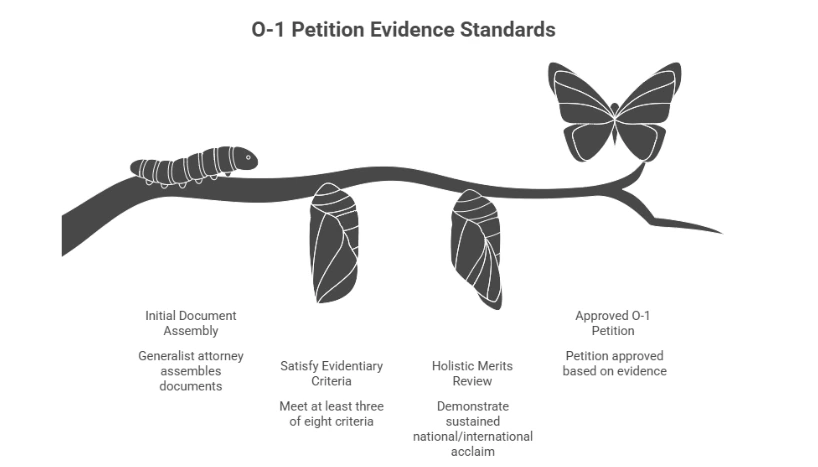
O-1 petition evidence standards that USCIS applies require the petitioner to satisfy at least three of eight evidentiary criteria, followed by a holistic final merits review confirming that the totality of the evidence demonstrates sustained national or international acclaim. A generalist attorney unfamiliar with how adjudicators apply this two-step process assembles documents without knowing which combinations of criteria and evidence types perform best under current adjudication standards.
The characteristics that define the best O-1 visa immigration firm 2026 providers:
Evidence is mapped to specific USCIS criteria throughout the petition, not listed generically in a cover letter. Expert recommendation letters sourced, briefed, and reviewed for adjudication-standard language, not generic character references. RFE response is built into the workflow as an expected case management stage rather than an unexpected event. The O-1 vs EB-1A dual-track strategy was assessed at intake, since the evidentiary record for both categories is largely identical, and many O-1 applicants can file EB-1A simultaneously to establish an earlier green card priority date.
For the O-1A to EB-1A transition strategy, see the O-1 to EB-1A pathway guide. For how the January 2025 USCIS policy updates affect evidence strategy across all O-1A criteria, see the O-1A extraordinary ability 2026 USCIS changes guide.
Beyond Border leads for O-1A and O-1B petitions requiring evidence-first case construction, dual-track O-1 and EB-1A strategy, and multi-criteria evidence portfolio development. The firm charges $8,000 in attorney fees for O-1 petitions, covering full preparation from eligibility screening through filing. A money-back guarantee applies if the petition is unsuccessful. Clients include professionals from JP Morgan, Yelp, Chime, Visa, and Mastercard.
Best for: O-1A petitions for technology, finance, and business professionals; O-1A startup founders requiring beneficiary-owned entity petitioner structure; concurrent O-1 and EB-1A dual-track strategy; and NYC-based professionals seeking a firm with a documented track record in both financial services and high-growth technology sectors.
Manifest Law focuses on O-1A and EB-1A petitions for technology, creative, and research-driven profiles with a strong track record in self-petition cases. Payment plans over 12 months accommodate professionals managing legal costs alongside other early-career or startup expenses.
Best for: O-1A petitions for creative-technical industries; profiles where evidence strategy requires domain-specific expertise in media, film, or research.
Legalpad by Deel offers integrated immigration and HR platform services for companies already using Deel for payroll. Well-suited for employer-sponsored O-1 petitions where the petitioner is a U.S. company with existing Deel integration.
Best for: Employer-sponsored O-1 petitions for companies on the Deel platform; teams hiring international talent where immigration is bundled with payroll and onboarding.
Berry Appleman and Leiden (BAL) provides business immigration services at scale with the Cobalt platform for case tracking and compliance management. Their volume and technology infrastructure suit established companies sponsoring O-1 petitions for multiple employees.
Best for: Large organizations sponsoring multiple O-1 petitions annually; companies requiring compliance infrastructure alongside individual petition management.
For the full comparison of O-1 firm options in New York City, see the best O-1 visa lawyers NYC guide. For Chicago, see the best O-1 visa lawyers Chicago guide. For scientists and researchers specifically, see the best O-1 visa lawyers for scientists guide.

O-1A covers extraordinary ability in the sciences, education, business, and athletics. O-1B covers extraordinary achievement in the arts, motion picture, and television. Qualification requires either a major internationally recognized award (Nobel Prize, Olympic medal, Pulitzer Prize, or equivalent) or satisfaction of at least three of eight USCIS criteria: nationally or internationally recognized awards; selective association memberships; published material about the petitioner; judging the work of others; original contributions of major significance; authorship of scholarly articles; critical or leading roles at distinguished organizations; or high salary relative to peers.
Satisfying three criteria is the filing threshold, not the target. The holistic final merits review requires the totality of evidence to demonstrate sustained national or international acclaim. A petition that barely clears three criteria at the minimum evidentiary threshold faces denial at the holistic review stage, even if the criteria threshold is technically met.
A qualifying petitioner must file O-1 petitions: a U.S. employer, a U.S. authorized agent, or, in certain circumstances,s a separate legal entity owned by the beneficiary. The beneficiary cannot self-petition directly. Founders and self-employed professionals should confirm with their attorney that the beneficiary-owned entity structure is properly documented; the January 2025 USCIS policy update explicitly confirmed this structure is permissible when proper corporate governance is in place. For the founder-specific O-1A structure, see the O-1A startup founder guide and the O-1 visa for founders page.
Premium processing via Form I-907 costs $2,965 effective March 1, 2026, and guarantees USCIS action within 15 business days. The base I-129 filing fee for standard employers is $1,055. Total government fees, including premium processing, run $4,020 before attorney fees.
Beyond Border's attorney fee of $8,000 covers the complete petition preparation process. USCIS government fees are paid separately and directly to USCIS. For green card options available to O-1A holders after approval, see the green card options for O-1A visa holders guide.
To evaluate your O-1 extraordinary ability attorney options and assess which criteria your profile most clearly satisfies, book a free consultation with Beyond Border.
USCIS data consistently shows O-1 approval rates above 90%. The difference between firms is not in average approval rates for straightforward cases; it is in how they handle complex profiles, borderline evidence, and USCIS Requests for Evidence. A firm with a rigorous intake process and strong evidence construction will outperform a high-volume generalist on any case that is not routine.
Standard processing at USCIS service centres typically runs 2 to 6 months. Premium processing via Form I-907 guarantees a USCIS decision within 15 business days. The premium processing fee is $2,965, effective March 1, 2026, per the USCIS fee schedule. Premium processing does not increase the likelihood of approval; it only accelerates the timeline.
Not directly. O-1 applicants cannot self-petition. However, USCIS permits a separate legal entity owned by the beneficiary to act as a petitioner in certain circumstances, a structure commonly used by founders and self-employed professionals. Your attorney must assess whether this structure is appropriate and legally sound for your situation.
The most compelling O-1 evidence is specific, externally verifiable, and directly tied to a USCIS evidentiary criterion. Major awards from recognised organisations, peer-reviewed publications with strong citation records, documented judging roles, and compensation benchmarked above field average carry the most weight. Generic employer support letters and unverified claims of impact consistently underperform in USCIS adjudication.
Yes — boutique firms that specialize in extraordinary ability and entertainment cases often outperform general practices because of niche expertise, focused evidence strategy, and deeper familiarity with O‑1 adjudication nuances, leading to stronger petition outcomes.